

Rare wooden tools from Stone Age China reveal plant-based lifestyle of ancient lakeside humans
- Written by Bo Li, Professor, Environmental Futures Research Centre, School of Science, University of Wollongong
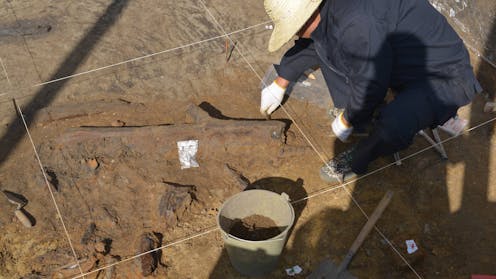
Ancient wooden tools found at a site in Gantangqing in southwestern China are approximately 300,000 years old, new dating has shown. Discovered during excavations carried out in 2014–15 and 2018–19, the tools have now been dated by a team of archaeologists, geologists, chronologists (including me) and paleontologists.
The rare wooden tools were found alongside an assortment of animal and plant fossils and stone artifacts.
Taken together, the finds suggest the early humans at Gantangqing were surprisingly sophisticated woodworkers who lived in a rich tropical or subtropical environment where they subsisted by harvesting plants from a nearby lake.

Why ancient wooden tools are so rare
Wood usually decomposes relatively rapidly due to microbial activity, oxidation, and weathering. Unlike stone or bone, it rarely survives more than a few centuries.
Wood can only survive for thousands of years or longer if it ends up buried in unusual conditions. Wood can last a long time in oxygen-free environments or extremely dry areas. Charred or fire-hardened wood is also more durable.
At Gantangqing, the wooden objects were excavated from low-oxygen clay-heavy layers of sediment formed on the ancient shoreline of Fuxian Lake.
Wooden implements are extremely rare from the Early Palaeolithic period (the first part of the “stone age” from around 3.3 million years ago until 300,000 years ago or so, in which our hominin ancestors first began to use tools). Indeed, wooden tools more than even 50,000 years old are virtually absent outside Africa and western Eurasia.
As a result, we may have a skewed understanding of Palaeolithic cultures. We may overemphasise the role of stone tools, for example, because they are what has survived.
What wooden tools were found at Gantangqing?
The new excavations at Gantangqing found 35 wooden specimens identified as artificially modified tools. These tools were primarily manufactured from pine wood, with a minority crafted from hardwoods.
Some of the tools had rounded ends, while others had chisel-like thin blades or ridged blades. Of the 35 tools, 32 show marks of intentional modification at their tips, working edges, or bases.
Two large digging implements were identified as heavy-duty digging sticks designed for two-handed use. These are unique forms of digging implements not documented elsewhere, suggesting localised functional adaptations. There were also four distinct hook-shaped tools — likely used for cutting roots — and a series of smaller tools for one-handed use.
Nineteen of the tools showed microscopic traces of scraping from shaping or use, while 17 exhibit deliberately polished surfaces. We also identified further evidence of intensive use, including soil residues stuck to tool tips, parallel grooves or streaks along working edges, and characteristic fracture wear patterns.
The tools from Gantangqing are more complete and show a wider range of functions than those found at contemporary sites such as Clacton in the UK and Florisbad in South Africa.

How old are the Gantangqing wooden tools?
The team used several techniques to figure out the age of the wooden tools. There is no way to determine their age directly, but we can date the sediment in which they were found.
Using a technique called infrared stimulated luminescence, we analysed more than 10,000 individual grains of minerals from different layers. This showed the sediment was deposited roughly between 350,000 and 200,000 years ago.
 Dating the different layers of sediment excavated at the site produced a detailed timeline.
Liu et al. / Science
Dating the different layers of sediment excavated at the site produced a detailed timeline.
Liu et al. / Science
We also used different techniques to date a mammal tooth found in one of the layers to roughly 288,000 years old. This was consistent with the mineral results.
Next we used mathematical modelling to bring all the dating results together. Our model indicated that the layers containing stone tools and wooden implements date from 360–300,000 years ago to 290–250,000 years ago.
What was the environment like?
Our research indicates the ancient humans at Gantangqing inhabited a warm, humid, tropical or subtropical environment. Pollen extracted from the sediments reveals 40 plant families that confirm this climate.
Plant fossils further verify the presence of subtropical-to-tropical flora dominated by trees, lianas, shrubs and herbs. Wet-environment plants show the local surroundings were a lakeside or wetlands.
Animal fossils also fit this picture, including rhinoceros and other mammals, turtles and various birds. The ecosystem was likely a mosaic of grassland, thickets and forests. Evidence of diving ducks confirms the lake must have been at least 2–3 metres deep during human occupation.
 Examples of stone and bone tools found at Gantangqing.
Liu et al. / Science
Examples of stone and bone tools found at Gantangqing.
Liu et al. / Science
What were the Gantangqing wooden tools used for?
The site contained evidence of plants such as storable pine nuts and hazelnuts, fruit trees such as kiwi, raspberry-like berries, grapes, edible herbs and fern fronds.
There were also aquatic plants that would have provided edible leaves, seeds, tubers and rhizomes. These were likely dug up from shallow mud near the shore, using wooden tools.
These findings suggest the Gantangqing hominins may have made expeditions to the lake shore, carrying purpose-made wooden digging sticks to harvest underground food sources. To do this, they would have had to anticipate seasonal plant distributions, know exactly what parts of different plants were edible, and produce specialised tools for different tasks.
Why the Gantangqing site is important
The wooden implements from Gantangqing represent the earliest known evidence for the use of digging sticks and for the exploitation of underground plant storage organs such as tubers within the Oriental biogeographic realm. Our discovery shows the use of sophisticated wood technology in a very different environmental context from what has been seen at sites of similar age in Europe and Africa.
The find significantly expands our understanding of early hominin woodworking capabilities.
The hominins who lived at Gantangqing appear to have lived a heavily plant-based subsistence lifestyle. This is in contrast to colder, more northern settings where tools of similar age have been found (such as Schöningen in Germany), where hunting large mammals was the key to survival.
The site also shows how important wood – and perhaps other organic materials – were to “stone age” hominins. These wooden artifacts show far more sophisticated manufacturing skill than the relative rudimentary stone tools found at sites of similar age across East and Southeast Asia.
Authors: Bo Li, Professor, Environmental Futures Research Centre, School of Science, University of Wollongong

















