Astronomers have spied an interstellar object zooming through the Solar System
- Written by Kirsten Banks, Lecturer, School of Science, Computing and Engineering Technologies, Swinburne University of Technology
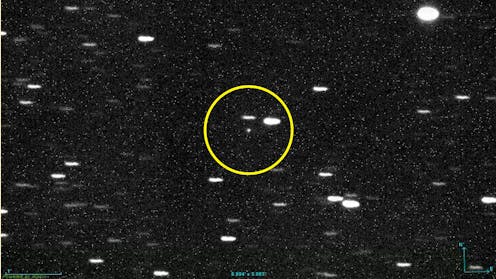
This week, astronomers spotted the third known interstellar visitor to our Solar System.
First detected by the Asteroid Terrestrial-impact Last Alert System (ATLAS) on July 1, the cosmic interloper was given the temporary name A11pl3Z. Experts at NASA’s Center for Near Earth Object Studies and the International Astronomical Union (IAU) have confirmed the find, and the object now has an official designation: I3/ATLAS.

There are a few strong clues that suggest 3I/ATLAS came from outside the Solar System.
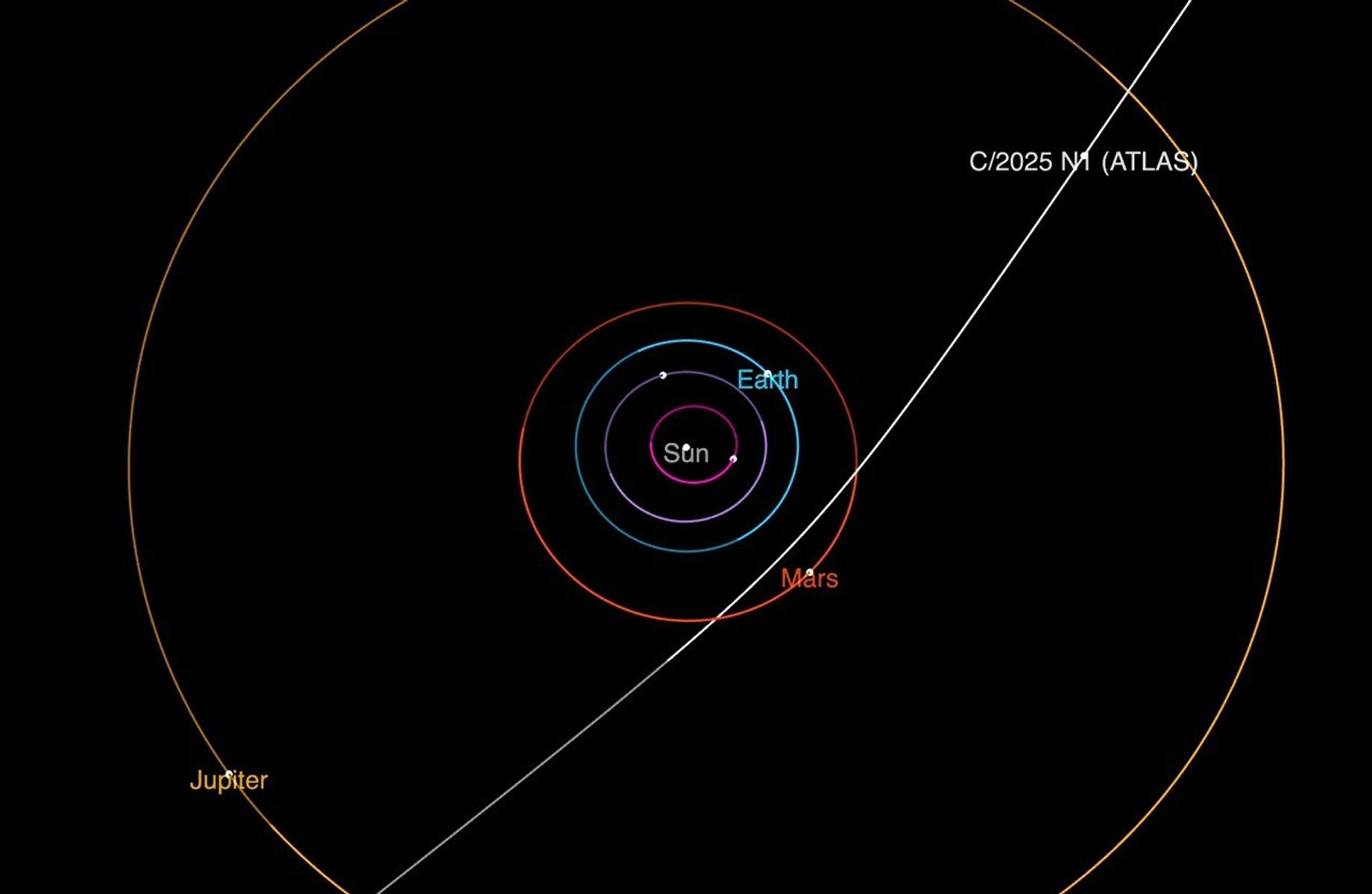
First, it’s moving really fast. Current observations show it speeding through space at around 245,000km per hour. That’s more than enough to escape the Sun’s gravity.
An object near Earth’s orbit would only need to be travelling at just over 150,000km/h to break free from the Solar System.
Second, 3I/ATLAS has a wildly eccentric orbit around the Sun. Eccentricity measures how “stretched” an orbit is: 0 eccentricity is a perfect circle, and anything up to 1 is an increasingly strung-out ellipse. Above 1 is an orbit that is not bound to the Sun.
3I/ATLAS has an estimated eccentricity of 6.3, by far the highest ever recorded for any object in the Solar System.
Has anything like this happened before?
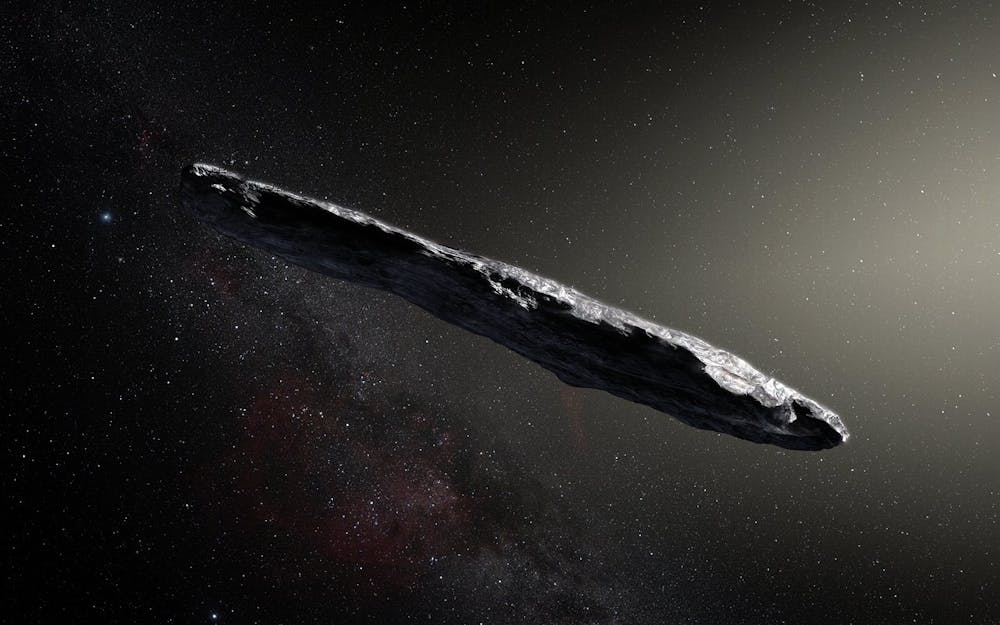
The first interstellar object spotted in our Solar System was the cigar-shaped ‘Oumuamua, discovered in 2017 by the Pan-STARRS1 telescope in Hawaii. Scientists tracked it for 80 days before eventually confirming it came from interstellar space.
 The interstellar comet I2/Borisov, imaged by the Hubble Space Telescope.
NASA, ESA, and D. Jewitt (UCLA), CC BY-NC
The interstellar comet I2/Borisov, imaged by the Hubble Space Telescope.
NASA, ESA, and D. Jewitt (UCLA), CC BY-NC
The second interstellar visitor, comet 2I/Borisov, was discovered two years later by amateur astronomer Gennadiy Borisov. This time it only took astronomers a few weeks to confirm it came from outside the Solar System.
This time, the interstellar origin of I3/ATLAS has been confirmed in a matter of days.
How did it get here?
We have only ever seen three interstellar visitors (including I3/ATLAS), so it’s hard to know exactly how they made their way here.
However, recent research published in The Planetary Science Journal suggests these objects might be more common than we once thought. In particular, they may come from relatively nearby star systems such as Alpha Centauri (our nearest interstellar neighbour, a mere 4.4 light years away).
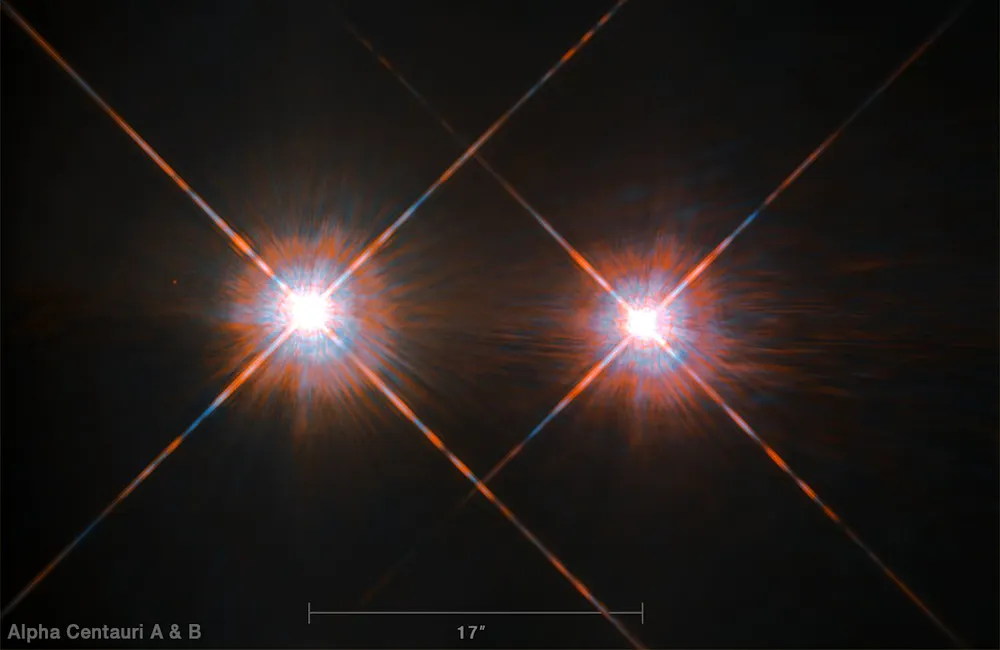 Alpha Centauri A and Alpha Centauri B, from the triple star system Alpha Centauri.
ESA/Hubble & NASA, CC BY
Alpha Centauri A and Alpha Centauri B, from the triple star system Alpha Centauri.
ESA/Hubble & NASA, CC BY
Alpha Centauri is slowly moving closer to us, with its closest approach expected in about 28,000 years. If it flings out material in the same way our Solar System does, scientists estimate around a million objects from Alpha Centauri larger than 100 metres in diameter could already be in the outer reaches of our Solar System. That number could increase tenfold as Alpha Centauri gets closer.
Most of this material would have been ejected at relatively low speeds, less than 2km/s, making it more likely to drift into our cosmic neighbourhood over time and not dramatically zoom in and out of the Solar System like I3/ATLAS appears to be doing. While the chance of one of these objects coming close to the Sun is extremely small, the study suggests a few tiny meteors from Alpha Centauri, likely no bigger than grains of sand, may already hit Earth’s atmosphere every year.
Why is this interesting?
Discovering new interstellar visitors like 3I/ATLAS is thrilling, not just because they’re rare, but because each one offers a unique glimpse into the wider galaxy. Every confirmed interstellar object expands our catalogue and helps scientists better understand the nature of these visitors, how they travel through space, and where they might have come from.
A swarm of new asteroids discovered by the NSF–DOE Vera C. Rubin Observatory.Thanks to powerful new observatories such as the NSF–DOE Vera C. Rubin Observatory, our ability to detect these elusive objects is rapidly improving. In fact, during its first 10 hours of test imaging, Rubin revealed 2,104 previously unknown asteroids.
This is an astonishing preview of what’s to come. With its wide field of view and constant sky coverage, Rubin is expected to revolutionise our search for interstellar objects, potentially turning rare discoveries into routine ones.
What now?
There’s still plenty left to uncover about 3I/ATLAS. Right now, it’s officially classified as a comet by the IAU Minor Planet Center.
But some scientists argue it might actually be an asteroid, roughly 20km across, based on the lack of typical comet-like features such as a glowing coma or a tail. More observations will be needed to confirm its nature.
Currently, 3I/ATLAS is inbound, just inside Jupiter’s orbit. It’s expected to reach its closest point to the Sun, slightly closer than the planet Mars, on October 29. After that, it will swing back out towards deep space, making its closest approach to Earth in December. (It will pose no threat to our planet.)
Whether it’s a comet or an asteroid, 3I/ATLAS is a messenger from another star system. For now, these sightings are rare – though as next-generation observatories such as Rubin swing into operation, we may discover interstellar companions all around.
Authors: Kirsten Banks, Lecturer, School of Science, Computing and Engineering Technologies, Swinburne University of Technology