

The hard questions NZ must ask about the claimed economic benefits of fast-track mining projects
- Written by Glenn Banks, Professor of Geography, School of People, Environment and Planning, Te Kunenga ki Pūrehuroa – Massey University
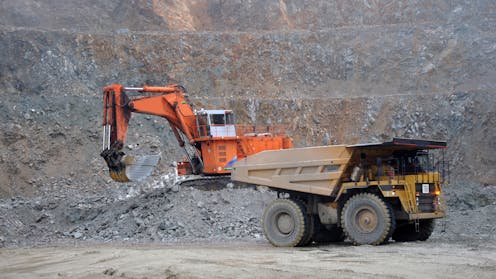
Much of the debate about the fast-track applications by a number of new or extended mining projects has, understandably, focused on their environmental impacts. But the other side of the equation – economic growth and investment, the government’s rationale for new mines – is rarely interrogated.
In fact, the environmental and economic debates are inseparable. Section 85(3)(b) of the Fast Track Approval Act allows for project applications to be declined if any “adverse impacts are sufficiently significant to be out of proportion to the project’s regional or national benefits”.
So, the claims of economic benefits from the current round of proposals need to be scrutinised closely. If those benefits don’t stack up, any adverse environmental impacts become harder to justify.
Having spent more than 35 years researching and consulting on mining projects and mineral policy in the Pacific, I have noted several important economic characteristics of the mining industry.
First, the capital spend – the setup cost of an operation – is typically largely spent offshore. In the case of Trans-Tasman Resources, currently seeking to fast-track seabed mining off the Taranaki coast, this amounts to 95% of the $1 billion construction estimate. This will largely be spent on the building in China of a huge, sophisticated barge and two 450-tonne seabed crawlers.
The government’s recent Investment Boost policy will also mean 20% of this investment is an immediate tax deduction for the company – money lost offshore to the foreign investor.
Second, any estimate of annual revenue, operational costs, taxation and distribution of net profit has to come with a caveat. Annual variations in all these factors are typical across the sector due to commodity price volatility, high rates of depreciation on capital expenditure, unexpected events, and exposure to changing operating costs.
The same applies to average annual figures for taxes and royalties. Mineral resource companies cannot be regarded as stable sources of government revenue. For example, foreign-owned OceanaGold – the largest gold producer in the country and operator of the MacRaes Flat and Waihi mines – paid no corporate income tax in 2021 or 2023 on gold production worth hundreds of millions of dollars.
Essentially, the country can often receive a minimal share of the value of its own natural resources. Unlike forestry, dairy, wine, tourism and other major sectors, with mining we don’t get a second chance: when the resource is gone, it’s really gone.
If New Zealand does decide to expand mineral resource extraction, however, there are four things that could be done to ensure the country benefits more.
1. Adopt international best practice
Over the past 30 years, the international mining sector has developed a range of best-practice guidelines, such as those developed by the International Council on Metals and Mining.
These have been adopted by leading global mining corporations elsewhere to ensure ethical behaviours, high levels of social and environmental performance, inclusive stakeholder engagement, and conservation of biodiversity.
International bodies such as the Extractive Industries Transparency Initiative also provide a means for signatory countries and their citizens to track the economic contributions mining (and oil) companies make.
2. Capture a fair share of resource value
Aside from being levied a small 2% royalty on the value of the minerals produced (or 10% of net profits, whichever is higher), mining companies are effectively treated like any other sector. But the price of mining commodities and revenues, and the operational costs, are highly volatile.
A better model might involve a simple calculation made each year to determine the total value of mineral exports from each operation. An agreed, a mandatory proportion – half or two-thirds, perhaps – would then be required to accrue within New Zealand.
This proportion of the value of the mineral resource exported should take into account local employment, locally sourced operational expenses, taxes and royalties. An additional tax could then be applied that brings the local share of the export value up to the agreed proportion, if needed.
3. Mandate a return to communities
Another common mechanism found in many countries is the community-level or regional development agreement. These exist at some New Zealand mine sites now, but they are not mandatory. They return a share of the value of the government’s take from the sector back to the communities or regions where the resource has come from.
While mining companies often make voluntary “corporate social responsibility” contributions to local communities, these are not community-led programs funded from a share of the mining royalties collected from the region.
Regional Development Minister Shane Jones has said he is looking at redirecting a greater share of mining royalties to the regions where mining takes place, particularly the west coast of the South Island.
4. Establish a form of sovereign wealth fund
Famously, Norway and the US state of Alaska have established hundred-billion-dollar trust funds by putting aside a proportion of mining and oil revenues.
These funds now support national budgets, lower or eliminate taxes, and provide a mechanism for the intergenerational transfer of mineral resource wealth.
New Zealand’s current oil, gas and mining sector is not of these magnitudes. But if the country does decide to significantly expand its extractive sector, we should be thinking about a “fair share” in intergenerational terms, too.
A local sovereign wealth fund might not be huge to begin with. But if it were used effectively, it could grow and deliver ongoing benefits from non-renewable mineral resources.
Without proper attention to the economic implications of mining, New Zealand risks being doubly worse off: few guaranteed long-term economic benefits from its own mineral resource, but still living with the inevitable environmental effects of those mines.
Authors: Glenn Banks, Professor of Geography, School of People, Environment and Planning, Te Kunenga ki Pūrehuroa – Massey University

















