

Low carbon economy can spur Australian "manufacturing boom": Albanese
- Written by Michelle Grattan, Professorial Fellow, University of Canberra
Anthony Albanese will seek to marry a strong commitment to a low carbon economy that can fuel a “manufacturing boom”, with firm support for coal, in his first “vision statement”, to be delivered in Perth.
“Simply put, the road to a low-carbon future can be paved with hundreds of thousands of clean energy jobs, as well as supporting traditional jobs,” the opposition leader says in his “Jobs and the future of work” address.
Albanese also continues repositioning Labor with pro-business and pro-growth rhetoric; his sentiments on business contrast with Bill Shorten’s criticisms of the “top end of town”.
Read more: Grattan on Friday – Anthony Albanese needs some meat in his first 'vision statement' next week
“Like Bob Hawke and Paul Keating, I understand that building the future means we must first and foremost be in the business of creating wealth, as well as ensuring it is distributed fairly,” he says.
“Labor is proudly and resolutely pro-growth. We understand that successful businesses and a vibrant economy are essential prerequisites for job growth.” An extract of the speech was provided ahead of its Tuesday delivery.
Labor wants to lead the “clean energy revolution”, Albanese says. But while he talks up the job creation capacity of expanding renewables, it won’t be until much closer to the election that the ALP crafts its revised policy on emissions reduction targets, about which there is sharp internal dispute.
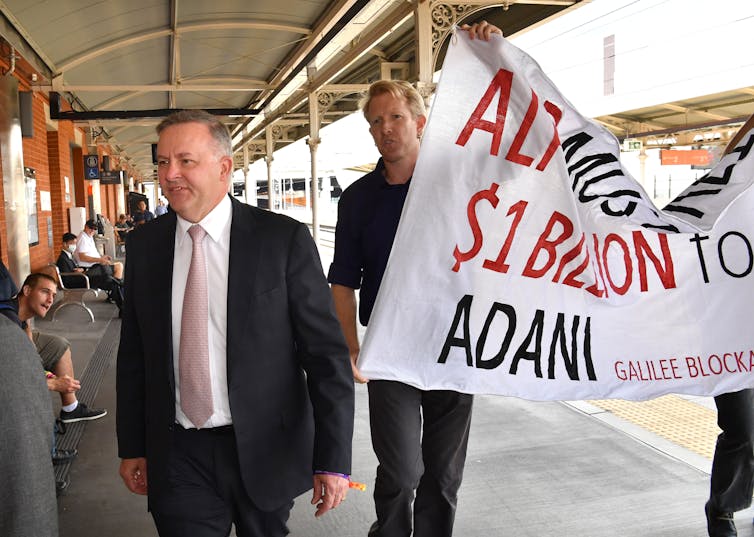 Anthony Albanese in 2017 when he was Labor’s transport and infrastructure spokesman, at a Brisbane train station followed by protesters opposed to the Adani coal mine.
Darren England/AAP
Anthony Albanese in 2017 when he was Labor’s transport and infrastructure spokesman, at a Brisbane train station followed by protesters opposed to the Adani coal mine.
Darren England/AAP
In the wake of the opposition losing votes, especially in Queensland, over its equivocation on coal mining, Albanese is sending a reassuring message to workers in that industry.
Moreover he links coal to clean energy, pointing to the use of coking coal in the production of wind turbines.
“Our traditional industries are also poised to benefit from a low-carbon future. Australia could be exporting 15.5 million tonnes of coking coal to build these turbines. This is the equivalent of three years output from the Moranbah North coking coal mine in Queensland,” he says.
Read more: Governments took the hard road on clean energy – and consumers are feeling the bumps
Albanese says in a decarbonising world “with the right planning and vision, Australia can not only continue to be an energy exporting superpower, we can also enjoy a new manufacturing boom. This means jobs.”
Noting the potential for hydrogen exports he says: “Experts tell us achieving 50% renewable energy at home while building a hydrogen export industry would create 87,000 good, well-paid jobs. Chief Scientist Alan Finkel sees a hydrogen export industry that in ten years could be worth $1.7 billion.”
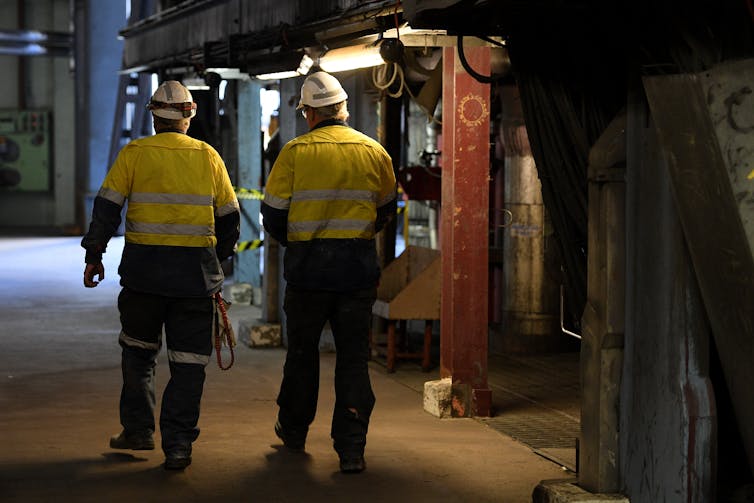 Workers at AGL’s coal-fired Liddell power station in Muswellbrook, New South Wales.
AAP/DAN HIMBRECHTS
Workers at AGL’s coal-fired Liddell power station in Muswellbrook, New South Wales.
AAP/DAN HIMBRECHTS
While a low-carbon future would give the opportunity to revitalise manufacturing and create jobs, the government’s “current policy settings barely acknowledge climate change, let alone seek to exploit the opportunities that, over time, can come with the global shift to renewables.
"In the century that’s before us, the nations that will transform into manufacturing powerhouses are those that can harness the cheapest renewable energy resources.”
Pointing to Australia’s abundant sources for renewable energy and its engineering and scientific expertise, Albanese says: “Australia can be the land of cheap and endless energy – energy that could power generations of metal manufacturing and other energy intensive manufacturing industries.
"Our resources and capability also offer us the scope to be the capital of mining and processing of the key ingredients of the renewables revolution.”
Read more: Oil companies are thinking about a low-carbon future, but aren't making big investments in it yet
Australia has rich supplies of rare earth elements, iron, titanium, copper, lithium and silver, he says.
“Just as coal and iron ore fuelled the industrial economies of the 20th century, it is these minerals that will fuel the clean energy economies of the 21st.”
In the low carbon world, Albanese points to the particular role for lithium, which is not just mined in Western Australia but is being developed into an upstream industry. “As electric vehicles, energy storage systems and smart devices become more mainstream, the global demand for lithium batteries will explode,” he says.
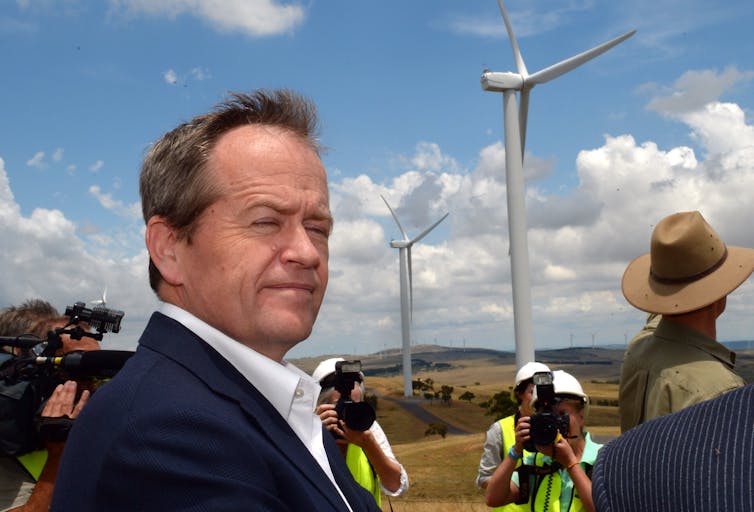 Former Labor leader Bill Shorten at a wind farm near Canberra. Labor was defeated at the May 2019 election under Mr Shorten, after the party equivocated over its position on coal.
ALAN PORRITT/AAP
Former Labor leader Bill Shorten at a wind farm near Canberra. Labor was defeated at the May 2019 election under Mr Shorten, after the party equivocated over its position on coal.
ALAN PORRITT/AAP
“The emerging lithium industry is a living example of how real world economic progress happens – business, unions, researchers and government coming together to deliver on an aspiration bigger than just digging stuff out of the ground and letting the value-adding happen offshore.
"Not only is Australia in a position to build the batteries, Brisbane-based company, Tritium, has developed and is already exporting the technology to recharge them. Their charging stations are the fastest in the world, and are fuelling the shift to electric vehicles in Europe.”
On macro economic policy, Albanese once again urges the government to inject some stimulus into the econony.
“Today I call upon the government to introduce an upgraded investment guarantee as part of a measured economic stimulus package to boost our sluggish economy.
"A bring forward of infrastructure investment combined with increased business investment would create jobs in the short term as well as lift productivity.”
Authors: Michelle Grattan, Professorial Fellow, University of Canberra
Read more http://theconversation.com/low-carbon-economy-can-spur-australian-manufacturing-boom-albanese-125953

















