

why everyone alive today can call northern Botswana home
- Written by Vanessa Hayes, Professor, Garvan Institute of Medical Research and, University of Sydney
Where was the evolutionary birthplace of modern humans? The East African Great Rift Valley has long been the favoured contender – until today.
Our new research has used DNA to trace humanity’s earliest footsteps to a prehistoric wetland called Makgadikgadi-Okavango, south of the Great Zambezi River.
Our analysis, published in Nature today, shows that the earliest population of modern humans (Homo sapiens sapiens) arose 200,000 years ago in an area that covers parts of modern-day Botswana, Namibia and Zimbabwe.
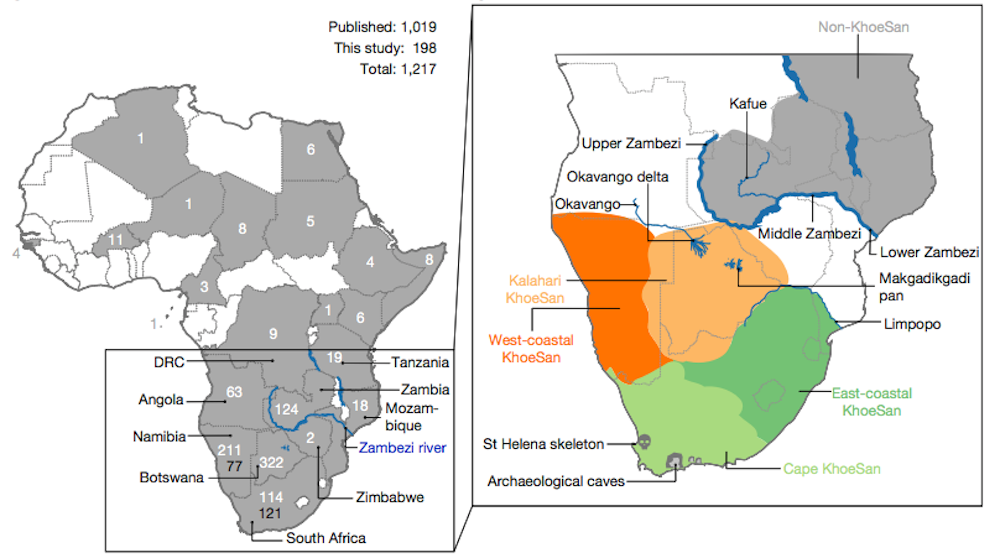 The left map shows the distribution of ancestral DNA among the sampled population. This allowed the ancestral homeland to be pinpointed to a region (shown on the right in pale orange) south of the Zambezi River, centred on northern Botswana.
Chan et al., Nature 2019
The left map shows the distribution of ancestral DNA among the sampled population. This allowed the ancestral homeland to be pinpointed to a region (shown on the right in pale orange) south of the Zambezi River, centred on northern Botswana.
Chan et al., Nature 2019
Today it is a dry and dusty land with scattered salt pans, and it is hard to believe that modern humans lived and thrived in wetlands here for 70,000 years before our ancestors began to explore the rest of Africa, and ultimately the world.
Read more: 'Ancestors': a new game provides insights into how the first humans evolved
We pinpointed this region by studying mitochondrial DNA, known as the “mitogenome”. Unlike nuclear DNA, which is passed on by both mother and father, mitochondrial DNA is passed on only by the mother, which means it is not jumbled up in each generation.
If we think of all modern humans as occupying a particular place on a huge family tree, logically we should find the most diverse mitogenomes at the very base of the tree, because it is the ultimate source of all the various branches.
We already know that genetic data points to southern Africa as the cradle of humanity (unlike fossil evidence, most of which has been found in East Africa). But we wanted to refine our search still further, to pinpoint the exact location where humans first evolved.
To do this, we turned our attention to a group of people known as the KhoeSan. KhoeSan have the most diverse mitogenomes of anyone on Earth, which suggests their DNA most closely resembles that of our shared common ancestors. If we all sit on branches of the human family tree, then KhoeSan are the tree’s trunk.
Linguistically, KhoeSan people are click speakers, while culturally KhoeSan are foragers, with groups of San people still practising the old ways of life – hunting and gathering for subsistence.
Members of our research team have spent a decade working with KhoeSan communities, as well as people from other ethnicities and language groups, in Namibia and South Africa.
By generating mitogenome data for around 200 rare or newly discoverd sub-branches of KhoeSan lineages, and merging them with all available data, we were able to zoom in on the very base of our evolutionary tree.
It is now clear our ancestors must have dispersed from a region south of the Zambezi River. This is consistent with geographical, archaeological and climate data, including the fact that this area would have been a fertile wetland at the time the first modern humans emerged.
Geological evidence suggests that at this time, the prehistoric Makgadikgadi lake that had dominated the region for millions of years had begun to break up through the shifting of the land. This would have created a vast wetland region, ideal to sustain life.
But if it was so ideal, why did our ancestors begin to explore other places between 130,000 and 110,000 years ago, first heading northeast and later southwest from the ancestral home?
Climate data suggests that at around that time the region experienced a huge drought. Notably, about 130,000 years ago humidity increased to the northeast of the homeland, and 110,000 years ago the same happened to the southwest. We speculate that this created passages of lush vegetation for our ancestors to leave the homeland, most likely following the game animals that were also forging into new regions.
What’s more, our genetic data suggests the southerly migrants went on to inhabit the entire southern coast of Africa, with multiple sub-populations and huge population growth. Archaeological findings from the Blombos caves in South Africa have shown this region to be rich in evidence for cognitive human behaviour as early as 100,000 years ago. Again, we were amazed at how well we could match timeline data, crossing different yet complimentary disciplines that have historically not worked together. This also allowed us to further speculate about the success of the southerly migrants being attributed to adapting their skills to the abundance of life in the oceans.
These earliest explorers left behind a homeland population, one that still remains within the ancestral lands today, having adapted to the much drier landscape. It has been a pleasure to spend the past decade engaging with the last descendants of humanity’s homeland, including the Ju/’hoansi people of the Kalahari in Namibia.
The Ju/’hoansi, who still practise their traditional way of life, are excited about our findings. They believe our study captures a history that they have told for generations by word of mouth alone. This is not only their story, but all of ours.
Authors: Vanessa Hayes, Professor, Garvan Institute of Medical Research and, University of Sydney

















