

Climate action can feel slow – but the fastest energy leap in history has begun
- Written by: Peter Newman, Professor of Sustainability, Curtin University
It’s increasingly common to hear from experts and the general public that the global shift away from fossil fuels is glacially slow, or even nonexistent.
As the view goes, the meteoric rise of clean energy is only supplementing fossil fuels rather than pushing them out. Repeated with increasing frequency by many – including the fossil fuel lobby – this view is not only incorrect, but dangerous. If accepted as truth, it will encourage climate fatalism.
In reality, we’re living through the fastest energy transformation in human history. Every previous large-scale shift in energy – from muscle power to wood to coal to oil – has taken decades or even longer. But the “renewable revolution” is happening far faster.
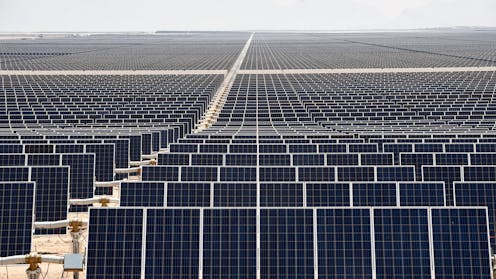
It’s only in the past ten years that renewables have become cheap and reliable, and only in the past five that energy storage has become cheap and widely available. Solar farms, wind turbines and grid-scale storage can be built remarkably quickly. Net-zero cities are becoming possible. The iron laws of economics have kicked in. These cheap forms of electricity generation are already displacing more and more fossil fuels.
Slow growth off a small base
You might have seen graphs showing how much power comes from renewables, fossil fuels and other energy sources. When shown over a longer timeframe, the explosive but very recent growth of renewables is compressed into a tiny, apparently insignificant addition.
This is about as useful as pointing out that in 1984 the internet had no users. While a few researchers were active in 1984, the wider internet ecosystem, infrastructure and enabling technologies did not exist until 1991.
Using graphs of early internet user growth to gauge future potential would have been very misleading. The internet started slowly before accelerating very rapidly. Zero users in 1984, 2.6 million in 1990, 412 million in 2000, one billion in 2005, 5.5 billion by 2025.
Today’s clean energy rollout similarly started from a very low base before maturing. Now it’s accelerating at remarkable speed.
Twenty years ago, solar and wind were still expensive and large-scale batteries even more so. In the 2010s, renewables became cheaper and cheaper. By the late 2010s, battery technology was progressing rapidly and costs began falling. In the 2020s, the price of electric vehicles began falling.
It was only ten years ago that nations signed the Paris Agreement on climate change. Since then, many nations have set about tackling climate change in earnest.
Here are five ways to grasp the scale of the change.
1. Unprecedented growth and investment
In 2025, the International Energy Agency projects clean energy investment will reach a record A$3.3 trillion, double the investment in fossil fuels and more than four times what it was just a decade ago.
Globally, renewable energy capacity is being added at all-time highs. More than 585 gigawatts of new wind and solar was built in 2024–25.
Solar is having a particularly rapid growth spurt, outpacing any other energy source. Solar is becoming king. Batteries are likely to undergo similar growth as prices fall.
2. Clean tech dominates new capacity
Across China, the European Union, the United States, India and Australia, newly installed solar and wind are now outpacing new coal, oil and gas capacity by a factor of three or higher. Solar and wind made up three-quarters of new electricity capacity worldwide in 2024.
Developing nations, too, are adopting renewable energy at speed. Nearly 90% of funding for new energy sources in these nations is now for renewables.
In the past five years, Pakistan has imported the equivalent of its national grid capacity in solar capacity. Sub-Saharan African nations are massively increasing solar imports. Solar now accounts for more than 60% of Sierra Leone’s power capacity.
At the end of 2024, there were almost 58 million battery electric and plug-in hybrid cars on the world’s roads. We calculate this avoided the need to burn more than 250 million litres of oil per day.
While Australia is sluggish on electric cars, it’s roaring ahead on renewables. In 2020, renewables contributed about 21% of Australia’s electricity. Five years later, that figure has almost doubled.
3. Decoupling growth from emissions
Electricity demand is rising in most economies, even as emissions plateau or fall where uptake of renewables is highest.
In the world’s largest electricity market, China, clean energy is being added so rapidly that power-sector emissions are declining for the first time even as GDP grows. China also manufactures most of the world’s clean tech.
4. Renewables are on the S-curve – slow and then sudden
When a new technology emerges, the uptake can often be mapped on an S-curve graph. Change is slow until a tipping point is reached. Then change happens very quickly. Solar, EVs and battery storage are now at that point of very rapid growth or already past it in multiple markets.
5. Fossil fuels are being displaced
As renewables and storage get cheaper, they are beginning to push out fossil fuels. In 2024, the United Kingdom closed its last coal plant. Its emissions have now fallen more than 50% below 1990 figures. This year, coal supplied less than half of Poland’s electricity for the first time.
Our modelling suggests the tipping point has arrived. In the next few years, we can expect to see cheap, plentiful renewables outcompete more and more fossil fuels.
Progress is slow? Look again
Energy underpins civilisation – we need more and more of it. Renewables can make the most versatile type of energy, electricity, very cheaply and, when firmed with storage, very reliably.
The claim that clean energy is rolling out too slowly echoes dismissals of new technologies.
Investment in new fossil fuels is falling and becoming riskier, while renewables attract record capital as clean technology costs keep dropping. For years, solar growth forecasts by the International Energy Agency have wildly underestimated the actual rate of growth.
None of this is to downplay the remaining work. Vested interests would much prefer the world stays hooked on oil, gas and coal until it’s all been burned.
But the narrative is clear. Real progress has already been made. To suggest otherwise is to ignore the size and momentum of the fastest energy transition in history.
Authors: Peter Newman, Professor of Sustainability, Curtin University


















