

The aged care royal commission's 3 areas of immediate action are worthy, but won't fix a broken system
- Written by Joseph Ibrahim, Professor, Health Law and Ageing Research Unit, Department of Forensic Medicine, Monash University
After many months of hearings across the country, the Royal Commission into Aged Care Quality and Safety has published its interim report.
Titled Neglect, the commissioners were courageous and accurate in laying out the fundamental issues facing the aged care system in Australia. They demonstrated an under-resourced system where the failures in delivering appropriate care are shocking and widespread. They noted the aged care industry fosters a culture where the voices of older people, their families and carers are not heard.
Finally, the commissioners highlighted the absence of accountability and the lack of transparency by governing, regulatory and provider organisations.
Read more: Aged care royal commission benefits Generation X: it's too late for the silent generation
The interim report identified three areas where action should be taken now. These are important to address, though change will be slow and mostly benefit future generations.
And unfortunately, rectifying these three areas will not make the system better overall. The underlying causes of the problems plaguing Australia’s aged care system remain deeply entrenched and systemic.
1. Home care packages
Home care packages aim to support older people with complex care needs to stay at home, rather than entering residential aged care.
At June 30 2019, there were 72,062 people waiting on a home care package. The commission recommends increased funding to reduce the waiting list. This is an obvious policy strategy that has been identified for some time.
But notably, Australia doesn’t have a standing army of personal carers or health professionals waiting to step in to provide these additional services. Increasing the number of home care packages will require more health professionals and care workers who have the skill set and desire to provide services in the home.
2. Reducing the use of chemical restraint
Chemical restraint is when residents are given sedative, antipsychotic and antidepressant medications to “control” their behaviour. The commission recommends reducing this practice, which is widespread across residential aged care.
They propose improving access to and strengthening the use of what’s called the “Residential Medication Management Review”. This provides for a pharmacist to examine and advise on the use of prescribed medications for aged care residents.
Read more: There's almost always a better way to care for nursing home residents than restraining them
But this will be of limited benefit as it fails to address the fundamental factors which contribute to the use of restraint, including a culture where the practice is accepted, shortages of staff, and inadequately trained and skilled staff.
We can’t reduce the use of restraint with money alone; it will require a cultural shift in clinical and aged care practice. This includes having staff who understand the unique needs of a person with dementia and are trained to respond appropriately.
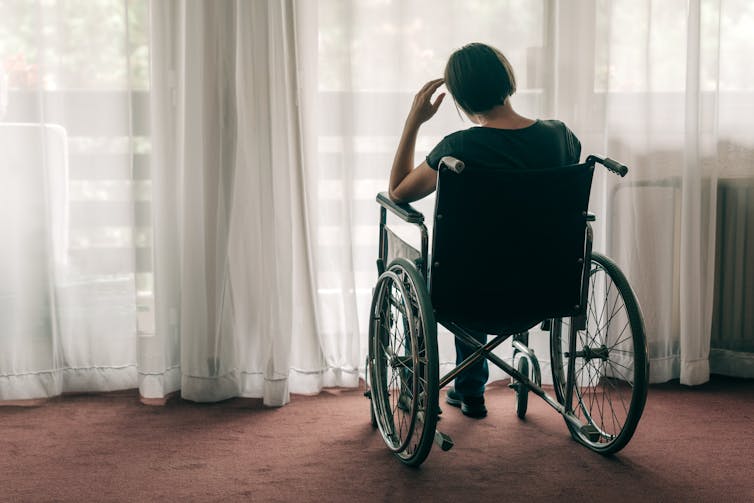 The commission recommended immediate action to ensure young people aren’t living in nursing homes.
From shutterstock.com
The commission recommended immediate action to ensure young people aren’t living in nursing homes.
From shutterstock.com
3. Getting young people out
The third area is stopping the flow of younger people with a disability entering residential aged care – and speeding up the process of relocating those younger people who are already in residential aged care into community living.
Advocacy for the plight of young people in residential aged care is not new. Over the past two decades neither two investigations by the Australian Senate Community Affairs Reference Committee, nor the roll out of the National Disability Insurance Scheme, have been able to reduce the number of young people living in nursing homes.
The logistics of building new housing and developing services in areas of need take careful planning and time.
Read more: 'It felt like a prison' – too many young Australians are still stuck in nursing homes
These are all worthwhile goals, but…
These solutions are neither simple nor straightforward. Additional funding is needed, but at the same time, providing more money doesn’t solve these problems. In fact, releasing large amounts of money into the aged care sector without the proper oversights to ensure safe, effective, efficient and person-centred care could cause harm.
The two major barriers to achieving these goals are an absence of political will to act – evident in repeated failures to implement recommendations from multiple earlier inquiries into aged care – alongside a failure to recognise the cause of poor care is systemic.
The commission’s report is a call to action. Yet the minister for ageing cannot solve this crisis alone. We need to see a whole of government response:
- the treasurer should be asking tougher questions about how our taxpayer funds are allocated and spent
- the minister for population, cities and urban infrastructure should be examining how and where nursing homes are located and integrated into the community
- the attorney general should be addressing elder abuse and neglect
- the minister for health should be building better partnerships with acute hospitals and general practice to improve care
- the minister for education should be creating programs and incentives for new graduate programs to train the skilled staff needed now and into the future.
Read more: Nearly 2 out of 3 nursing homes are understaffed. These 10 charts explain why aged care is in crisis
There are no simple or quick fixes here. But a whole of government response, alongside a concerted effort from the aged care industry, would be a good start.
The commission’s final report is due in November 2020.
Authors: Joseph Ibrahim, Professor, Health Law and Ageing Research Unit, Department of Forensic Medicine, Monash University

















