

Smart tech systems cut congestion for a fraction of what new roads cost
- Written by Hussein Dia, Professor of Future Urban Mobility, Swinburne University of Technology
The new transport projects governments are constantly announcing are expensive. In the recent New South Wales and Victorian elections, the returned state governments’ transport infrastructure promises added up to A$165 billion. What’s mostly missing from the promised transport solutions is smart technology that provides higher benefits at a fraction of the cost – when retrofitting existing roads in particular. The benefit-to-cost ratio can be more than a dozen times greater than for a new road.
Clearly, infrastructure spending helps to drive the economy. These projects also deliver benefits to the community, including increased road safety, shorter travel times and fewer delays.
The economic merit of these projects is usually captured using a benefit-to-cost ratio (BCR). For example, the BCR of the A$15.8 billion North East Link road project in Melbourne is estimated to be 1.25 – for every A$1 invested, A$1.25 is returned in benefits to the economy and community. For the Melbourne Metro rail tunnel, a best-case BCR of 3.3 has been reported.
But are we getting good value for money? Could cheaper alternatives deliver more benefits?
Technology offers smarter, cheaper solutions
Technology offers transport solutions that provide higher benefits at a fraction of the cost of building new infrastructure. Collectively known as intelligent transport systems, these are widely recognised today as better answers for smart transport outcomes.
Intelligent transport systems can have positive impacts on the safety, efficiency and environmental performance of transport.When comparing different “congestion-busting” options, “building more roads” provides, on average, a BCR of 3.0. This is dwarfed by the much higher BCR values of tech solutions.
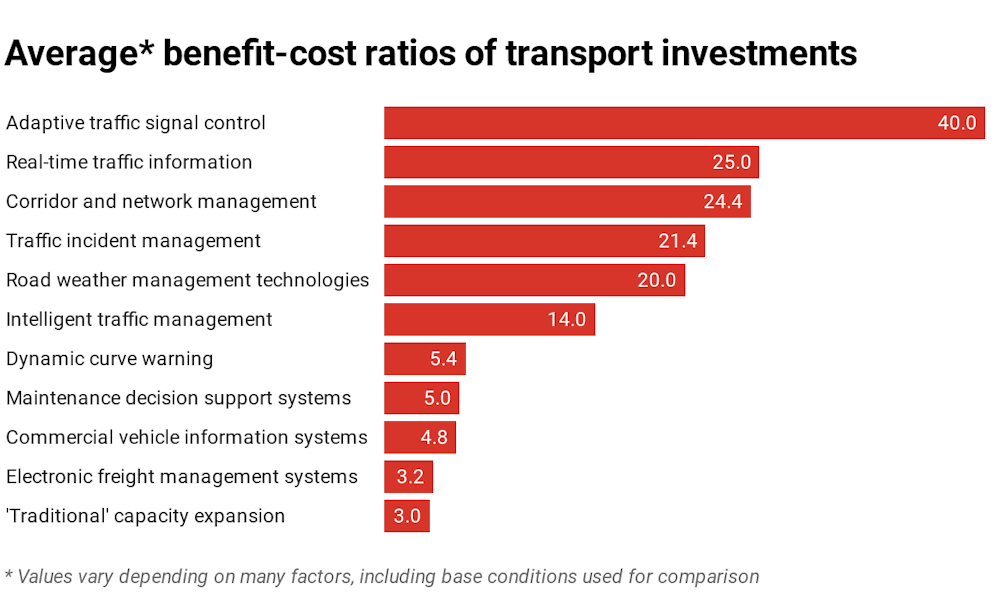 Source: Low Carbon Mobility for Future Cities: Principles and Applications (Dia, H. ed, 2017), adapted from Infrastructure Productivity: how to save $1 trillion a year (McKinsey, 2013), Author provided
Read more:
Our new PM wants to 'bust congestion' – here are four ways he could do that
Adaptive traffic signal control allows traffic signals to change based on actual traffic demand. This yields, on average, a BCR of 40.
Traffic signals along a route can be coordinated to create “green waves” for platoons of vehicles to travel without stopping. These solutions are effective for congested cities that experience rapid traffic growth and changing traffic patterns.
A simulation of adaptive traffic signalsCorridor management systems use technology to control networks of motorways and urban roads. The average BCR is 24.
On managed motorways, ramp signals, variable speed limit signs and traveller information systems are proven tools to respond in real time to changing traffic conditions. In one case, a managed motorway reduced travel times by 42% and accidents by 30%.
Active motorway management improves the performance of existing roads.Traffic incident management, which has a BCR of 21, includes technologies that aid quick detection and removal of crashes. They also detect other incidents such as broken-down vehicles or spilled loads that reduce road capacity. The systems rely on smart software that analyses sensor data in real time.
Benefits include a 40% reduction in time to detect incidents. The technology also reduces incident duration by 23% and road crashes by 35%.
Combining tech solutions magnifies benefits
When solutions are combined, benefits are amplified. The Florida Department of Transportation implements a transport technology program on its networks. The solutions include incident management, ramp signalling, traveller information and express lanes. Reduced incident duration and traffic delays are among the key benefits.
In 2018, the benefits of this program totalled almost US$3.1 billion (A$4.5 billion). The costs were US$70.3 million (A$102 million). That’s a BCR of 43.7.
Source: Low Carbon Mobility for Future Cities: Principles and Applications (Dia, H. ed, 2017), adapted from Infrastructure Productivity: how to save $1 trillion a year (McKinsey, 2013), Author provided
Read more:
Our new PM wants to 'bust congestion' – here are four ways he could do that
Adaptive traffic signal control allows traffic signals to change based on actual traffic demand. This yields, on average, a BCR of 40.
Traffic signals along a route can be coordinated to create “green waves” for platoons of vehicles to travel without stopping. These solutions are effective for congested cities that experience rapid traffic growth and changing traffic patterns.
A simulation of adaptive traffic signalsCorridor management systems use technology to control networks of motorways and urban roads. The average BCR is 24.
On managed motorways, ramp signals, variable speed limit signs and traveller information systems are proven tools to respond in real time to changing traffic conditions. In one case, a managed motorway reduced travel times by 42% and accidents by 30%.
Active motorway management improves the performance of existing roads.Traffic incident management, which has a BCR of 21, includes technologies that aid quick detection and removal of crashes. They also detect other incidents such as broken-down vehicles or spilled loads that reduce road capacity. The systems rely on smart software that analyses sensor data in real time.
Benefits include a 40% reduction in time to detect incidents. The technology also reduces incident duration by 23% and road crashes by 35%.
Combining tech solutions magnifies benefits
When solutions are combined, benefits are amplified. The Florida Department of Transportation implements a transport technology program on its networks. The solutions include incident management, ramp signalling, traveller information and express lanes. Reduced incident duration and traffic delays are among the key benefits.
In 2018, the benefits of this program totalled almost US$3.1 billion (A$4.5 billion). The costs were US$70.3 million (A$102 million). That’s a BCR of 43.7.
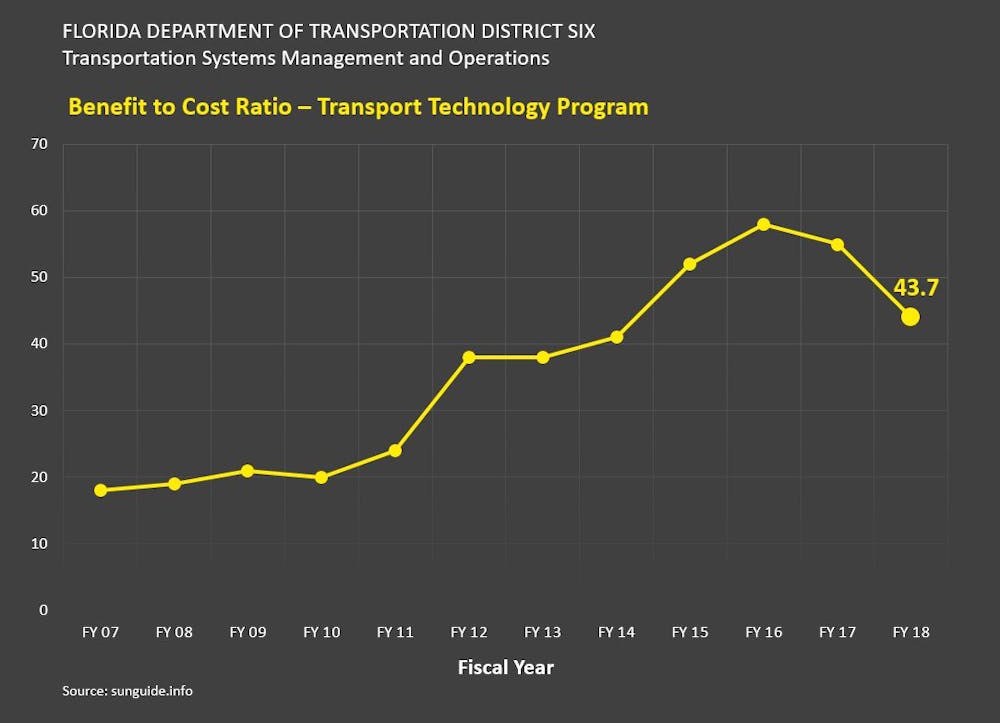 Benefit-cost ratios of transport technology solutions implemented over a decade by Florida Department of Transportation.
Author provided
In the UK, the cost of implementing technology solutions on the M42 motorway was US$150 million (A$218 million) and took two years to complete. Widening the road to produce the same outcome would have taken 10 years and cost US$800 million (A$1.16 billion).
A shift in priorities is needed
Considerable investment in transport infrastructure is still required. It should be guided by strong business cases and aligned with community values and expectations.
Read more:
A closer look at business cases raises questions about 'priority' national infrastructure projects
However, technology is getting to the point where it’s making a serious difference in tackling the mega challenges facing our cities. Its role must be prioritised.
The benefits are compelling. Intelligent technology systems improve the use of existing assets and increase their operational life. They enhance traveller experience and reduce reliance on building new roads. And they deliver superior value for money.
But widespread deployment of these technologies is still limited. To spur change and unlock value, we must move beyond a project-by-project approach.
Learn from the best
Governments can be guided by leading nations in this field such as South Korea, Japan and Singapore. Their citizens experience the benefits every day. Smart transport solutions improve their quality of life through easier travel, less congestion and more reliable services.
The recurring policy themes in these countries include a national vision of smart infrastructure and commitment to funding. They prioritise investment in research and trials, standards development and partnerships with industry. These are key factors in the success of their tech-driven transport solutions.
These are the policies and investments Australia should prioritise. They will modernise our transport systems in innovative ways that lift our economy and living standards.
Benefit-cost ratios of transport technology solutions implemented over a decade by Florida Department of Transportation.
Author provided
In the UK, the cost of implementing technology solutions on the M42 motorway was US$150 million (A$218 million) and took two years to complete. Widening the road to produce the same outcome would have taken 10 years and cost US$800 million (A$1.16 billion).
A shift in priorities is needed
Considerable investment in transport infrastructure is still required. It should be guided by strong business cases and aligned with community values and expectations.
Read more:
A closer look at business cases raises questions about 'priority' national infrastructure projects
However, technology is getting to the point where it’s making a serious difference in tackling the mega challenges facing our cities. Its role must be prioritised.
The benefits are compelling. Intelligent technology systems improve the use of existing assets and increase their operational life. They enhance traveller experience and reduce reliance on building new roads. And they deliver superior value for money.
But widespread deployment of these technologies is still limited. To spur change and unlock value, we must move beyond a project-by-project approach.
Learn from the best
Governments can be guided by leading nations in this field such as South Korea, Japan and Singapore. Their citizens experience the benefits every day. Smart transport solutions improve their quality of life through easier travel, less congestion and more reliable services.
The recurring policy themes in these countries include a national vision of smart infrastructure and commitment to funding. They prioritise investment in research and trials, standards development and partnerships with industry. These are key factors in the success of their tech-driven transport solutions.
These are the policies and investments Australia should prioritise. They will modernise our transport systems in innovative ways that lift our economy and living standards.
Authors: Hussein Dia, Professor of Future Urban Mobility, Swinburne University of Technology

















