

NGV's Colony is a bold attempt to confront Australia's colonial past, but divisions remain
- Written by: Anita Pisch, Visiting Fellow, School of Literature, Languages and Linguistics, Australian National University
The National Gallery of Victoria’s complementary exhibitions Colony: Australia 1770–1861 and Colony: Frontier Wars approach the colonisation of Australia from two different perspectives. The first is an extensive, 600-piece survey of Australian colonial art to 1861, the year in which the NGV was established. The second is a counterpoint, a response to colonisation of a couple of hundred pieces that include both historic and contemporary art and perspectives from Indigenous artists.
There is much to admire in the NGV’s bold attempt to engage in an inclusive dialogue about Australia’s colonial past. The array and sheer quantity of materials – artistic, cultural and ethnographic – that are shown in the Colony: Australia 1770-1861 exhibition on the ground floor of the Ian Potter Centre is impressive. The works displayed provide a fascinating and multi-faceted introduction to the white settlement of Australia as perceived and publicised at the time.
Curators Catherine Leahy, Susan van Wyk, Judith Ryan, Alisa Bunbury, Myles Russell-Cook and Rebecca Edwards have assembled a vast quantity of art works and “artefacts”, some of which are of greater educational and anthropological value than of intrinsic artistic significance.
We see how Melbourne, Adelaide and Hobart looked in the time of early settlement. It is interesting to see how settlers and convicts interpreted First Peoples’ cultures and customs, our now-familiar flora and fauna, the Australian landscape, and their own culture imported into a new environment.
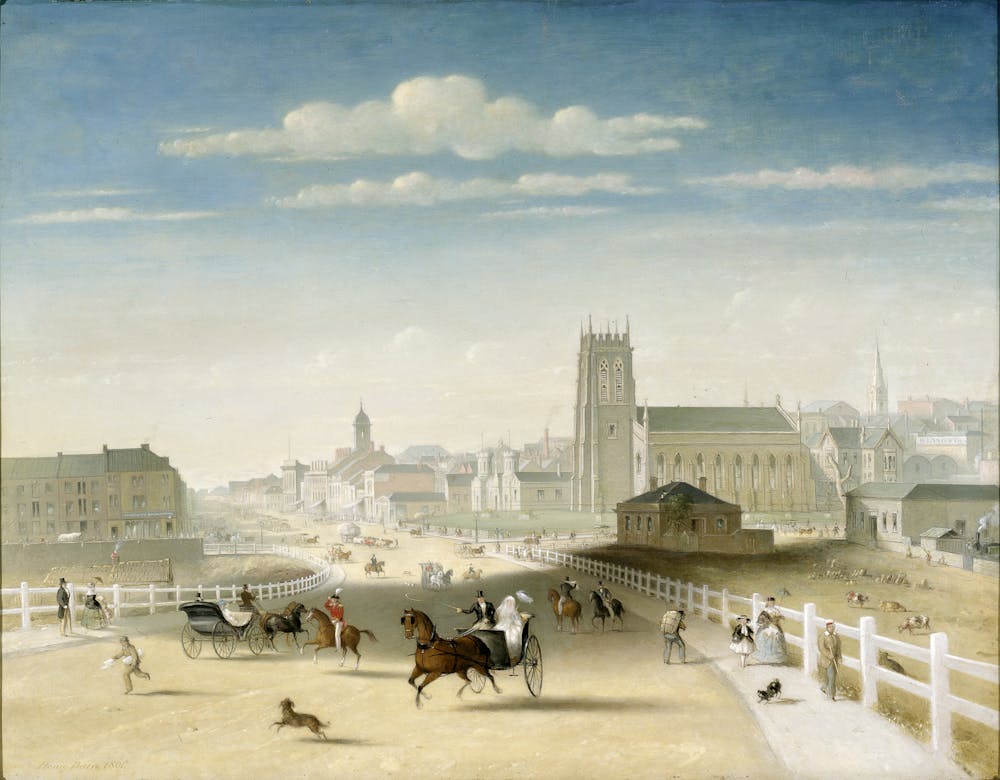 Henry Burn, Swanston Street from the Bridge, 1861, oil on canvas71.8 x 92.2 cm.
National Gallery of Victoria, Melbourne, Gift of John H. Connell, 1914
Henry Burn, Swanston Street from the Bridge, 1861, oil on canvas71.8 x 92.2 cm.
National Gallery of Victoria, Melbourne, Gift of John H. Connell, 1914
Highlights include the first European image of a kangaroo; the earliest known predecessor to the Australian coat of arms on the flounces of Lady Mary Bowman’s skirt; a rarely exhibited seven-metre 1841 panorama of Melbourne; and the earliest surviving photographs produced in Australia.
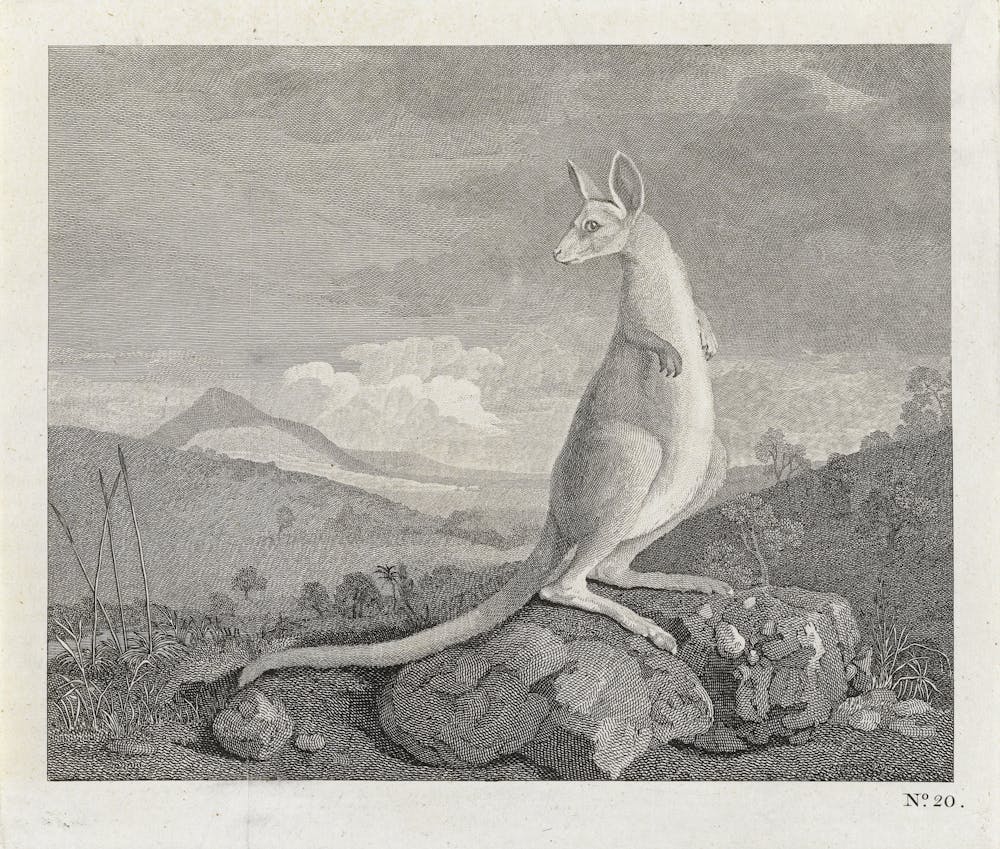 George Stubbs (after) Unknown (etcher), The kanguroo, an animal found on the coast of New Holland, 1773, 19.8 x 24.3 cm (image) 22.9 x 26.8 cm (plate) 29.2 x 27.5 cm irreg. (sheet)
National Gallery of Victoria, Melbourne, Joe White Bequest, 2011
George Stubbs (after) Unknown (etcher), The kanguroo, an animal found on the coast of New Holland, 1773, 19.8 x 24.3 cm (image) 22.9 x 26.8 cm (plate) 29.2 x 27.5 cm irreg. (sheet)
National Gallery of Victoria, Melbourne, Joe White Bequest, 2011
At the entrance to the exhibit is a row of shields, and within it a Dixson cabinet of curiosities. While beautiful and interesting in their own right, they also form a commentary on exhibition practices in the 19th century, the great age of international exhibitions. Collections of spears arranged in vertical rows were often placed at the entrance to colonial courts. The cabinet of curiosities attempts to categorise and classify what the colonists saw as exotic and utterly different to themselves. In this we can see the origin of the European museum.
The Colony: Frontier Wars exhibition presents an alternate version of this “proud” history of European colonisation. With works from both First Peoples and non-Indigenous artists, it highlights the impact of the occupation of this “terra nullius” on the Indigenous inhabitants, who had a history in the land dating back 65,000 years.
Particularly powerful are works by Wurundjeri leader, activist and artist, William Barak; Yvonne Koolmatrie’s woven sedge sculptures of a mother and her stolen baby; Lorraine Connelly-Northey’s Possum-skin cloak: Blackfella Road; Christian Thompson’s subversive photographs, Museum of Others; and Michael Cook’s provocative The Majority Rule.
Julie Gough’s Chase, at the entrance to the exhibit, forms a screen of tea-trees as a counterpoint to the row of shields downstairs, and also as a dialogue between the surrounding works: E. Phillips Fox’s The landing of Captain Cook and her own work, Imperial Leather.
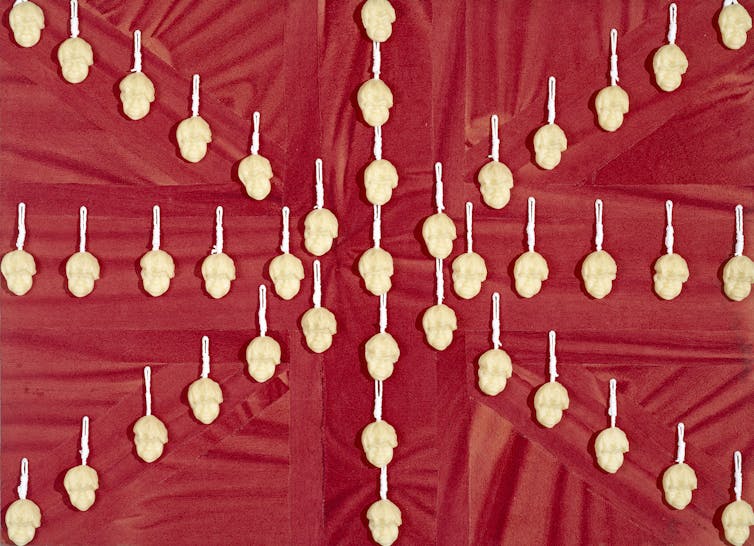 Julie Gough, Imperial Leather, 1994, wax and cotton rope and drawing pins on tie-dyed cotton on composition board (a-pp) 149.2 x 204.4 cm (overall)
National Gallery of Victoria, Melbourne Presented through The Art Foundation of Victoria by Gabrielle Pizzi, Member, 1995 © Julie Gough
Julie Gough, Imperial Leather, 1994, wax and cotton rope and drawing pins on tie-dyed cotton on composition board (a-pp) 149.2 x 204.4 cm (overall)
National Gallery of Victoria, Melbourne Presented through The Art Foundation of Victoria by Gabrielle Pizzi, Member, 1995 © Julie Gough
Perhaps one minor criticism of the exhibition setup is that, possibly for pragmatic reasons, the dialogue between the two exhibitions is not facilitated by their spatial separation. The traditional colonial exhibition is housed downstairs, and the Frontier Wars is one floor up. Entry to the former is ticketed, while to the latter it is free. Although one exhibition may be said to comment on the other, there is little opportunity for genuine push and pull between the two.
This curatorial decision has major implications and raises issues that are, perhaps, unresolvable at the present time. These questions go to the heart of the issue of frames of reference that the exhibitions seek to address.
The huge, densely hung Colony: Australia 1770–1861 exhibition feels like an anthropological museum exhibition. In it, the provision of information about the past and presentation of rare items take precedence over aesthetics. Featuring loaned objects from around the country as well as those from the NGV collection, these objects from contemporary museums and galleries speak loudly of earlier collectors’ preoccupations and preconceptions about the world, with particular emphasis on preserving the “exotic” and the “other”.
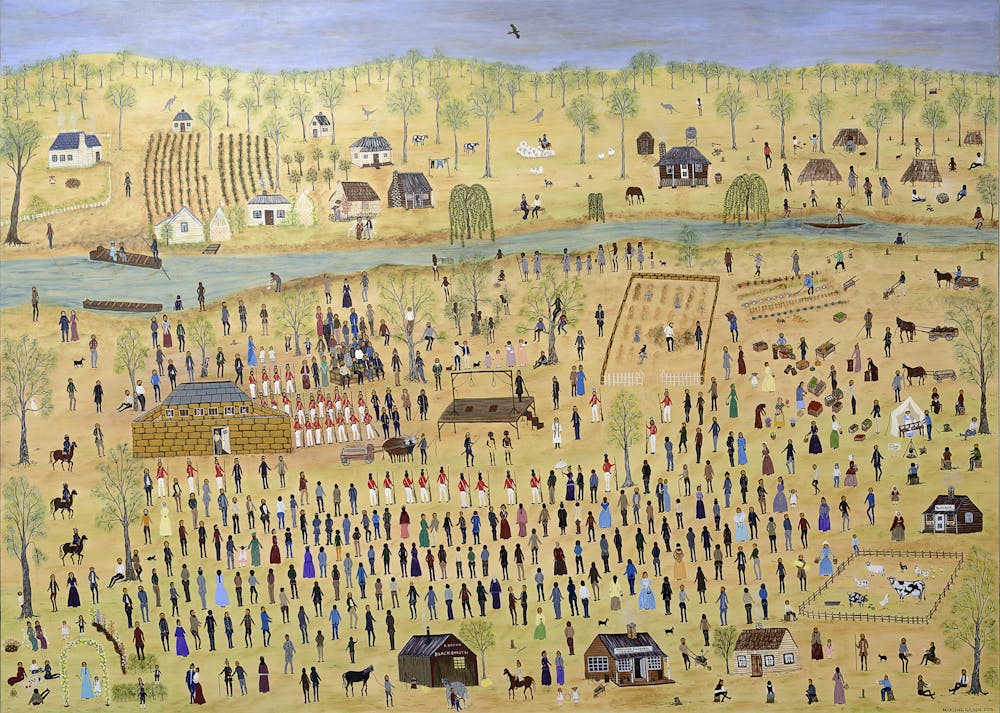 Marlene Gilson, Tunnerminnerwait and Maulboyheenner, 2015, synthetic polymer paint on canvas, 142.5 x 198.5 cm.
City of Melbourne Arts & Culture Collection © Marlene Gibson
Marlene Gilson, Tunnerminnerwait and Maulboyheenner, 2015, synthetic polymer paint on canvas, 142.5 x 198.5 cm.
City of Melbourne Arts & Culture Collection © Marlene Gibson
The much smaller Colony: Frontier Wars response looks more like an art exhibition. It presents an opposing point of view that, through its more contemporary frame of reference and strong emotive appeal, induces a strong empathetic response and a mixture of other, at times unsettling, emotions.
However, I wonder whether this whole dualistic structure, based on a deeply entrenched, taken-for-granted Western European mode of thought and discourse, simply reinforces notions of irreconcilable differences.
The exhibitions are separated in space and, in some respects, in time; differ in scope and orientation; one is free, the other paid. One uses the traditional curatorial term “unknown artist” while the other pointedly introduces the term “once known” for unidentified Indigenous artists. There is not so much a dialogue between the two exhibitions, as a chasm.
There is a certain honesty in acknowledging this in a nation divided over the meaning and propriety of celebrating Australia Day on January 26, and unable to agree on how to enshrine an Indigenous voice in the constitution.
Our education system, our political system, our legal system, our academic life, our science, our understanding of gender, of nature, of other lifeforms on the planet, of god and of morality are all formed around notions of duality.
People are pushed into adopting polarised positions that are then argued vehemently. We need a paradigm shift. While the Colony exhibitions educate, inform, reveal, agitate and engage, they do so from within a cultural frame of reference that seems doomed to reinforce division. This is, perhaps, a sign of our time.
Colony: Australia 1770-1861 will be exhibited at the NGV until July 15 2018. Colony: Frontier Wars will be exhibited until September 2.
Authors: Anita Pisch, Visiting Fellow, School of Literature, Languages and Linguistics, Australian National University


















