

here are 5 steps to help them cope
- Written by Toni Noble, Adjunct Professor, Institute for Positive Psychology & Education, Australian Catholic University
More than 600 schools have been closed, and some damaged, in recent days as bushfires rage across Queensland and New South Wales. Some students have been urgently evacuated while in school. People have lost homes and animals and are experiencing significant distress.
Research shows somewhere between 7% and 45% of children suffer depression after experiencing a natural disaster. Children more at risk of depression include those who were trapped during the event; experienced injury, fear, or bereavement; witnessed injury or death; and had poor social support.
The Victorian Education Department commissioned us after the 2009 Black Saturday fires to train teachers in seven fire-affected regions in methods to foster resilience in children.
Read more: Mr Morrison, I lost my home to bushfire. Your thoughts and prayers are not enough
Teachers told us their students had experienced distressing emotions including high anxiety, fear and even panic during the event. Comments from teachers included:
Their world had changed forever; they became more fearful.
Some children were very frightened and for a long time stayed close to their parents.
Many children became scared and anxious about worldwide issues.
Their anxiety was triggered by the smell of smoke, a fire engine’s siren or a foggy day.
The teachers we interviewed also noted children’s profound sense of loss (of their homes, pets and livestock). Many students knew someone who had lost a family member or friend.
One teacher said:
The fires opened students’ eyes to what a disaster is. Not just something you see on TV.
We trained teachers using our Bounce Back program – a research-based social and emotional learning program first published in 2003. Most children are resilient and will bounce back quickly. Only a small minority may be at risk of ongoing anxiety and there are ways to minimise that risk.
How to help kids cope now
Try to stay calm and reassuring. Children take cues from the adults in their lives. If adults show fear and nervousness, children tend to mirror these emotions.
Try to focus on the small positives such as “we are all safe”. You can list the things that haven’t changed, such as your children’s friends. Reassure them other people such as family, friends, teachers and their community will help and that life will return to normal.
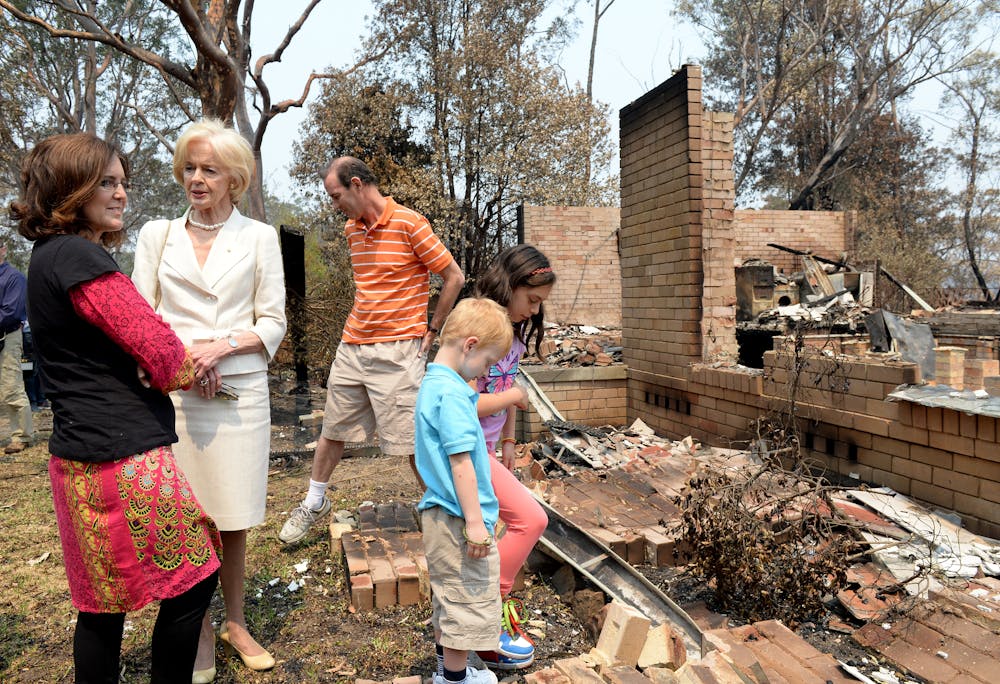 Children can feel a profound sense of loss after a natural disaster. Pictured: children who lost their home to fire in the Blue Mountains, west of Sydney, in 2013.
DAN HIMBRECHTS
Children can feel a profound sense of loss after a natural disaster. Pictured: children who lost their home to fire in the Blue Mountains, west of Sydney, in 2013.
DAN HIMBRECHTS
Everyone feels sad, anxious or upset when a bushfire burns near their home. By helping your child name their feeling, you are helping them feel more in control. Here are five steps to encourage your children to do this:
- take notice when your child is feeling sad, frightened, angry or upset
- encourage your child to talk about what’s troubling them, and listen and show you understand how they are feeling
- name the emotion in words your child can understand – are they “worried”, “scared”, “a bit frightened” or “sad”?
- help your child understand it’s normal to feel that strong emotion and help them to sit with their feelings
- finish with a hopeful or optimistic statement they can do something to help make things feel better. This may include something physical (such as going for a walk or throwing a basketball through a hoop), something that creates positive feelings (like playing with a pet or friend, or drawing), or doing something kind or helpful for someone else.
 Children are naturally resilient. Pictured: play area inside a Hobart evacuation centre during the January 2013 Tasmanian bushfires.
ROB BLAKERS/AAP
Children are naturally resilient. Pictured: play area inside a Hobart evacuation centre during the January 2013 Tasmanian bushfires.
ROB BLAKERS/AAP
Resilience is the capacity to bounce back after hardship.
To help your child bounce back, you can communicate that:
- life is mainly good but now and then everyone has a difficult or unhappy time
- although things aren’t good now and it might take a while to improve, it’s important to stay hopeful and expect things to get better
- you will feel better and have more ideas about what to do if you talk to someone you trust about what’s worrying or upsetting you
- unhelpful thinking (“our family will never get a nice home again”) isn’t necessarily true and makes you feel worse
- helpful thinking (“it might take a while to get our home back again but it will happen”) makes you feel better because it is more accurate and helps you work out what to do.
Read more: Ignoring young people's climate change fears is a recipe for anxiety
Coping after the event
Children with strong emotional support, such as from family and friends, are better able to cope with adversity.
Friendships may be disrupted after bushfires because of family relocations. Helping children connect via social media or phone with friends can reduce their sense of isolation.
Getting children back to school and regular routines can be one of the best ways to help their resilience.
Teachers are encouraged to allow time for children to talk about the bushfires and their feelings about them during class.
The teachers who participated in the Bounce Back program after Black Saturday explicitly taught children the skills for being optimistic and resilient – such as to challenge their unhelpful thinking and understand everybody, not just you, experiences setbacks sometimes.
They also taught kids skills for regulating their emotions and everyday courage to face their fears.
They used circle-time discussions of picture books and media stories to allow them to talk about their own experiences in a safe way.
Read more: 'It's real to them, so adults should listen': what children want you to know to help them feel safe
We held focus groups with children of different ages in five of the primary schools that used our Bounce Back program. The children told us they: “know now what to do when something goes wrong”; “focus on more positives”; “don’t think the worst now”; “know things change”; “have learnt that sometimes you just have to put up with it”; and “now feel it’s easier to get back up in bad times”.
While a disaster can be challenging for children, a supportive home and school environment, together with coping skills, can help children recover reasonably quickly and get back to normal life.
Authors: Toni Noble, Adjunct Professor, Institute for Positive Psychology & Education, Australian Catholic University

















