

Mysterious molecule found on brown dwarf casts further doubt on potential signs of life on Venus
- Written by Laura McKemmish, Senior Lecturer, School of Chemistry, UNSW Sydney
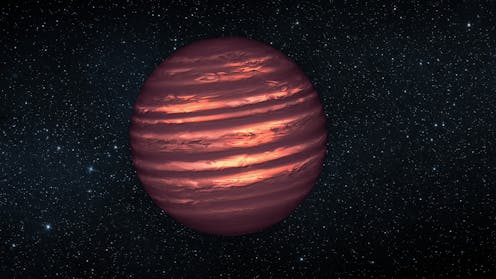
Brown dwarfs: too small to be stars, too big to be planets.
Only discovered in the 1990s, these in-between cosmic objects aren’t big enough to burn as hot and bright as a true star, instead usually giving off a warm dim glow.
In new research published today in Science, a team of astronomers report the detection of a surprising substance in a brown dwarf known as Wolf 1130C: a chemical called phosphine, which has been the focus of controversial claims for evidence of life of Venus.
However, the presence of phosphine in the turbulent and inhospitable atmosphere of a brown dwarf shows our understanding of the life cycle of this small, simple molecule is incomplete – and casts doubt on the idea is can be regarded as a “biosignature” of alien life.
What are brown dwarfs?
Like true stars, brown dwarfs are formed from collapsing clouds of gas in space. The gas heats up as its falls inward, but in a brown dwarf it never gets hot enough to trigger the fusion of hydrogen into helium which powers stars.
But as long as the cloud of gas is at least 13 times as heavy as Jupiter, it will get hot enough to fuse a slightly heavier kind of hydrogen called deuterium. This fusion will burn out quite quickly in astrophysical terms, after between 1 and 100 million years.
However, the gravitational collapse and fusion create an enormous amount of heat in the brown dwarf’s core. This creates a convection loop: gas near the core warms up and rises, transferring heat to the upper levels before cooling and falling back down.
Brown dwarfs are much cooler than stars. The surface of the youngest and largest can reach up to 2,000°C, but the coolest are close to room temperature.
Once the heat from the core reaches the surface layers of the brown dwarf, it radiates out into space mainly in the form of photons of infrared light.
Infrared wavelengths are difficult to observe with ground-based telescopes, but space telescopes such as the James Webb Space Telescope (JWST) have a better view. This gives us a better look at brown dwarfs.
What’s going on with phosphine?
Interesting chemical reactions and processes happen in brown dwarfs, in ways they don’t in hot stars.
For nearby brown dwarfs, JWST can observe the outcomes of these chemical processes. It does this by looking for the “barcodes” of each molecule, specific patterns of dark lines in the spectrum of light emitted by the brown dwarf.
Phosphine is a simple molecule with one phosphorus atom and three hydrogen atoms.
In 2020, some scientists thought they detected its spectral signature in the atmosphere of Venus. The conditions on Venus mean phosphine should be destroyed pretty quickly there, so detecting it would mean something was making a lot of phosphine.
On Earth, phosphine is only present due to life, and so phosphine has been explored extensively as a potential sign of life. So the potential detection on Venus was exciting stuff.
But dig beneath the headlines and it is more subtle. Phosphine is found in the atmospheres of Jupiter and Saturn, and no one is proposing life exists in the clouds of these planets.
The reason is we understand how phosphine can be created and survive in the lower levels of the atmosphere on these planets. Then it rises to the surface where it is rapidly destroyed – but not before we see its spectral signature.
What about phosphine in brown dwarfs?
What happens to phosphine in hotter or bigger systems, such as brown dwarfs and hot Jupiter exoplanets?
According to some models, we should see significant amounts of phosphine here. But earlier JWST observations, looking at 23 brown dwarfs with temperatures between 100°C and 700°C, found no phosphine.
Yet the recent observation of phosphine on brown dwarf Wolf 1130C (temperature approximately 320°C), matches the models very well. Why?
The researchers behind the new study aren’t sure yet. Their best guess is that it might have something to do with the fact Wolf 1130C is old and contains low concentrations of metals.
At this stage, they conclude with a simple statement: there is no consistent model that explains the amounts of phosphine we see on Jupiter, Saturn, Wolf 1130C, other brown dwarfs and exoplanet gas giant atmospheres. Without a better understanding, the use of phosphine as a biosignature is questionable.
So perhaps there was phosphine on Venus after all, but the cause was unknown chemistry or physics, not biology. Alien life remains the hypothesis of last resort.
Authors: Laura McKemmish, Senior Lecturer, School of Chemistry, UNSW Sydney

















