

how climate change is trashing Australia’s roads
- Written by Hannah Seligman, Lecturer in Municipal Services and Public Works Engineering, University of Southern Queensland
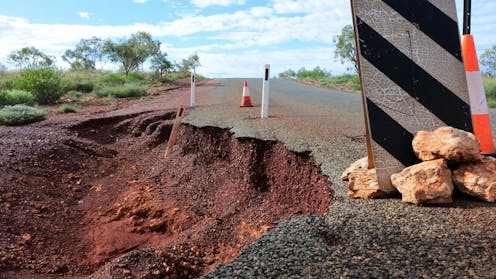
Australia has one of the world’s longest road networks, covering almost 900,000 kilometres. More than 80% of it is rural or remote.
It was hard and expensive enough to maintain this network before climate change began causing havoc. But the job of roadworkers, engineers and transport departments is getting much harder. As many drivers know, roads are suffering. Potholes are everywhere.
Record flooding in 2023 destroyed a vital bridge at Fitzroy Crossing in Western Australia, causing chaos. In 2024, bushfires closed the Eyre Highway linking South Australia to WA, followed by floods not long after. With road links out of action, communities have been cut off for months.
Climate change is a major cause of this accelerated deterioration. Extreme heat and bushfires are projected to do more damage in Australia’s southern and eastern regions. To date, water is doing the most damage through extreme rainfall and floods. Floods are projected to hit harder and more often in the continent’s northern and eastern regions.
The new National Climate Action Plan calls for upgrading Australia’s transport networks so they can better withstand the changing climate. It won’t be possible to climate-proof the whole network. Authorities will have to focus on keeping vital lifelines open.

Queensland on the frontline
Queensland’s roads are particularly vulnerable. The state has the largest road network of any state or territory, at around 180,000 kilometres.
Two-thirds of these roads run through rural and remote regions, which makes monitoring and maintenance more difficult. Almost 40% of the state’s roads (70,000 km) are built on black clay soils, which swell when wet and shrink when dry. Roads built on clay are highly susceptible to cracking, rutting and accelerated failure.
Intense rainfall and flooding events are now a leading cause of road closures and pavement damage, isolating communities and disrupting freight routes. The floods this year in northern Queensland left supermarkets emptied and disrupted industries such as agriculture and mining which rely on reliable freight connections.
Short term, this means more emergency repairs and disruption. Longer term, it means faster deterioration, higher costs and shorter road lifespans.
Extreme weather is driving up maintenance spending. In the aftermath of the 2022 floods in southeast Queensland, the state government allocated A$350 million to repair damaged roads.
These costs are climbing fast. Transport authorities estimate the state had $8.6 billion in necessary but unfunded road renewal and maintenance as of 2023-24, up from $7.8 billion a year earlier.
The challenge is most acute at a local government level. Queensland’s councils are responsible for about three-quarters of the state’s road network. They also have the least financial resources to draw on. Many report significant maintenance backlogs.
As a result, councils often resort to reactive maintenance such as patching up roads after floods. But fixing after failure drives up the lifetime cost of a road, increases disruption to traffic and leaves infrastructure exposed to the next extreme event.
Road closures hit rural and regional communities harder than urban residents. Remote communities face even greater upheaval. Many remote towns in northern Queensland have no alternative routes. If one road is closed, the town can be cut off from food, fuel, water, services and emergency responses.

Time to build resilience
In 2023, a government inquiry into the problem recommended several approaches to make Australia’s roads more resilient.
The inquiry found it wasn’t realistic to climate-proof the nation’s full road network on cost, timeframe and staffing grounds.
Instead, the inquiry recommended authorities focus on improving the most important corridors and ensuring roads reopen quickly after closures.
It won’t be easy to make this a reality. Coordinating road maintenance between federal, state and local tiers of government has long been a challenge. It’s going to get harder.
 Extreme rains and floods are doing real damage to Australian roads. Pictured: residents looking at a landslide which cut off a road in Coalcliff, New South Wales, in 2024.
Saeed Khan/Getty
Extreme rains and floods are doing real damage to Australian roads. Pictured: residents looking at a landslide which cut off a road in Coalcliff, New South Wales, in 2024.
Saeed Khan/Getty
Responding to large scale events will require better collaboration to ensure essential road corridors stay open for freight and community access. It will also mean strengthening backup options where possible.
Preventative maintenance will have to ramp up to overcome the chronic backlogs of repairs to road drainage, shoulders and surface.
Authorities will have to get better at collecting and sharing data in consistent ways to guide new investment, target maintenance and make roads safer.
It’s long been common to rebuild roads exactly as they were before a disaster. But this means they’re vulnerable to the next disaster, which may be even bigger.
Instead, we should invest in “betterment”: using disaster recovery as a chance to upgrade roads by making culverts bigger, raising bridges, widening shoulders or even shifting roads to safer ground. This approach reduces future risks and often saves money over the long run.
Greener, stronger roads are possible
As climate change intensifies, new roads will have to be built to be more resilient. Design standards focused on resilience will be essential.
We already have stronger, greener ways of building roads. Foamed bitumen roads are much more flood resistant. Crumb rubber from old car and truck tyres makes road surfaces tougher.
Old asphalt pavement and waste glass can be used as recycled aggregate for new roads, cutting waste and emissions. New intelligent road rollers use real-time monitoring to compact the layers of new roads more evenly, boosting quality.
These methods haven’t been widely taken up due to cost concerns, supply chain challenges in regional areas and a reluctance to try new things. Policymakers could speed up uptake by setting new procurement rules for stronger, more resilient and low-carbon materials.
Climate change is already hitting Australian roads hard. If nothing is done, the damage will only intensify. Traditional methods will stop working.
Authors: Hannah Seligman, Lecturer in Municipal Services and Public Works Engineering, University of Southern Queensland

















