

New adaptation of Rebecca is visually haunting, but misses the core tensions of the original story
- Written by Sarah Austin, Senior Lecturer in Theatre, The University of Melbourne
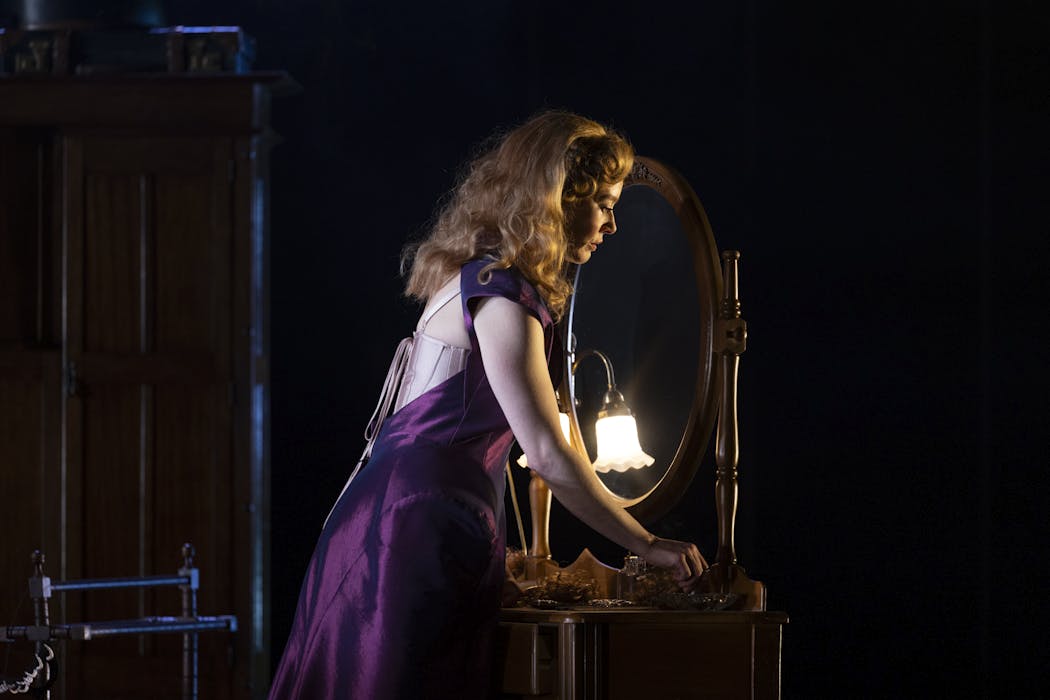
Melbourne Theatre Company’s (MTC) latest offering is a striking adaptation of the 1938 gothic novel Rebecca by Daphne du Maurier.
Like Alfred Hitchcock’s 1940 film, the story follows a young woman who marries a widower, Maxim de Winter, and relocates to his grand ancestral estate of Manderley – only to be haunted by the memory of his dead first wife, Rebecca, and the dark mysteries surrounding her demise.
Though it was celebrated as a love story by many upon its release, du Maurier dismissed that interpretation. For her, Rebecca was always far more about jealousy, rage, and the fragility of relationships. Themes of class, power, sexuality and gender – radical in 1938 and still pressing today – pulse through the text.
The latest MTC production gestures toward them, but at times they feel more like lost opportunities than fully realised dimensions that might offer powerful insight into our contemporary context.
An exploration of haunting and visibility
The entire story of Rebecca is told as a flashback. In an opening scene the young, naive protagonist, simply named Woman in the program (and compellingly portrayed by Nikki Shiels) tells the audience: “Last night I dreamt I went to Manderley again”.
With that evocative first line, the opening monologue situates the dream-like logic, desire and longing that lie at the heart of the text.
We are whisked to Monte Carlo, where the young Woman, practically a school girl with knee high socks and pulling at her jumper sleeves, is serving as a companion to Mrs Van Hopper (Pamela Rabe).

Here, our main characters meets and is rapidly courted by Maxim de Winter (Stephen Phillips), and eventually returns with him to Manderley as his wife.
At the estate, the new Mrs de Winter encounters the imposing housekeeper Mrs Danvers (also played by Pamela Rabe), and Rebecca’s spectre begins to dominate: her reputation for beauty, her competence in managing the household, and her lingering influence even in absence.
Visually and structurally, the staging leans into Gothic and cinematic modes. There are shifting sets, sliding doors, and blackouts that create a visual sense of abyss and emptiness. An enormous oval mirror, hung from the ceiling, also plays a central role.

The stage design allows for swift changes of locale as we move through the wings of Manderley. The mirror becomes a motif of doubling – two marriages, two wives, and two versions of Manderley, one grand and one decayed. These devices help articulate the psychological tension between past and present, seen and unseen.
The absence of Rebecca, and the house itself, almost become characters. They shape others’ behaviours, influence memory, and exert social and psychological pressure.
The set and costume design by Marg Horwell, lighting by Paul Jackson, and sound design by Grace Ferguson and Joe Paradise Lui and are among the production’s strongest features.
 The set, costume, lighting and sound design are among the production’s strongest features.
Pia Johnson
The set, costume, lighting and sound design are among the production’s strongest features.
Pia Johnson
Where themes glimmer, and where they lack
A core tension in du Maurier’s Rebecca lies in class.
Rebecca, a women who inherited privilege, moved through Manderley with a sense of entitlement. The young Woman, by contrast, is not from the wealthy elite. She carries the mark of outsider and can’t compete.
While MTC’s adaptation acknowledges this gulf, it seldom renders it in sharp relief. The Woman’s discomfort and self‑doubt are clear, but the persistent social machinery that excludes her – the whispers, expectations and inherited status – could be more deeply excavated.
The show seems to under-emphasise the idea that to “belong” in Manderley is not only psychological, but also structural. Had it fully inhabited these tensions, it could speak powerfully to how invisibility and inherited privilege continue to shape and inform our lives.
 Rebecca is an ambitious show that delivers on many front, but lack thematic depth.
Pia Johnson
Rebecca is an ambitious show that delivers on many front, but lack thematic depth.
Pia Johnson
Likewise, the themes of gender and sexuality seem under-explored in the production.
There are moments or erotically charged exploration – most notably in a bedroom scene where the seemingly sexually repressed Mrs Danvers reveals her devotion to Rebecca, and convinces the new Mrs De Winter to try on Rebecca’s old clothing. But these moments seem more atmospheric than substantive.
These thematic spaces the production seems to miss – class, sexuality, gender – are not decorative. They are integral to what makes Rebecca more than a love story, and why Du Maurier resisted the framing of a melodramatic gothic romance.
A promising show that needed more anchoring
Eventually we discover Rebecca was not all she seemed to be. In a chilling twist, we become privy to her final act of manipulation. The end scene, staged on a revolve, is a kind of operatic fever dream of luxury, despair, desire and loss.
This is where the production is at its most successful theatrically, and where the tension and energy that were so difficult to sustain through many blackouts reaches an electrifying fever pitch.
MTC’s Rebecca is not without its triumphs. The performances, especially from Shiels and Rabe, are outstanding. It is a daring adaptation that turns the novel’s internal shadows outward, striving to make the psychological physical, and to render absence as presence. In a collision of design, performance and imagery, it offers moments of genuine haunting.
Yet, those moments are without a connection to deeper possibilities and more contemporary anchors, rendering them powerful flashes in a landscape of narrative drift. The ambition is high, but coherence wavers.
Authors: Sarah Austin, Senior Lecturer in Theatre, The University of Melbourne

















