

Would you watch a film with an AI actor? What Tilly Norwood tells us about art – and labour rights
- Written by Amy Hume, Lecturer In Theatre (Voice), Victorian College of the Arts, The University of Melbourne
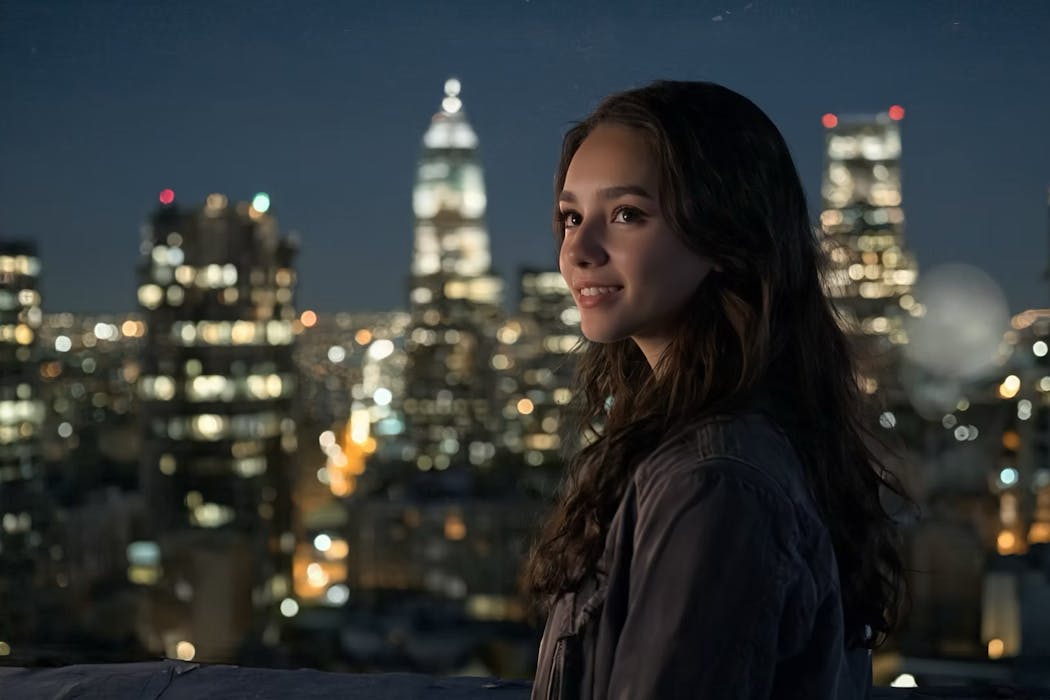
Tilly Norwood officially launched her acting career this month at the Zurich Film Festival.
She first appeared in the short film AI Commissioner, released in July. Her producer, Eline Van der Velden, claims Norwood has already attracted the attention of multiple agents.
But Norwood was generated with artificial intelligence (AI). The AI “actor” has been created by Xicoia, the AI branch of the production company Particle6, founded by the Dutch actor-turned-producer Ven der Velden. And AI Commissioner is an AI-generated short film, written by ChatGPT.
A post about the film’s launch on Norwood’s Facebook page read,
I may be AI generated, but I’m feeling very real emotions right now. I am so excited for what’s coming next!
The reception from the industry has been far from warm. Actors – and audiences – have come out in force against Norwood.
So, is this the future of film, or is it a gimmick?
‘Tilly Norwood is not an actor’
Norwood’s existence introduces a new type of technology to Hollywood. Unlike CGI (computer generated imagery), where a performer’s movements are captured and transformed into a digital character, or an animation which is voiced by a human actor, Norwood has no human behind her performance. Every expression and line delivery is generated by AI.
Norwood has been trained on the performances of hundreds of actors, without any payment or consent, and draws on the information from all those performances in every expression and line delivery.
Her arrival comes less than two years after the artist strikes that brought Hollywood to a stand-still, with AI a central issue to the disputes. The strike ended with a historic agreement placing limitations around digital replicas of actors’ faces and voices, but did not completely ban “synthetic fakes”.
SAG-AFTRA, the union representing actors in the United States, has said:
To be clear, ‘Tilly Norwood’ is not an actor; it’s a character generated by a computer program that was trained on the work of countless professional performers – without permission or compensation.
Additionally, real actors can set boundaries and are protected by agents, unions and intimacy coordinators who negotiate what is shown on screen.
Norwood can be made to perform anything in any context – becoming a vessel for whatever creators or producers choose to depict.
This absence of consent or control opens a dangerous pathway to how the (digitally reproduced) female body may be represented on screen, both in mainstream cinema, and in pornography.
Is it art?
We consider creativity to be a human quality. Art is generally understood as an expression of human experience. Norwood’s performances do not come from such creativity or human experience, but from a database of pre-existing performances.
All artists borrow from and are influenced by predecessors and contemporaries. But that human influence is limited by time, informed by our own experiences and shaped by our unique perspective.
AI has no such limits: just look at Google’s chess-playing program AlphaZero, which learnt by playing millions of games of chess, more than any human can play in a life time.

Norwood’s training can absorb hundreds of performances in a way no single actor could. How can that be compared to an actor’s performance – a craft they have developed throughout their training and career?
Van der Velden argues Norwood is “a new tool” for creators. Tools have previously been a paintbrush or a typewriter, which have helped facilitate or extend the creativity of painting or writing.
Here, Norwood as the tool performs the creative act itself. The AI is the tool and the artist.
Will audiences accept AI actors?
Norwood’s survival depends not on industry hype but on audience reception.
So far, humans show a negative bias against AI-generated art. Studies across art forms have shown people prefer works when told they were created by humans, even if the output is identical.
We don’t know yet if that bias could fade. A younger generation raised on streaming may be less concerned with whether an actor is “real” and more with immediate access, affordability or how quickly they can consume the content.
If audiences do accept AI actors, the consequences go beyond taste. There would be profound effects on labour. Entry- and mid-level acting jobs could vanish. AI actors could shrink the demand for whole creative teams – from make-up and costume to lighting and set design – since their presence reduces the need for on-set artistry.
Economics could prove decisive. For studios, AI actors are cheaper, more controllable and free from human needs or unions. Even if audiences are ambivalent, financial pressures could steer production companies towards AI.
The bigger picture
Tilly Norwood is not a question of the future of Hollywood. She is a cultural stress-test – a case study in how much we value human creativity.
What do we want art to be? Is it about efficiency, or human expression? If we accept synthetic actors, what stops us from replacing other creative labour – writers, musicians, designers – with AI trained on their work, but with no consent or remuneration?
We are at a crossroads. Do we regulate the use of AI in the arts, resist it, or embrace it?
Resistance may not be realistic. AI is here, and some audiences will accept it. The risk is that in choosing imitation over human artistry, we reshape culture in ways that cannot be easily reversed.
Authors: Amy Hume, Lecturer In Theatre (Voice), Victorian College of the Arts, The University of Melbourne

















