

An Australian chemist just won the Nobel prize. Here’s how his work is changing the world
- Written by Deanna D'Alessandro, Professor & Director, Net Zero Institute, University of Sydney
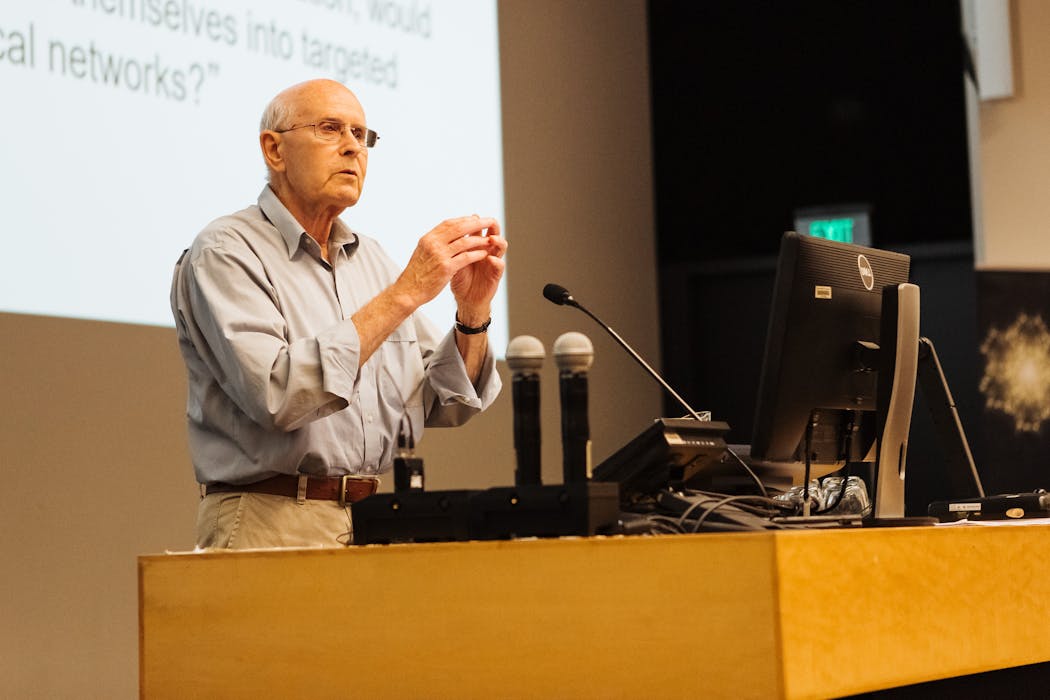
The 2025 Nobel prize in chemistry has been awarded for the development of metal–organic frameworks: molecular structures that have large spaces within them, capable of capturing and storing gases and other chemicals.
The prize is shared by Susumu Kitagawa from Kyoto University, Omar M. Yaghi from the University of California, Berkeley, and an Australian professor – Richard Robson from the University of Melbourne.
Robson first discovered the metal–organic frameworks, known as MOFs for short, in 1989, with his close collaborator Bernard Hoskins.
At a time when the value of research is being questioned, Robson’s story is a powerful reminder of how scientific research leads to real-world impact after years of sustained effort and support.
A personal connection
Like many other Australian scientists, I was inspired to pursue research in MOFs because of professor Richard Robson. He’s still working in the lab at nearly 90, mentoring students, teaching and collaborating with many of us. This recognition honours Richard’s decades of dedication as a researcher and educator in coordination and inorganic chemistry.
I’ve had the great fortune of being among his many collaborators, and he’s left an indelible mark. With Richard and his close colleague, University of Melbourne professor Richard Abrahams, we have explored how electrons move around inside MOFs.
As young chemists, we first learnt about Richard’s discovery in undergraduate lectures. It’s an inspiring story of the deep connection between teaching and research in our universities.
While the work that led to these materials was fundamental science, Richard’s achievement shows that deep, curiosity-driven research has critically important real-world impacts.
What began as scientific curiosity for Richard as he prepared models of chemicals to demonstrate to his undergraduate chemistry students, has grown into a transformative innovation. MOFs are now helping solve some of the world’s biggest challenges, from greenhouse gas capture to drug delivery and medical imaging.
Olof Ramström, professor of organic chemistry and member of the Nobel Committee for Chemistry, explains MOFs.So, what are MOFs?
Metal–organic frameworks are incredibly porous crystalline materials that are made up of metal ions, linked by organic bridges.
Think of a sponge where the holes are on the atomic scale. One teaspoon of one of these materials can have a surface area of a football field.
The shapes, sizes and functionality of these tiny pores can be changed, much like an architect designing a building where the rooms each have different functions and can carry out different tasks.
There are now tens of thousands of MOFs. Some are used to capture water from desert air. Others have been designed to remove greenhouse gases such as carbon dioxide from the atmosphere. Yet others can clean Earth’s waterways by capturing and removing potentially harmful chemicals.
Read more: Nobel chemistry prize awarded for crystal materials that could revolutionise green technology
The long road to real-world applications
While there are now companies scaling MOFs to help address major global problems, Richard began this work many decades ago.
In 2018, in a plenary lecture at the 6th global MOFs conference in Auckland, New Zealand, he described how he was preparing molecular models for a lecture when the idea struck him.
Richard reasoned that metal ions such as copper could be connected in a systematic and controlled way to other atoms such as carbon and nitrogen using coordination chemistry. It’s essentially like molecular Lego, where one piece can only click into the other in a particular way.
With his colleague Bernard Hoskins, they recognised that the geometric structure was ordered and contained innumerable cavities. Over the following decade, fellow Nobel recipients Kitagawa and Yaghi made subsequent discoveries that showed how these materials could be made stable, and designed in a controlled way.

Of the tens of thousands of MOFs now known, a number are making it through to commercial application. For example, Richard’s work with Brendan Abrahams has shown these materials can remove excesses of anesthetic greenhouse gases from operating room theatres. These greenhouse gases are many tens of thousands of times more potent than carbon dioxide.
MOFs are also being used to pull water out of thin air, especially important in dry and arid environments where there is water scarcity.
At a time when Australia is debating the contribution of research, the value of higher education and universities, and how to increase productivity, Richard’s legacy highlights the profound value of education and research, and the way they are deeply interconnected.
But to truly thrive, they require sustained support over many years, far beyond the short-term horizon of political cycles.
Fundamental science, often driven by curiosity and without an immediate application, lays the groundwork for breakthroughs that can help solve the pressing challenges we face today and those yet to come.
Richard Robson now joins just 11 other Australian scientists whose work has been recognised with a Nobel prize. All Australians can be very proud of Richard’s achievement on the world stage.
Authors: Deanna D'Alessandro, Professor & Director, Net Zero Institute, University of Sydney

















