

A collapsing star in a distant galaxy fired out some of the most energetic gamma rays ever seen
- Written by Gavin Rowell, Associate Professor in High Energy Astrophyics, University of Adelaide
The brightest fireworks in the universe are called gamma-ray bursts and are created by the death throes of certain kinds of stars. These intense blasts release as much energy in one second as the Sun will over its whole lifetime, but we still don’t understand exactly how they do it.
We are getting closer, however. We recently had the best ever look at the incredibly high-energy gamma rays emitted by these bursts. Gamma rays are like particles of visible light, but each of these high-energy rays carries as much as 100 billion times more energy.
New research published this week in Nature by two teams of scientists from around the world (I am a member of one of them) reveals the gamma rays are more energetic than we knew and that the afterglow of the burst lasts much longer.
What are gamma-ray bursts?
In the late 1960s, secret spy satellites designed to look for gamma-ray flashes from nuclear explosions began to detect mysterious bursts of gamma rays coming from outer space. It was not until the 1990s that scientists began to unravel the mystery with data from new satellites.
We now believe at least some of these gamma-ray bursts are caused by the collapse of super-massive stars. Many stars end their lives in an enormous explosion called a supernova, but very heavy stars can create an even bigger blast called a hypernova.
Read more: Flash, aah-aah! Could a gamma ray burst eradicate all life on Earth?
In this process, the star’s core collapses and becomes a rapidly rotating black hole. The surrounding gas forms a spinning disk around the black hole, which then creates a narrow, intense jet of radiation. If this jet is pointing towards Earth, we can see it as a bright gamma-ray burst, which typically lasts no more than a minute or two.
The very high-energy gamma rays are given off by matter that is accelerated to very close to the speed of light as it whirls around the black hole.
Because the bursts are rare and don’t last long, it can be difficult to get a good look at one with a telescope.
The afterglow
On July 20 2018, gamma-ray and X-ray satellites alerted the world to a new gamma-ray burst, named GRB 180720B. It was a very strong burst and lasted for about 50 seconds – a relatively long duration, indicating the death of a massive star.
Following the alert, several observatories around the world immediately began observing the spot in the sky that the burst came from. About 10 hours later, that spot came into view for the High-Energy Stereoscopic System (HESS) gamma-ray telescopes in Namibia.
Even though 10 hours had passed, HESS was able to observe the afterglow of the burst, which still included extremely energetic gamma rays.
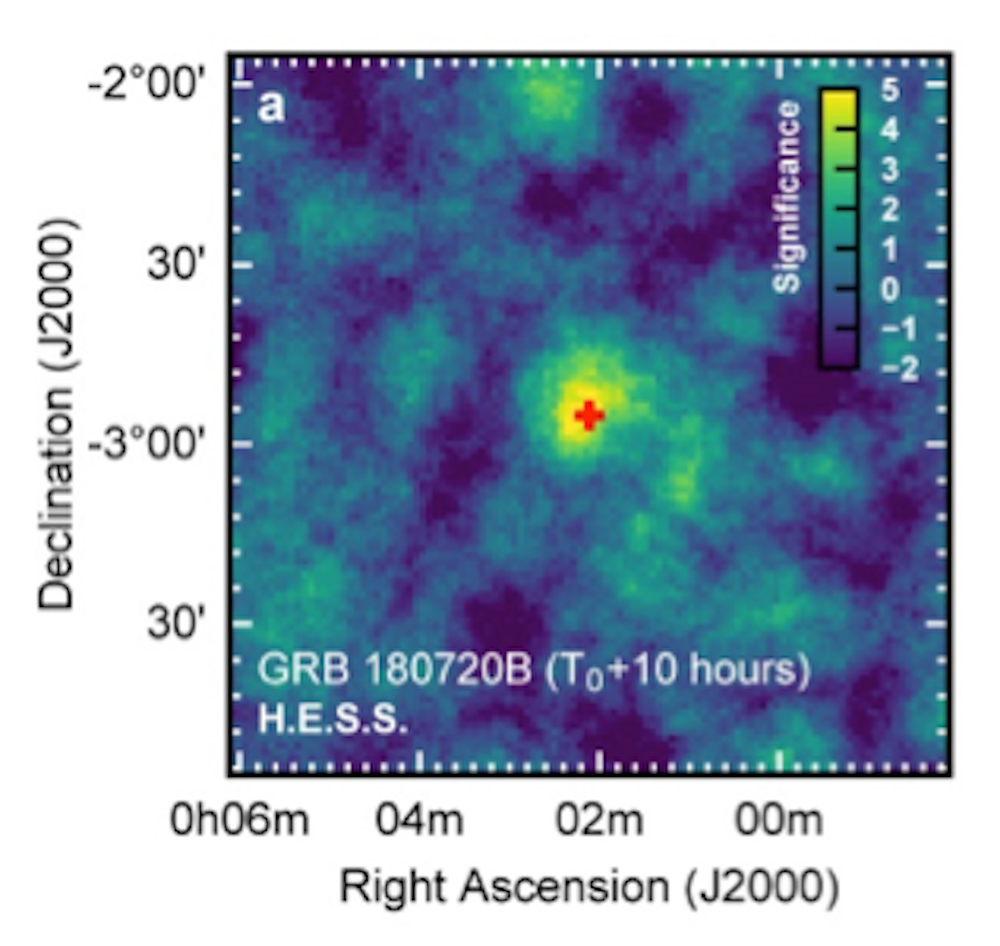 Very high-energy gamma rays from the gamma-ray burst GRB 180720B, 10 to 12 hours after the burst, as seen by the large HESS telescope.
Supplied, Author provided
Very high-energy gamma rays from the gamma-ray burst GRB 180720B, 10 to 12 hours after the burst, as seen by the large HESS telescope.
Supplied, Author provided
At HESS we have been looking at other gamma-ray bursts in this way for more than a decade. This was the first time it detected gamma rays from the high-energy afterglow at energies never seen before.
While we had anticipated the detection of gamma-ray bursts at these high energies, the discovery that they were still around many hours after the initial burst came as a great surprise.
This result suggests the accelerated particles creating the gamma rays still exist or are created a long time after the explosion, which is hard to explain with our existing theories of what happens in gamma-ray bursts.
Read more: An extragalactic mystery: where do high-energy cosmic rays come from?
Even more energy
Also just published are observations of a different gamma-ray burst (GRB 190114C) made using the Major Atmospheric Gamma Imaging Cherenkov (MAGIC) telescopes in the Canary Islands.
The MAGIC astronomers caught the “prompt” early stages of the burst, detecting gamma rays with even more energy – some of the most energetic ever seen.
These detections show we still have much to learn about gamma-ray bursts. But they also give us confidence that our methods to detect them are improving. We will be able to study plenty more in the future with the much more sensitive Cherenkov Telescope Array, which is now under construction.
Authors: Gavin Rowell, Associate Professor in High Energy Astrophyics, University of Adelaide

















