

Enough ambition (and hydrogen) could get Australia to 200% renewable energy
- Written by Scott Hamilton, Strategic Advisory Panel Member, Australian-German Energy Transition Hub, University of Melbourne
The possibilities presented by hydrogen are the subject of excited discussion across the world – and across Australia’s political divide, notoriously at war over energy policy.
Read more: Hydrogen fuels rockets, but what about power for daily life? We're getting closer
On Friday Australia’s chief scientist Alan Finkel will present a national strategy on hydrogen to state, territory and federal energy ministers. Finkel is expected to outline a plan that prioritises hydrogen exports as a profitable way to reduce emissions.
It is to be hoped the strategy is aggressive, rather than timid. Ambition is key in lowering the cost of energy. Australia would do better aiming for 200% renewable energy or more.
It’s likely the national strategy will feature demonstration projects to test the feasibility of new technology, reduce costs, and find ways to share the risk of infrastructure investment between government and industry.

There are still a number of barriers. Existing gas pipelines could be used to transport hydrogen to end-users but current laws are prohibitive, mechanisms like “certificates of origin” are required, and there are still key technology issues, particularly the cost of electrolysis.
These issues raise questions of what a major hydrogen economy really looks like. It may prompt suspicions this is just the a latest energy pipe dream. But our research at the Australian-German Energy Transition Hub argues that an ambitious approach is better than a cautious one.
Aggressively pursing hydrogen exports will reduce costs of domestic energy supply and provide a basis for new export industries, such as greens steel, in a carbon-constrained world.
Read more: Making Australia a renewable energy exporting superpower
Optimal systems cost less
We used optimisation modelling to examine how a major hydrogen industry might roll out in Australia. We wanted to identify where major plants for electrolysis could be built, asked whether the existing national electricity market should supply the power, and looked at the effect on the cost of the system and, ultimately, energy affordability.
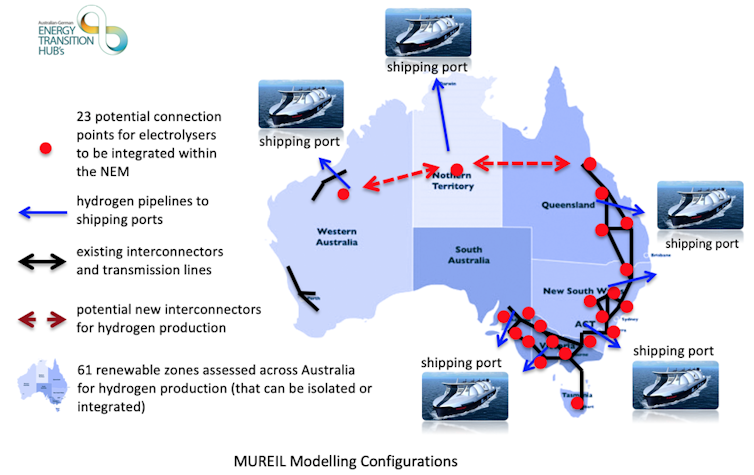 Australian Hydrogen export locations.
Our results show the locations for future hydrogen infrastructure investment will be mainly determined by their capital costs, the share of wind and solar generation and the capacity of electrolysers to responsively provide energy to the system, and the magnitude of hydrogen production.
Read more: How hydrogen power can help us cut emissions, boost exports, and even drive further between refills
We also identified potential demonstration projects across Australia, such as:
- large-scale production of liquid hydrogen and export from the Pilbara in Western Australia
- hydrogen to support steel manufacturing in South Australia
- injecting hydrogen into the gas networks in Victoria and support industry and electricity generation
- hydrogen to supply transport fuel for major users such as trucks, buses and ferries in New South Wales, and
- hydrogen to produce ammonia at an existing plant in Queensland.
An export-oriented economy
If we assume electrolysers remain expensive, around A$1,800 per kilowatt, and need to run at close to full-load capacity all the time, the result is large hydrogen exporting hubs across the country, built near high quality solar and wind power resources. Ideal locations tend to be remote from the national energy grid, such as in Western Australia and Northern Territory, or at relatively small-scale in South Australia or Tasmania.
There is much debate around the current cost of electrolysis, but consensus holds that economies of scale will substantially reduce these costs - by as much as an order of magnitude. This is akin to the cost reductions we have seen in solar power and batteries.
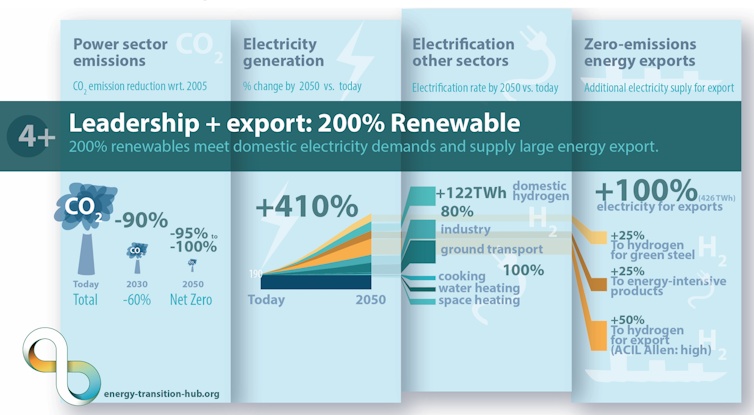 200 per cent renewables scenario
This infrastructure requires some major investment. However, our modelling shows that if Australia produces 200% of our energy needs by 2050, exporting the surplus, we see major drops in system costs and lower costs of energy for all Australia. If Australia can produce 400 Terrawatt-hours of hydrogen energy for export, modelling results show the average energy cost could be reduced by more than 30%.
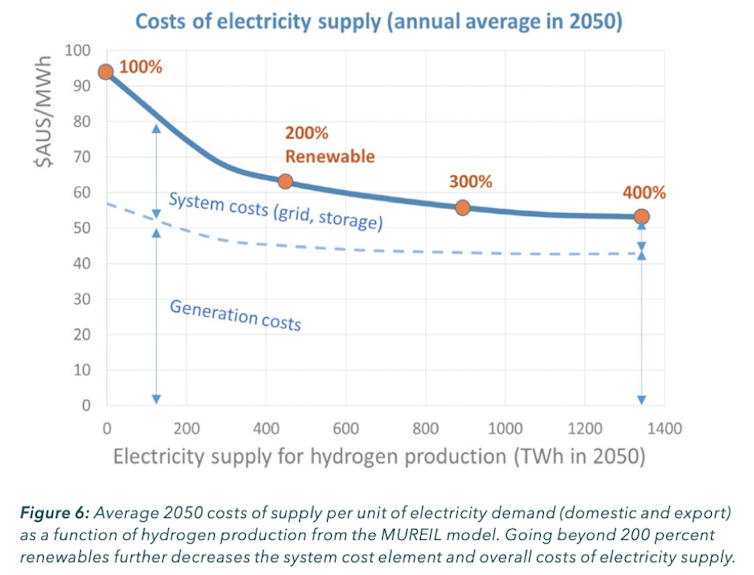 Hydrogen ambition reduces costs of electricity supply.
The driving factor is our level of ambition. The more we lean into decarbonising our economy with green energy, the further the costs fall. The savings from the integrated and optimised use of electrolysers in a renewable-heavy national electricity market outweigh the cost of building large renewable resources in remote locations.
A large hydrogen export industry could generate both substantial export revenue and substantial benefits to the domestic economy.
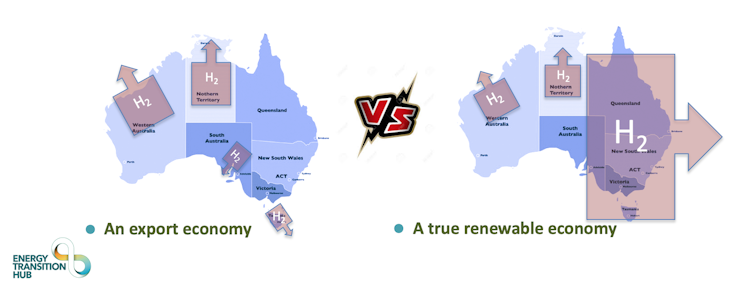 Hydrogen export economy versus true RE economy
To sum up, the picture above shows two possible hydrogen futures for Australia.
In the first, Australia lacks climate actions and electrolyser costs remain high with limited economies of scale, and we export from key remote hubs such as the Pilbara.
Read more: We need a national renewables approach, or some states – like NSW – will miss out
In the other, ambition increases and costs drop, and the hydrogen export industry connects to the national grid, providing both renewable exports and benefits to the grid. This also promotes the use of hydrogen in the domestic market. Australia embraces a true renewable economy and a new chapter of major energy exports begins.
Either way, Australia is primed to become a hydrogen exporting superpower.
Authors: Scott Hamilton, Strategic Advisory Panel Member, Australian-German Energy Transition Hub, University of Melbourne

















