

Making every building count in meeting Australia's emission targets
- Written by Timothy O'Leary, Lecturer in Construction and Property, University of Melbourne
Buildings in Australia account for over 50% of electricity use and almost a quarter of our carbon emissions but the failures, frailties and fragmentation of the construction sector have created a major obstacle to long-term reductions. Reducing our carbon footprint plays second fiddle to the multibillion-dollar work of replacing flammable cladding, asbestos and other non-compliant materials and ensuring buildings are structurally sound and can be safely occupied.
Buildings – whether residential, commercial or institutional – do not score well under the nation’s main emissions reduction program, the A$3.5 billion Climate Solutions Package. This is intended to help meet Australia’s 2030 Paris Agreement commitment to cut emissions by 26–28% from 2005 levels.
This climate fund has very successfully generated offsets under the vegetation and waste methods – these projects account for 97% of Australian carbon credit units issued. But built environment abatements have been very disappointing.
Australians have very high emissions per person. That’s partly due to how we use our buildings.
Our states and territories control building regulations. This year the Council of Australian Governments (COAG) set ambitious energy-reduction trajectories for buildings out to 2022 and beyond. This was to be achieved through amendments to national codes and implementing energy-efficiency programs.
Making the best use of our buildings
Last month, the Green Building Council and Property Council launched a policy toolkit, called Making Every Building Count. The councils urged governments to adopt practical plans to reduce emissions in the building sector.
The toolkit contains no fewer than 75 recommendations for all tiers of government. These are the result of work done through industry and university research partnerships in places like the Low Carbon Living Collaborative Research Centre – now disbanded after its seven-year funding ended.
Read more: We have the blueprint for liveable, low-carbon cities. We just need to use it
Most energy-efficiency studies and programs focus solely on the operational aspect of buildings, such as the energy used to heat and cool them. However, various studies have proved that the energy and emissions required to manufacture building products, even energy-saving products such as insulation, can be just as significant.
A more holistic approach is to look at the embodied energy already in our building stock, which then poses a serious question about our consumption. So, besides aspirational codes for net zero-energy buildings, we should be asking: can we meet our needs with fewer new buildings?
Read more: The other 99%: retrofitting is the key to putting more Australians into eco-homes
In Melbourne, for example, an estimated 60,000 homes are sitting unused. Commercial property has very high vacancy rates – up to one in six premises are unoccupied in parts of the city. This points to a less-than-effective market in valuing our embodied carbon emissions in property.
If we are to get serious about reducing emissions, we need to tackle inefficient space use.
Empowering people to cut emissions
In occupied commercial buildings, some evidence suggests most building managers are grappling with complexity and challenging tenant behaviours. They also don’t get the clear information they need to continually improve their building’s performance beyond a selected benchmark.
In residential property, home energy performance is very much in our own hands. So we need to consider the means, motivations and opportunities of households, which I did in my doctoral study. A major barrier is that most of us don’t even know what we are getting when we buy or rent an ageing stock of more than 9 million homes.
Europe and the United States moved to mandatory residential energy disclosure at point of sale and lease well over a decade ago. If you rent or buy a home in these countries you get an energy performance certificate. It identifies emissions intensity and gives advice on how to operate the home more efficiently and hence with lower emissions.
In Australia, we have just sat on a commitment made by COAG back in 2009 to introduce a nationwide scheme.
Size matters, too. Residential space per person is high by international standards. Although McMansions are on the wane, our apartments are getting a bit bigger. The average size of freestanding houses built in 2018-19 shrank by 1.3% from 2017-18 to a 17-year low of 228.8 square metres.
And we are putting more solar on our roofs as a carbon offset. As of September 30 2019, Australia had more than 2.2 million solar photovoltaic (PV) installations. Their combined capacity was over 13.9 gigawatts.
However, the trend towards high-rise living is not helpful for emissions. Solar for strata apartments is tricky.
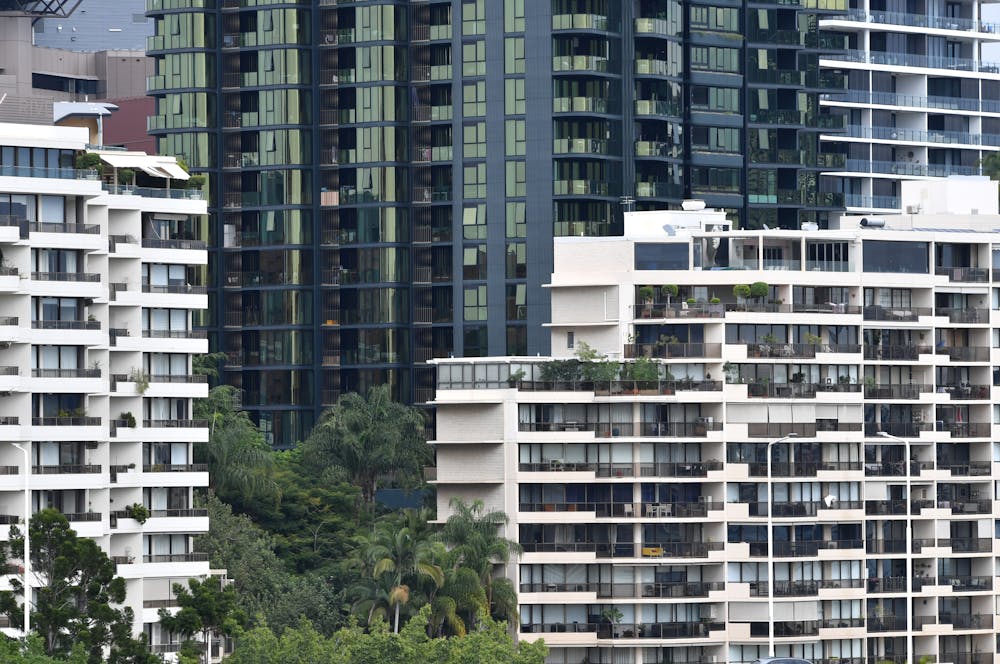 The trend towards apartment housing in Australian cities makes it harder for residents to use solar power.
Darren England/AAP
The trend towards apartment housing in Australian cities makes it harder for residents to use solar power.
Darren England/AAP
I recently worked with colleagues in Australia and overseas in a study of the user experience of PV. We found residents face a range of issues that limit emission reductions. These issues include:
- initial sizing and commissioning with component failures such as faulty inverters
- lack of knowledge about solar and expected generation performance
- regulatory barriers that limit the opportunity to upgrade system size.
Looking to improve regulations and codes and billion-dollar funds may be sensible ways to meet emission targets, but human empowerment is the secret weapon in improving energy performance and lowering emissions. Good low-carbon citizens will help create good low-carbon cities.
Read more: Cutting cities' emissions does have economic benefits – and these ultimately outweigh the costs
A set of clear guides on how to use a building is a good starting point. The low-carbon living knowledge hub provides these.
What will make every building count in lowering emissions is the behaviour of occupants, the commitment of owners to make their buildings low-carbon and building managers’ ability to become more adept at reducing building-related emissions.
Authors: Timothy O'Leary, Lecturer in Construction and Property, University of Melbourne
Read more http://theconversation.com/making-every-building-count-in-meeting-australias-emission-targets-126930

















