

Having problems with your kid's tantrums, bed-wetting or withdrawal? Here's when to get help
- Written by Jade Sheen, Associate Professor, School of Psychology, Deakin University
Remember anxiously waiting for your child to take their first steps or speak their first words? It’s exhilarating when they reach a new stage in their development.
Every child grows and develops differently. Some will change at a steady pace and amaze us each day with a new skill or word, whereas others appear slow to change before taking a huge developmental leap.
These differences make us all unique – but they also make it a challenge to know when the worry is justified and when to seek help.
Read more: What’s in a milestone? Understanding your child’s development
A new Australian government initiative may ease parents’ concerns by supporting GPs to better understand infant and childhood development and, particularly, the early signs of mental health concerns.
A range of infant and child behaviours cause parents concern including tantrums, bed-wetting and withdrawal. So, what’s normal and when should you see your GP or other health practitioner?
Tantrums
Tantrums are a typical part of development for most children, and may look like emotions and behaviour that are out of control, such as crying, yelling, pushing, kicking or slamming doors.
Read more: 'No, I don't wanna... wahhhh!' A parent's guide to managing tantrums
Tantrums are most common in toddlers but can still occur for some primary school age children. Children’s brains develop at a rapid pace from infancy, and at around three to four years of age they begin to develop skills to better manage or “self-regulate” their emotions and behaviour.
 Young children are still working out how to regulate their emotions.
Leon Rafael/Shutterstock
Young children are still working out how to regulate their emotions.
Leon Rafael/Shutterstock
Just like adults, when a child is going through a change (even if it’s an exciting one like the arrival of a new sibling or starting school) it becomes more difficult for them to self-regulate. This is when parents may notice an increase in tantrums or difficult behaviour.
When should you get help?
Parents might want to see their GP if their child has really long tantrums (more than 30 minutes), or has frequent tantrums (nearly every day for at least two weeks) that cause stress or distress in the child and/or those around them.
Bed-wetting
Bed-wetting is when children are able to use the toilet, and wet the bed at night without meaning to.
There is a wide window for the normal development of toileting skills. Timing depends on many factors including genetics, the child’s physical, emotional and cognitive development and readiness, and their environment.
Read more: Explainer: how do you stop children from wetting the bed?
When is bed-wetting a concern?
Bed-wetting is not considered to be of medical concern until six or seven years of age.
 There is a wide window of normal development for staying dry through the night.
Zdan Ivan/Shutterstock
There is a wide window of normal development for staying dry through the night.
Zdan Ivan/Shutterstock
However, parents should take note of changes in toileting, or any “regressions” – where children seem to lose skills or go backwards from whatever stage they’d previously reached.
Changes in toileting, including bed-wetting, can be a common response when children experience stress or change. Parents might want to see their GP if they are concerned about a change in their child’s usual toileting behaviour that lasts more than two weeks.
Withdrawal
Children vary a lot in terms of their natural level of social engagement. Some appear shy or are slow to warm up but in their own home or other familiar settings engage and communicate easily.
Withdrawal doesn’t refer to a shy child, but indicates a change in usual behaviour, or a persistent pattern where a child shows a lack of social interest and interaction, even in familiar settings.
Read more: Is my child being too clingy and how can I help?
Withdrawn children may avoid eye contact, talk less, and avoid social play and interaction with adults and children.
When to see your GP?
It can be difficult for parents to know the difference between their child’s normal nature and temperament, versus behaviour that may be of concern. Parents may want to see a GP if their child has never engaged well socially, such as avoiding eye contact, physical closeness, or avoiding social interactions.
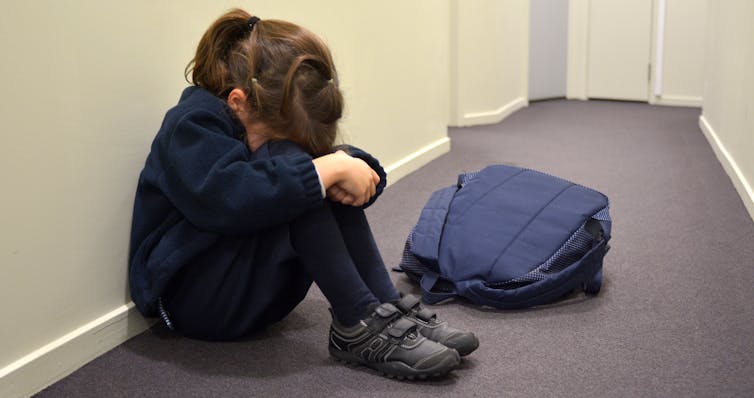 Some children withdraw by avoiding interaction with adults and other children.
Shutterstock/ChameleonsEye
Some children withdraw by avoiding interaction with adults and other children.
Shutterstock/ChameleonsEye
Parents may also want to see a GP if they notice a change in their child’s social interactions, where the child suddenly avoids social interactions in one or more settings (home, school or childcare) where they were previously engaged and interactive.
How to get help
Parenting can be incredibly stressful, overwhelming and all-consuming. If you haven’t been around many children before or are new to parenting, it can be difficult to know if your child’s behaviour is normal or not.
For these reasons, it’s so important to have good support networks in place, including a trusted family GP. See your GP or other medical professional if your child’s behaviour:
- is causing significant distress
- is unusual for them and/or
- has occurred almost every day for at least two weeks or less often for a couple of months.
Other services that can form part of your support network include your maternal and child health nurse, the Maternal and Child Health Line (Victoria, 13 22 29) or other parenting hotlines in your state or territory, and online resources such as the Raising Children Network.
To find other local health services such as psychology, you can access the National Health Services Directory.
Read more: Stressed about managing your child's behaviour? Here are four things every parent should know
Authors: Jade Sheen, Associate Professor, School of Psychology, Deakin University

















