

what actually works to protect us from bushfire smoke?
- Written by Lidia Morawska, Professor, Science and Engineering Faculty; Director, International Laboratory for Air Quality and Health (WHO CC for Air Quality and Health); Director - Australia, Australia – China Centre for Air Quality Science and Management (ACC-AQSM)
Bushfire smoke has now been blanketing parts of Australia for months. This week the air quality in Sydney reached new lows, reported to be 12 times hazardous levels in some parts of the city on Tuesday.
Beyond being stifling and unpleasant, people are experiencing irritated eyes and breathing difficulties.
Statistics emerging from hospital records show an increase in emergency hospital admissions for a range of diseases from asthma to heart disease and stroke.
We’ll only fully understand the longer term health effects in the weeks and months to come.
When the situation is as bad as it has been in Sydney over the past few days, people stop asking questions about whether air pollution has an impact on health; we know it has. The question on everybody’s mind now is: how can I protect myself and my family?
Read more: Now Australian cities are choking on smoke, will we finally talk about climate change?
Does staying indoors help?
Our natural instinct tells us if the conditions outside are bad, we should seek refuge inside. The indoor environment provides some protection against bushfire smoke and outdoor air pollution in general, but the degree of protection depends on the type of building and importantly, its ventilation.
Buildings such as shopping centres, most modern office buildings and hospitals are equipped with heating ventilation and air conditioning (HVAC) systems, which incorporate air filters.
The efficiency of these systems depends on the filter technology and the size of the filtered particles. Smaller particles are generally more difficult to catch and remove, but sophisticated technology can achieve this. It varies, but what we call HEPA (high efficiency particulate air) filters can remove close to 100% of airborne particles.
The particles we’re concerned about in bushfire smoke are ultrafine particles. So these are likely to be removed with HEPA filters, but could get through less sophisticated filters.
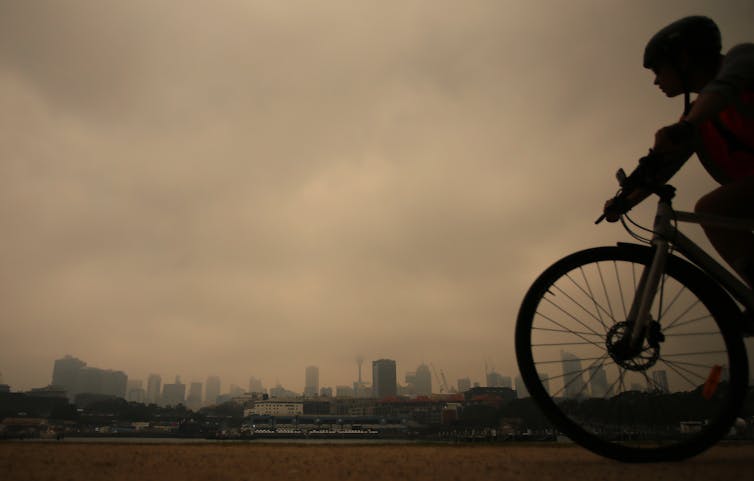 The smoke haze is a result of ongoing bushfires outside of Sydney.
Steven Saphore/AAP
The smoke haze is a result of ongoing bushfires outside of Sydney.
Steven Saphore/AAP
Residential homes and apartments are not commonly equipped with HVAC systems. Instead, they’re naturally ventilated, typically by opening the windows. So in residential houses, the indoor concentrations of pollutants are often close to the outdoor concentrations, particularly when the windows are open.
Even if the windows are closed, outdoor pollutants will penetrate indoors if the building is “leaky”, meaning there are cracks the air can get through. This is the case in many old buildings, particularly those built from timber.
Air purifiers
One option to improve the quality of indoor air is to use air purifiers. Air purifiers use a system of internal fans to pull the air through a series of filters that remove airborne particles. The air purifier then circulates the purified air back into the room.
But again, the protection offered by purifiers can range from low to very high. As with filtration systems, the level of protection depends on the type of purifier you have. Those equipped with HEPA filters are much more efficient.
Read more: How does poor air quality from bushfire smoke affect our health?
Their effectiveness also depends on the volume of air the purifier services, the setting (one room or several interconnected rooms), the ventilation rate (this is measured by how many times the whole volume of air is exchanged per hour) and how it is set to operate (continuous or intermittent).
To put this in context, operating a purifier equipped with a HEPA filter in a typical bedroom would significantly reduce the concentration of air pollution in the bedroom, most likely to a safe level. However, operating a less efficient purifier in a large, open plan house is not likely to help much.
Face masks
Many people consider face masks to be the best protection against air pollution. But for the most part, they merely provide a false sense of security.
Firstly, a mask is only effective if it’s properly fitted: if the fit is not perfect, most of the small particles, such as those present in the pollution plume from bushfires, will get through.
Secondly, the efficiency of the mask depends on the behaviour of the person wearing it. This includes how long you wear the mask for and how often you take it off. Considering wearing a mask is uncomfortable – particularly when it’s hot – it’s not easy to keep it on all the time.
Industrial style masks are more fitted than simple fabric masks, so can be more effective – but still depend on the wearer’s behaviour. These are not practical to wear all the time.
And if it’s questionable whether a mask will protect an adult, it’s even less likely to protect a small child. A child cannot be expected to tolerate the inconvenience and discomfort of correctly wearing a mask.
Read more: I've always wondered: why many people in Asian countries wear masks, and whether they work
In summary, indoors we are protected to some degree from outdoor air pollution, so consider staying inside where possible – particularly if you have an existing health condition.
You might like to wear a mask or invest in an air purifier. These may help to some degree, but are emergency measures that don’t in themselves represent a solution.
While the air quality is likely to improve in Sydney and other affected regions as these fires ease, our changing climate means we can only expect to be in this situation more and more. The only real way forward is to address the climate crisis urgently and decisively.
Authors: Lidia Morawska, Professor, Science and Engineering Faculty; Director, International Laboratory for Air Quality and Health (WHO CC for Air Quality and Health); Director - Australia, Australia – China Centre for Air Quality Science and Management (ACC-AQSM), Queensland University of Technology

















