

Right-swipes and red flags – how young people negotiate sex and safety on dating apps
- Written by Kath Albury, Professor of Media and Communication, Faculty of Health, Arts and Design, Swinburne University of Technology
Popular commentary on dating apps often associates their use with “risky” sex, harassment and poor mental health. But anyone who has used a dating app knows there’s much more to it than that.
Our new research shows dating apps can improve young people’s social connections, friendships and intimate relationships. But they can also be a source of frustration, rejection and exclusion.
Our study is the first to invite app users of diverse genders and sexualities to share their experiences of app use, safety and well-being. The project combined an online survey with interviews and creative workshops in urban and regional New South Wales with 18 to 35 year olds.
While dating apps were used to meet people for sex and long-term relationships, they were more commonly used to “relieve boredom” and for “chat”.
The most popular apps used were Tinder (among LGBTQ+ women, straight women and men), Grindr (LGBTQ+ men), OK Cupid (for non-binary participants), and Bumble (straight women).
 Dating apps are commonly used to relieve boredom and for chat.
Oleg Ivanov/Unsplash
Dating apps are commonly used to relieve boredom and for chat.
Oleg Ivanov/Unsplash
We found that while app users recognised the risks of dating apps, they also had a range of strategies to help them feel safer and manage their well-being – including negotiating consent and safe sex.
Safe sex and consent
The majority of survey participants frequently used condoms for safe sex. Over 90% of straight men and women frequently used condoms.
Just over one-third of gay, bisexual and queer men frequently used PreP (pre-exposure prophylaxis) to prevent HIV transmission.
Read more: Is Truvada (PrEP) the game-changer that will end new HIV transmissions in Australia?
Half (50.8%) of straight people said they never or rarely discussed safe sex with potential partners on dating/hook-up apps. Around 70% of LGBTQ+ participants had those conversations to some extent.
Amber (22, bisexual, female, regional) said she was “always the one that has to initiate a sex talk over messages”. She used chat to discuss what she liked, to assert her need for condom use, to give an account of her own sexual health, and to feel “safer”.
Some gay and bisexual men’s apps – such as Grindr and Scruff – allow for some negotiation around sexual health and sexual practices within the profile. Users can share HIV status, treatment regimes, and “date last tested”, as well as stating their preferred sexual activities.
Red flags
Many participants discussed their practices of reading a profile for “red flags”, or warning signs that their physical or emotional safety might be at risk. Red flags included lack of information, unclear photos, and profile text that indicated sexism, racism, and other undesirable qualities.
 Unclear photos can be a red flag on dating apps.
Daria Nepriakhina/Unsplash
Unclear photos can be a red flag on dating apps.
Daria Nepriakhina/Unsplash
Apps that require a mutual match before messaging (where both parties swipe right) were perceived to filter out a lot of unwanted interaction.
Many participants felt that red flags were more likely to appear in chat rather than in user profiles. These included pushiness and possessiveness, or messages and pictures that were too sexual, too soon.
Read more: Love, lust and digital dating: Men on the Bumble dating app aren't ready for the Queen bee
Charles (34, gay/queer, male, urban), for example, defined red flags as:
nude photos completely unsolicited or the first message that I get from you is just five pictures of your dick. I would think that’s a straight up signal that you’re not going to respect my boundaries […] So I’m not going to have an opportunity to say no to you if we meet in real life.
Negotiating consent
Consent emerged as a key concern across all areas of the study. Participants generally felt safer when they were able to explicitly negotiate the kinds of sexual contact they wanted – or didn’t want – with a prospective partner.
Read more: Yes means yes: moving to a different model of consent for sexual interactions
Of 382 survey participants, female respondents (of all sexualities) were 3.6 times more likely to want to see app-based information about sexual consent than male participants.
Amber, 22, recommended negotiating consent and safe sex via chat:
It’s a fun conversation. It doesn’t have to be sexting, it doesn’t have to be super sexy […] I just wish it was easier just to discuss sex in a non-sexual way. Most of the girls that are my friends, they’re like, “it’s way too awkward, I don’t talk about sex with a guy”, not even when they’re having sex.
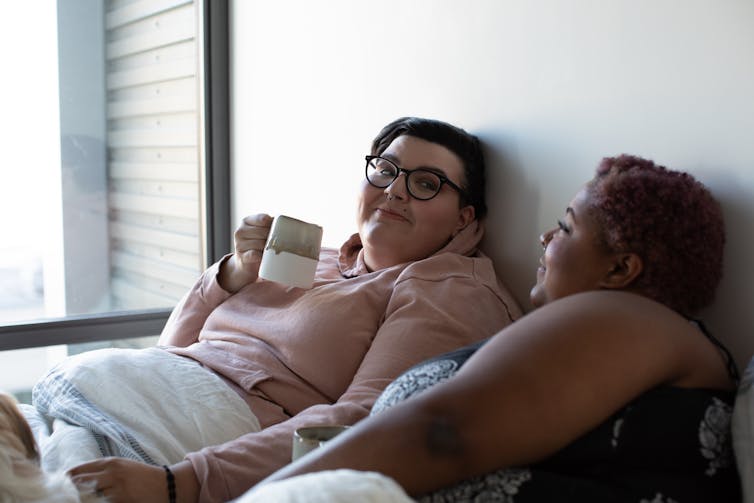 App users feel safer when they’re explicitly able to negotiate what they want and don’t want.
Unsplash/AllGo - An App For Plus Size People
App users feel safer when they’re explicitly able to negotiate what they want and don’t want.
Unsplash/AllGo - An App For Plus Size People
However, others worried that sexual negotiations in chat, for example on the topic of STIs, could “ruin the moment” or foreclose consent options, ruling out the possibility that they might change their mind.
Chelsea (19, bisexual, female, regional) noted:
Am I going, “okay so at 12 o'clock we’re going to do this” and then what if I don’t want to?
Safety precautions
When it came to meeting up, women, non-binary people and men who had sex with men described safety strategies that involved sharing their location with friends.
Ruby (29, bisexual, female, urban) had an online group chat with friends where they would share details of who they were meeting with, and others described telling female family members where they planned to be.
Anna (29, lesbian, female, regional) described an arrangement she had with her friends for getting out of bad dates:
If at any point I send them a message about sport, they know that shit is going down […] So if I send them a message like, “How is the football going?” they know to call me.
While all participants described “ideal” safety precautions, they did not always follow them. Rachel (20, straight, female, regional) installed an app for telling friends when you expect to be home, but then deleted it.
Amber said:
I tell my friends to only meet up in public even though I don’t follow that rule.
Managing disappointment
For many participants, dating apps provided a space for pleasure, play, connecting with community or meeting new people. For others, app use could be stressful or frustrating.
Rebecca (23, lesbian, female, regional) noted that apps:
definitely can send someone into a deep depression as well as an ego boost. If you’ve been on the app and had little to no matches or no success, you begin to question yourself.
Henry (24, straight male, urban) felt that many straight men experienced apps as a space of “scarcity” in contrast to “an abundance of choice” for women.
 Dating apps can be stressful and frustrating.
Kari Shea/Unsplash
Dating apps can be stressful and frustrating.
Kari Shea/Unsplash
Regina (35, straight, female, regional) suggested that app users who felt unsuccessful were likely to keep this to themselves, further increasing feelings of isolation:
I think when people are having a hard time with the apps they are quite private about it. They’ll only share with friends who they know are regular or current users and might disclose their use – even bordering on addiction to swiping – in a sensitive moment.
Read more: Dating apps make men unhappy and provide a platform for racism
Participants shared a range of personal strategies for managing the distress associated with app use including taking time out, deleting apps, turning off “push” notifications and limiting time spent on apps.
While most participants welcomed more attention to apps among health professionals and public health agencies, they cautioned them against defining apps as “risky” spaces for sex and relationships.
As Jolene (27, queer, female, urban) said:
app dating is just part of regular dating life and therefore health promotion should fully integrate it into their campaigns, rather than it be something niche or different.
Authors: Kath Albury, Professor of Media and Communication, Faculty of Health, Arts and Design, Swinburne University of Technology

















