

the 150-year-old feud over glacial retreat
- Written by Ciaran Doolin, PhD candidate, School of Science in Society, Te Herenga Waka — Victoria University of Wellington
Climate change may seem a uniquely 21st-century concern, but people have been wrestling with the idea for a long time.
My new research sheds light on the heated debate among New Zealand scientists during the 1860s and 1870s over the possibility of ancient climate change, prompted by geological signs that glaciers in the Southern Alps had once been much larger.
During the 19th century, a controversy roiled European geology over what had occurred during the most recent geological period, known as the Quaternary, which spans the past 2.6 million years.
Puzzling phenomena included scratched or polished bedrock and large angular boulders displaced great distances from their sources. In 1840, Swiss scientist Louis Agassiz hypothesised there had been a drop in global temperature, resulting in vast glaciers and ice sheets. He called this the Eiszeit (ice age).
Although Agassiz’s theory is close to the modern scientific view, it was several decades before his hypothesis was widely accepted.
At the time, Scottish geologist Charles Lyell’s “uniformitarian” school of geology dominated. According to Lyell’s method, only “actual” processes observable in the present were to be used to account for past change.
Vast ice sheets and a severe cold period were initially viewed as implausible in light of present-day observations.
But by the early 1860s, New Zealand’s first professional geologist Julius von Haast was conducting pioneering surveys of the Southern Alps, revealing signs in the landscape left by vast ancient glaciers.
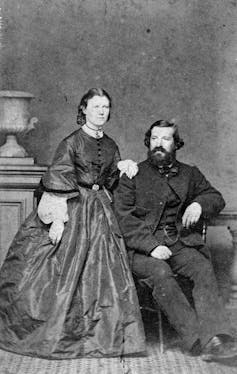
The idea of past glaciation was uncontroversial to Haast’s peers in New Zealand. The question of what brought it about, however, proved much thornier. Complicating the scientific debate were the intense rivalries and jealousies of New Zealand science at that time.
In an 1864 report, Haast argued the ice age had been caused by uplift of the South Island. Vast glaciers had formed as the Alps rose above the snowline, with the moving ice masses scratching and polishing the hard rock, excavating deep valleys and lakes, and leaving behind a trail of debris.
Although Haast emphasised uplift as the cause of the ice age, he did not explicitly rule out a colder climate. He suggested New Zealand had been a “desolate” country during the ice age, with the landscape resembling polar or Tibetan glacial regions.
This ambiguity was a major sticking point for some of Haast’s critics.

James Hector, a dominant figure in 19th-century science in New Zealand who controlled practically all state scientific activity, had similar views to Haast, but argued the remains of the past fauna afforded no evidence of a colder climate.
Frederick Hutton, another early New Zealand geologist, broadly concurred with Haast and Hector, but showed that an elevation of the Alps sufficient to bring about the past glaciation was equivalent to a lowering of temperature by about 5.5°C.
Based on fossil evidence, Hutton argued that if such a cooling had occurred, a host of still-living species would have gone extinct. This ruled out past climate change in his mind.
The lawyer, politician, amateur scientist and noted “character” William Travers wrote several bitterly polemical articles on Haast’s theories, arguing that if the country had gone through a much colder period in the past, this would have led to a complete extinction of all life in New Zealand.
Despite the sometimes heated disagreement between these scientists, they settled on the ice age having been brought about by uplift not climate change.
Scientists today recognise major, frequent climatic oscillations as a defining characteristic of the Quaternary. These changes are understood to be primarily driven by variations in Earth’s orbit, the so-called Milankovitch cycles.
Considering today’s knowledge, or even what was known to late 19th-century European geologists, the ruling out of a colder past climate as a cause of the New Zealand ice age seems a significant error.
Haast, Hector, Travers and Hutton’s resistance to the idea stemmed primarily, I think, from their commitment to Lyell’s uniformitarianism. Working in the “Shaky Isles”, they felt they had the actual causes (uplift from tectonic activity) they needed to explain the evidence. It was not necessary to posit climatic change.
Today, glaciers are in retreat across the world due to a warming climate. In New Zealand, glaciers have lost nearly a third of their mass over the past quarter century.
This is not a mere scientific curiosity. Glaciers, together with the ice sheets of Greenland and Antarctica, store nearly three quarters of Earth’s freshwater reserves. With glaciers in many regions not expected to survive the 21st century, the livelihoods of millions of people downstream are under threat.
In the modern science of climate change, teasing out natural variability – as Haast, Hector, Hutton and Travers were attempting to do 150 years ago – from human-induced change is critical to delivering reliable future projections.
As we navigate the uncharted territory of a warming world caused by human activity, we should not forget the pioneers of New Zealand climate science.
Authors: Ciaran Doolin, PhD candidate, School of Science in Society, Te Herenga Waka — Victoria University of Wellington

















