

New coral bleaching outbreak in NT a worrying sign of our warming oceans
- Written by: Selina Ward, Lecturer, School of Biological Sciences, The University of Queensland
An outbreak of coral bleaching has been reported over the summer in Gang Gurak Barlu National Park on the Cobourg Peninsula, 60km northeast of Darwin, homeland of several clans of the Iwaidja-speaking Aboriginal people of Western Arnhem Land.
As no formal monitoring or assessment program is in place for these reefs, it’s impossible to gauge the full severity and extent of the bleaching. However, this video from Black Point on the Cobourg Peninsula contrasts the healthy reef in 2015 and the bleached reef in 2018.
Footage courtesy Alan Withers, music from Kai Engel – Anxiety.The Northern Territory has unique marine ecosystems which are largely untouched and sit in waters receiving flow from untamed rivers. There are extensive coral reefs with abundant breeding turtle populations, saltwater crocodiles and sharks.
In January this year, the water temperature between the Northern Territory and Papua New Guinea reached what the National Oceanic and Atmospheric Administration (NOAA) calls Alert Level 2 – its highest alert for the risk of bleaching and subsequent coral death.
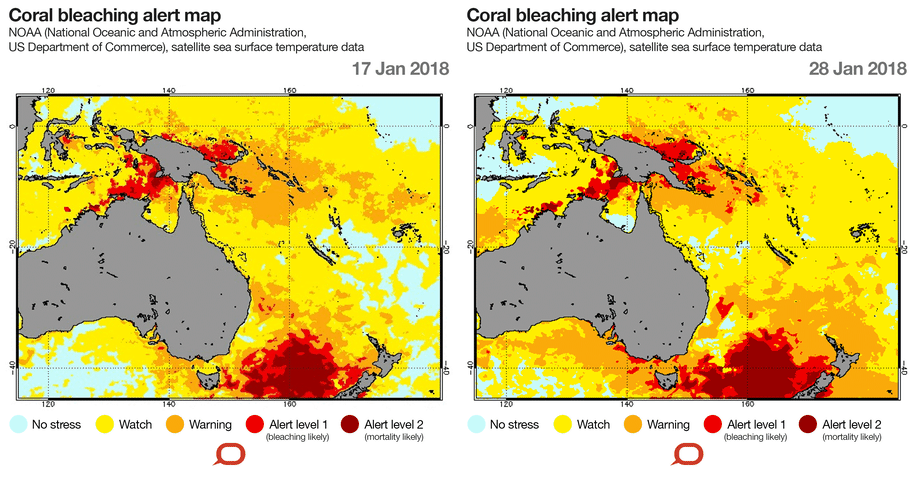
This is an indication of the duration and intensity of a warming event, measured in “degree heating weeks” – the number of degrees above the average summer maximum temperature, multiplied by the number of weeks. Alert Level 2 indicates at least eight degree heating weeks.
This is not the first time coral bleaching has been seen in the NT. Severe bleaching was recorded in seas off Arnhem Land during the global bleaching event in 2015-16.
Increases in sea surface temperature cause mass bleaching events. The bleached corals have lost most of the single-celled algae, called zooxanthellae, that live and photosynthesise inside the coral cells and provide the corals with most of their energy.
The Great Barrier Reef also suffered severe bleaching in 2016. This resulted in 67% mortality in its northern sections, dwarfing the effects of previous bleaching events in 1998 and 2002.
Read more: How much coral has died in the Great Barrier Reef's worst bleaching event?
Bleaching patterns tell a story
The bleaching patterns of these three events were tightly correlated with degree heating weeks within geographic areas, with the 1998 and 2002 events having prominent effects in the southern areas.
In 2016 the highest degree heating weeks were recorded on the northern stretches of the Great Barrier Reef, where the most severe bleaching occurred. Southern areas experienced temperatures close to average, partly due to cooler water from Cyclone Winston.
In 2017 the Great Barrier Reef experienced another bleaching event that affected northern and central areas. This event was particularly disturbing, as it followed 2016 and, unlike 1998, 2002 and 2016, it was not an El Niño year.
It is vital that reefs have time to recover between bleaching events if they are to avoid becoming degraded. For corals that survive being bleached, full recovery takes time. Reproductive output can be reduced for extended periods, resulting in less successful recruitment.
This, often combined with the increased competition from algae and soft corals, means that replacement of corals that do not survive bleaching events can be slow. Even fast-growing corals require 10-15 years to return to their prebleaching size.
Read more: Will the Great Barrier Reef recover from its worst-ever bleaching?
Recent analysis has shown that the intervals between bleaching events across the globe have decreased substantially since the 1980s. The median period between bleaching events is now six years. One reason for this is that temperatures in La Niña conditions (when we expect lower temperatures) are now higher than those of El Niño conditions in the 1980s.
This is further evidence that if we continue on our current path of rapidly increasing emissions, it is increasingly likely that bleaching events will occur annually later this century, as predicted by coral scientists last century.
Resilience of reefs
The 2016 bleaching event demonstrated that areas with good water quality and controlled fishing were not protected from bleaching during this temperature anomaly. However, local conditions can be vitally important for recovery in previously bleached areas and to maintain healthy populations prior to bleaching events.
Unfortunately, climate change is not only causing higher temperatures but also increased intensity of storm and cyclone damage, sea level rise and ocean acidification. So we need resilient reefs to cope with these additional challenges.
We can increase the resilience of reefs by improving water quality. We can do this by reducing sediment and nitrogen and phosphorus input and other toxins such as coal dust, herbicides and pesticides, alongside regulating fishing pressure and protecting as many areas as possible.
New management approaches urgently needed
The beautiful reefs of the Northern Territory and the Great Barrier Reef need to be protected. If we wish to enjoy Australia’s reefs in future decades, it is vital that we change our management priorities.
State and federal governments need to give these areas the priority they deserve through marine parks and ranger programs, and regulation of potentially harmful activities. Water quality needs to be funded in a serious manner. Industrial developments, such as port expansions, need to be evaluated with protection of reefs as a primary concern.
Reducing emissions dramatically is crucial to slowing all the climate change effects on reefs. Australia can lead by example by rapidly moving away from fossil fuels and opening no new coal mines.
Authors: Selina Ward, Lecturer, School of Biological Sciences, The University of Queensland


















