

Modern Australian
The Times

Most people with disabling mental health conditions can’t access the NDIS. Here’s a better way to provide support

  • Written by Sam Bennett, Disability Program Director, Grattan Institute

The pathway to reforming the National Disability Insurance Scheme (NDIS) is littered with obstacles.

Among the biggest challenges is the federal and state governments agreeing on responsibility and funding for “foundational supports”. These are disability-specific services for people who don’t qualify for individual NDIS funding.

There has been some progress on foundational supports for children with developmental delay and autism. The federal government’s Thriving Kids initiative is due to begin mid-2026.

But there has been no progress on non-NDIS foundational supports for people with “psychosocial disability”. This is disability that can result from mental health conditions such as schizophrenia, major depression or post-traumatic stress disorder, affecting the person’s ability to function.

Our new Grattan Institute report shows how Australia can build a national system of psychosocial supports within five years without spending any more money. This will require a clear vision, smart design choices and strong commitment from all governments.

What does psychosocial support look like?

Psychosocial supports are non-clinical supports that help people with mental health challenges live meaningful, independent lives in the community.

They include programs that help people to build social connections, learn skills, or maintain stable housing.

The personal, social and economic costs of not getting this support are significant – including reduced quality of life, fewer opportunities for community participation and lost productivity.

What’s the problem?

Almost 223,000 Australians aged 25–64 had a significant psychosocial disability in 2023.

Of those, almost 58,000 received psychosocial supports from the NDIS, with the scheme providing more than A$5.8 billion to support this group in the past year.

However a majority of people with significant psychosocial disability are below the NDIS eligibility threshold. And around 130,000 adults receive no support.
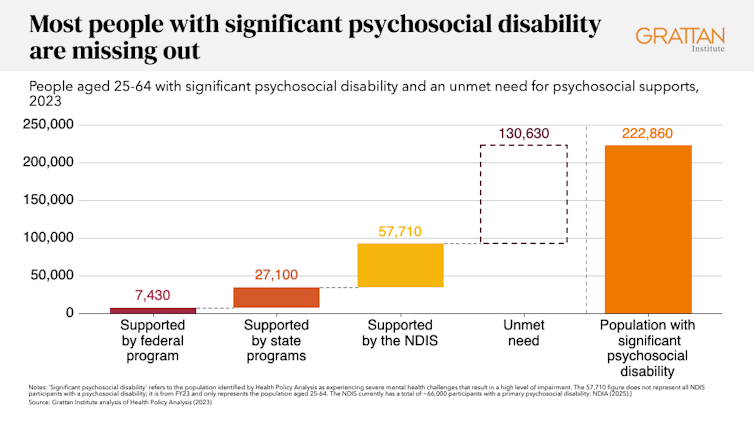
Graph showing most people with significant psychosocial disability miss out on support.
Almost 60% of adults with significant psychosocial disability have unmet needs. Grattan Institute

Access to non-NDIS supports is patchy

Federal, state and territory governments all fund small psychosocial support programs through their mental health systems. These are outside the NDIS.

Coverage is insufficient in all states and territories. The extent of support available depends far more on where you live than on your level of need.

Our analysis shows this variation is dramatic. There is a seven-fold difference in the proportion of people who receive psychosocial support outside the NDIS between Queensland (the highest) and Tasmania (the lowest).

There are also huge differences in the intensity of services offered. Queensland, for example, provides small amounts of support to relatively high numbers. In New South Wales, services reach very few people but provide more than ten times the number of hours per person.
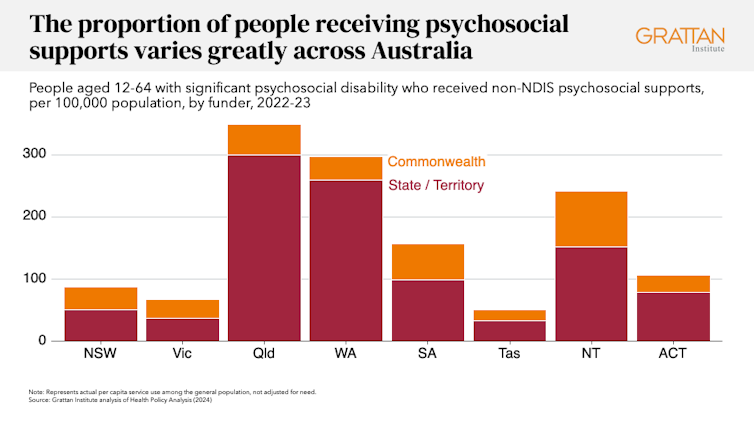
Most people with disabling mental health conditions can’t access the NDIS. Here’s a better way to provide support
A plan for more widespread support Our new report proposes a new national program of psychosocial supports, which reflects evidence of what we know works. Examples of evidence-based services include: How would the program work? Our proposal is simple: fund a tier of psychosocial supports for people outside the NDIS. Primary Health Networks (PHNs) are 31 health organisations across Australia that plan services to meet the needs of their local communities. They should be tasked with commissioning psychosocial supports, in collaboration with local providers, non-government organisations, state local hospital networks, and consumer and carer organisations. Rather than perpetuating a postcode lottery, where access to psychosocial supports depends on where you live, a PHN-led approach could provide a clearer pathway to national consistency and equity. A continuum of supports This program would not replace the NDIS, which has an important ongoing role supporting people with the most intensive support needs. A key feature of a more flexible and integrated system should also be the ability for people to “step down” from the NDIS to lower-intensity psychosocial supports outside the scheme – and to step back up again if their needs increase again. We propose the use of “zero-dollar plans”, where a person is still in the NDIS system but doesn’t receive any funding. This would enable NDIS supports to be paused without affecting a person’s ongoing NDIS eligibility status. They could resume supports at a later stage without the need to reapply. Why it doesn’t have to cost more Previously we’ve shown the problem isn’t a lack of enough money in the system, it’s how it’s distributed. Governments can fund a new program of psychosocial supports using the existing NDIS funding pool, which both the federal government and state/territory governments contribute to, rather than needing to spend more money. Delivering these supports through the NDIS budget would ensure stable funding, provide a more equitable distribution of resources, and give all governments a stake in building a more balanced system. Read more: How to reform the NDIS and better support disabled people who don't qualify for it In order to do this, governments would need to carefully redirect a small proportion of funding from NDIS supports that lack an evidence base towards the new program. Success would reduce pressure on the NDIS: if psychosocial supports outside the NDIS help people live well, they could prevent, reduce or delay the need for an individualised package in future. Governments should pivot from the current plan. This aims for federal and state/territory governments to commit to new funding for foundational supports, including psychosocial supports. Requiring new funding has led to two years of unnecessary delay. A more practical approach is to spend existing NDIS funding better to meet the needs of more Australians with significant psychosocial disability.

Authors: Sam Bennett, Disability Program Director, Grattan Institute

Read more https://theconversation.com/most-people-with-disabling-mental-health-conditions-cant-access-the-ndis-heres-a-better-way-to-provide-support-270957

Road Signs: Understanding Their Role in Clear and Effective Signage

Effective signage and display hardware can help businesses communicate information, promote products and organise customer or visitor movement. Road...

Bottle Label Printing: Key Factors to Consider Before Your Next Packaging Run

Effective packaging begins with understanding the product, bottle material, artwork and production requirements when planning bottle label printing. H...

Planning a Long-Distance Move With Interstate Movers Melbourne

Moving between states involves more planning than a typical local relocation. Along with packing and transporting household belongings, you need to...

Understanding the Role of an I/O Controller in Industrial Automation

Modern industrial systems depend on accurate communication between sensors, machines and control systems. An I/O controller can help manage this commu...

How the Right Mining Hose Supports Demanding Operations

Mining environments place considerable demands on equipment used for material transfer, water management and processing. Hoses operating in these co...

Simple Ideas for Making Social Gatherings More Memorable

We have all been to those parties where everyone just stands around the kitchen island, staring at their phones, waiting for someone else to make a mo...

Outdoor Wall Lights: Improving Exterior Lighting Around Your Home

Lighting can influence how a room looks, feels and functions, so the right fitting should be selected according to both appearance and practical req...

Commercial Office Cleaning: Combining Routine Office Cleaning With Melbourne Service

Keeping a workplace clean requires a service that can accommodate everyday tasks as well as the particular needs of the business. Professional comme...

Caravan Sales in Queensland: How to Find the Right Caravan for Sale QLD

Caravan ownership is about more than having somewhere to sleep while travelling. For many Queenslanders, it is one of the best ways to explore regio...

What Sir Walter Buffalo Turf Actually Costs in 2026 (And Why Quotes Vary So Much)

Two quotes landed on a Hills District homeowner's kitchen table last spring for the exact same 80-square-metre backyard. One said $12 a metre. The o...

Nearly 1,300 NSW Hospital Beds Are Occupied By People Who Are Ready To Go Home

1,276 people in NSW hospitals have been medically cleared for discharge but remain in hospital because they're still waiting for NDIS or aged care sup...

National Survey Launched to Measure Operational Impacts of Federal NDIS Policy Reforms

The effects of recent NDIS reforms are beginning to move beyond policy papers and into day to day service delivery. A new national survey is asking ...

Beyond the Nappy Cake: Baby Shower Gifts That Get Used

What new Australian parents unwrap, keep, and quietly thank you for months later. Six weeks after my daughter was born, I did an audit of the baby sh...

Parent-Advocates Are Reshaping Frontline Disability Service Delivery

Parents have always been part of the disability sector. They advocate, coordinate services, challenge decisions and often become the person holding ev...

Vista Cruises Enters "Two-Flagship Era" as Vista Aurora Completes Inaugural Voyage

Vista Aurora Sets Sail along the Yangtze. (Photo courtesy of the company)YICHANG, China — August 5, 2026 — Vista Aurora, a high-end interprovinc...

A Digital Preparation Checklist For International Medical Conferences

An international medical conference compresses many responsibilities into a few days. A delegate may need to present research, move between venues, ...

The Growing Popularity of Lab Grown Diamonds in Sydney and Hong Kong

The diamond industry has changed significantly in recent years as more buyers seek ethical, affordable, and sustainable alternatives to mined diamon...

Modern AI SEO Agency vs Traditional SEO: What’s the Difference

Search engine optimisation has changed dramatically over the past few years. Search engines have become smarter, user behaviour has evolved, and bus...
















