

Iran vows revenge for Soleimani's killing, but here's why it won't seek direct confrontation with the US
- Written by Shahram Akbarzadeh, Professor of Middle East & Central Asian Politics, Deputy Director (International), Alfred Deakin Research Institute for Citizenship and Globalisation, Deakin University
US President Donald Trump has not held back on threatening Iran after the targeted killing of General Qassem Soleimani, a veteran of the Iran-Iraq war in the 1980s and a key player in expanding Iran’s links with armed groups across Iraq, Syria and Lebanon.
In addition to extreme sanctions, Trump’s latest threat includes hitting 52 military and cultural targets in Iran. As might be expected, the Iranian leadership has doubled down on its anti-US rhetoric and promises of retribution. Soleimani was too important to the regime to let this slide.
As the commander of the Quds Force in the Islamic Revolutionary Guards Corps (IRGC), Soleimani was in direct contact with Hezbollah in Lebanon. He mobilised the militant group to defend Syrian leader Bashar al-Assad against US-backed rebels and armed Islamist groups. Soleimani also visited Moscow in 2016 to make a case for, and coordinate, Russia’s military involvement in Syria.
Read more: How likely is conflict between the US and Iran?
Soleimani made frequent trips to Iraq to bolster the Kurdish and later the Shia militia push-backs against the Islamic State. The recapture of Mosul from the Islamic State in 2016 by the US-backed Iraqi army and the Shia Popular Mobilization Units (PMU) was greeted in Iran with joy.
Soleimani was celebrated as a national hero. The Iranian regime praised him for serving the national security doctrine of offensive defence: defeating ISIS beyond Iran’s borders.
Direct military confrontation is unlikely
It makes sense, then, that the Iranian regime feels compelled to respond to Soleimani’s assassination. Iran cannot afford to let its national hero be slain without retribution. When Soleimani’s daughter asked President Hassan Rouhani, “Who will avenge my father’s blood?”, his response was swift: “We will all take revenge”.
But what can Iran do? The Iranian leadership has been woefully aware of its limitations in case of any direct confrontation with the United States. Iran’s armed forces, including the zealot IRGC, are no match for US firepower. Direct military confrontation will amount to suicide, and the Iranian leadership is in no hurry to act crazy, no matter how deeply hurt it may feel.
This fits the pattern of the cat-and-mouse game the IRGC has been playing with the US navy in the Persian Gulf to disrupt oil shipments without raising the stakes too high. Iran threatened on many occasions to block the Strait of Hormuz and seriously hurt the global economy, but never carried through as it could have prompted a military retaliation from the US.
Iran, likewise, had a calibrated response to the re-imposition of crippling US sanctions following Trump’s withdrawal from the 2015 nuclear deal: a combination of harsh rhetoric and mild action. Tehran sought to look tough but not too threatening to invite a US reprisal.
Read more: Infographic: what is the conflict between the US and Iran about and how is Australia now involved?
But the targeted killing of a celebrated Iranian commander is a game changer, meaning the Iranian response will likely be stronger.
Given the perils of direct confrontation for the Iranian regime, the most likely recourse may be a mobilisation of Iran’s proxy affiliations to exact revenge on the United States, most likely in Iraq.
In fact, Iran does not really need to instruct Shia militia in Iraq to hurt the United States. The Popular Mobilization Units (PMU) also lost its second-in-command (Abu Mahdi al-Muhandis) in the same drone attack that killed Soleimani.
Rocket attacks in recent days on the Green Zone in Baghdad are likely to be just the prelude to a major PMU action against US assets in Iraq.
The turning tide against the US military presence, evident in the Iraqi parliament’s resolution to expel foreign forces, could embolden PMU to step up its operations even further. This would be disastrous for the war-ravaged country, and there is no guarantee that Iran would not be embroiled in the conflict.
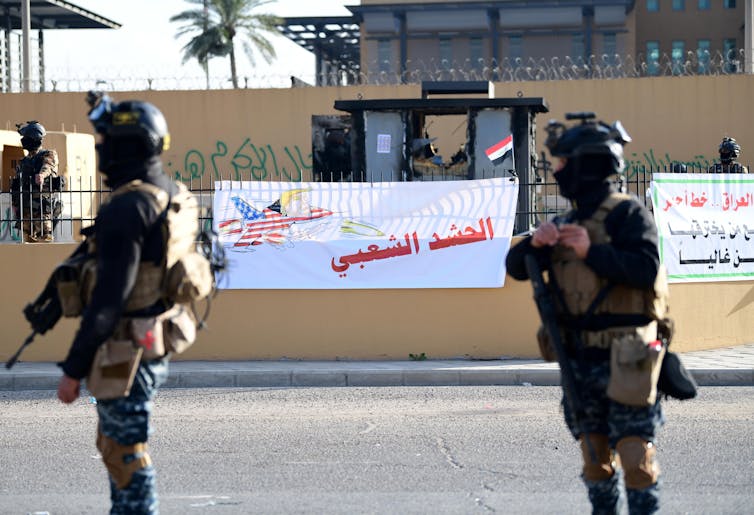 Pro-Iranian demonstrators targeted the US embassy in Iraq after American airstrikes against an Iran-backed militia late last month.
Murtaja Lateef/EPA
Pro-Iranian demonstrators targeted the US embassy in Iraq after American airstrikes against an Iran-backed militia late last month.
Murtaja Lateef/EPA
Diplomatic responses also have limited appeal
Beyond the military options, Iran also has two immediate diplomatic options. The first is to completely revoke the nuclear deal and resume its nuclear program.
With the US withdrawal from the deal in 2018 – and the Trump administration’s subsequent imposition of a “maximum pressure” strategy on Tehran – Iran already has no incentive to observe its commitments.
And Iran was edging away from the deal even before the latest escalation of tensions. After Soleimani’s assassination, Rouhani said Iran will recommence uranium enrichment and stockpiles, measures that the nuclear deal was designed to seriously limit and monitor.
The Iranian leadership claims it is still in compliance with the general rules set by the International Atomic Energy Agency to govern nuclear activity for civilian use. This move is designed to drive a wedge between the United States and its European allies. By addressing European leaders directly, Rouhani reiterated that Iran would be prepared to return to the deal, but only if Europe, Russia and China could offer a way around US sanctions. This scenario looks extremely unlikely.
Read more: Iran's leader is losing his grasp on power. Does this mean diplomacy is doomed?
Second, Iran could take its case to the United Nations and seek justice through international law.
In the wake of the Soleimani killing, the Iranian ambassador to the UN lambasted the United States for “an illegitimate action” and “an act of aggression”.
This move could resonate with the majority opinion in the United Nations, as well as many US lawmakers and international law experts, who have questioned Trump’s justification for assassinating Soleimani to prevent an imminent threat against the United States.
But going through the UN would be a lengthy and ineffective process as the United States has made a habit of dismissing or ignoring UN resolutions it does not like.
In addition, it is difficult to imagine that any non-military option would be enough to satisfy Iran’s impulse for revenge.
Authors: Shahram Akbarzadeh, Professor of Middle East & Central Asian Politics, Deputy Director (International), Alfred Deakin Research Institute for Citizenship and Globalisation, Deakin University

















