

Bushfires threaten drinking water safety. The consequences could last for decades
- Written by Stuart Khan, Professor of Civil & Environmental Engineering, UNSW
Bushfires pose serious short- and long-term impacts to public drinking water quality. They can damage water supply infrastructure and water catchments, impeding the treatment processes that normally make our water safe to drink.
Several areas in New South Wales and Victoria have already been issued with warnings about the quality of their drinking water.
Here’s what we know about the short- and long-term risks.
Read more: How to monitor the bushfires raging across Australia
Short-term risks
Bushfires can damage or disrupt water supply infrastructure as they burn. And the risks can persist after the fires are out.
A loss of power, for example, disables important water treatment processes such as chlorine disinfection, needed to kill microorganisms and make our water safe to drink.
Drinking water for the towns of Eden and Boydtown on the NSW south coast has been affected in this way over recent days. Residents have been advised to boil their water before drinking it and using it for cooking, teeth brushing, and so on.
Other towns including Cobargo and Bermagui received similar warnings on New Year’s Eve.
Read more: Disaster recovery from Australia's fires will be a marathon, not a sprint
In some cases, untreated water, straight from a river supply, may be fed directly into drinking water systems. Water treatment plants are bypassed completely, due to damage, power loss, or an inability to keep pace with high volumes of water required for firefighting.
We’ve seen this in a number of southern NSW towns this week including Batlow, Adelong, Tumbarumba, and the southern region of Eurobodalla Council, stretching from Moruya to Tilba. Residents of these areas have also been urged to boil their drinking water.
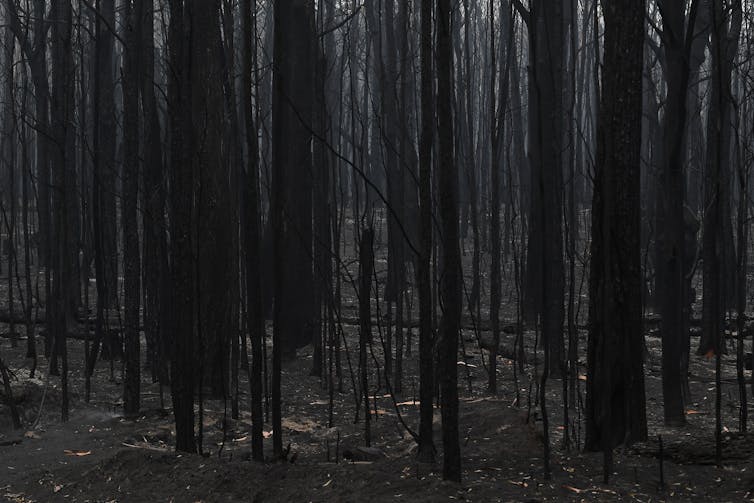 The ash left by a bushfire can contaminate the water supply.
Dean Lewins/AAP
The ash left by a bushfire can contaminate the water supply.
Dean Lewins/AAP
Untreated river water, or river water which has not been properly disinfected with chlorine, is usually not safe for drinking in Australia. Various types of bacteria, as well as the parasites giardia and cryptosporidium, could be in such water.
Animals including cattle, birds and kangaroos can excrete these microorganisms into river water. Septic tanks and sewage treatment plants may also discharge effluents into waterways, adding harmful microorganisms.
Human infection with these microorganisms can cause a range of illnesses, including gastrointestinal diseases with symptoms of diarrhoea and vomiting.
Read more: What are parasites and how do they make us sick?
Long-term risks
Bushfires can damage drinking water catchments, which can lead to longer term threats to drinking water. Drinking water catchments are typically forested areas, and so are vulnerable to bushfire damage.
Severe impacts to waterways may not occur until after intense rainfall. Heavy rain can wash ash and eroded soil from the fires into waterways, affecting drinking water supplies downstream.
For example, bushfire ash contains nutrients, such as nitrogen and phosphorous. Increased nutrient concentrations can stimulate the growth of cyanobacteria, commonly known as “blue-green algae”.
Cyanobacteria produce chemicals which may cause a range of water quality problems, including poor taste and odour. Some cyanobacteria can produce toxic chemicals, requiring very careful management to protect treated drinking water.
 Boiling water will kill microorganisms, but not chemical substances.
From shutterstock.com
Boiling water will kill microorganisms, but not chemical substances.
From shutterstock.com
Many water treatment plants include filtration processes to filter small suspended particles from the water. But an increase in suspended particles, like that which we see after bushfires, would challenge most filtration plants. The suspended particles would be removed, but they would clog the filters, requiring them to be more frequently pulled from normal operation and cleaned.
This cleaning, or backwashing, is a normal part of the treatment process. But if more time must be spent backwashing, that’s less time the filters are working to produce drinking water. And if the rate of drinking water filtration is slowed and fails to keep pace with demand, authorities may place limitations on water use.
Read more: The bushfires are horrendous, but expect cyclones, floods and heatwaves too
Boiling water isn’t always enough
In order to reduce the risk of gastrointestinal and other illnesses, water suppliers and health departments may issue a boil water alert, as we’ve seen in the past week. Bringing water to a “rolling boil” can reliably kill most of the microorganisms of concern.
In cases where water may be contaminated with chemical substances rather than microorganisms, boiling is usually not effective. So where there’s a risk of chemical contamination, public health messages are usually “do not drink tap water”. This means bottled water only.
Such “do not drink” alerts were issued this week following bushfire impacts to water treatment plants supplying the Victorian towns of Buchan and Omeo.
Read more: How does poor air quality from bushfire smoke affect our health?
Impacts to catchments from bushfires and subsequent erosion can have long-lasting effects, potentially worsening untreated drinking water quality for many years, even decades.
Following these bushfires, many water treatment plant operators and catchment managers will need to adapt to changed conditions and brace for more extreme weather events in the future.
Authors: Stuart Khan, Professor of Civil & Environmental Engineering, UNSW

















