

Heat kills. We need consistency in the way we measure these deaths
- Written by Thomas Longden, Research Fellow, Australian National University
One of the most confronting impacts of climate change is the risk of more deaths from hot weather. Heat stress can exacerbate existing health conditions including diabetes, kidney disease and heart disease. Older people are particularly vulnerable.
It may then surprise you to learn a few recent studies have suggested climate change will decrease temperature-related deaths in Australia. And a related study published in The Lancet found the cold kills more people in Sydney, Melbourne and Brisbane than the heat.
But my research, published in Climatic Change, disputes these results.
Using a similar methodology as that used in the study published in The Lancet, I found the majority of deaths related to temperature in Australia are caused by heat.
As temperature-related deaths are one of the main measures we use to assess the effects of climate change, it’s important we measure them accurately and consistently.
Read more: Hot and bothered: heat affects all of us, but older people face the highest health risks
How do researchers measure temperature-related deaths?
An important part of the process is estimating the proportion of deaths that occurred during cold weather and hot weather.
To determine this many studies use a reference (or baseline) temperature. This reference temperature should be a day where people in a region feel comfortable and their health is unlikely to be affected by cold or heat. Temperature-related deaths falling below this temperature are classified as cold-related, and deaths above will be heat-related.
We use statistical techniques to distinguish temperature-related deaths from deaths due to unrelated causes.
For example, estimates should adjust for the severity of seasonal factors, including flu seasons. Flu and pneumonia deaths do rise in winter, but they’re not directly caused by the cold.
Temperature-related death estimates vary depending on the underlying assumptions made, and the modelling techniques used. But a key issue causing a discrepancy between results is the use of different reference temperatures. This influences the proportion of deaths classified as being related to cold and heat.
Read more: How rising temperatures affect our health
The importance of the reference temperature
The relationship between temperature and death can be shown as a curve of the risk of death from high/low temperatures in relation to the reference temperature.
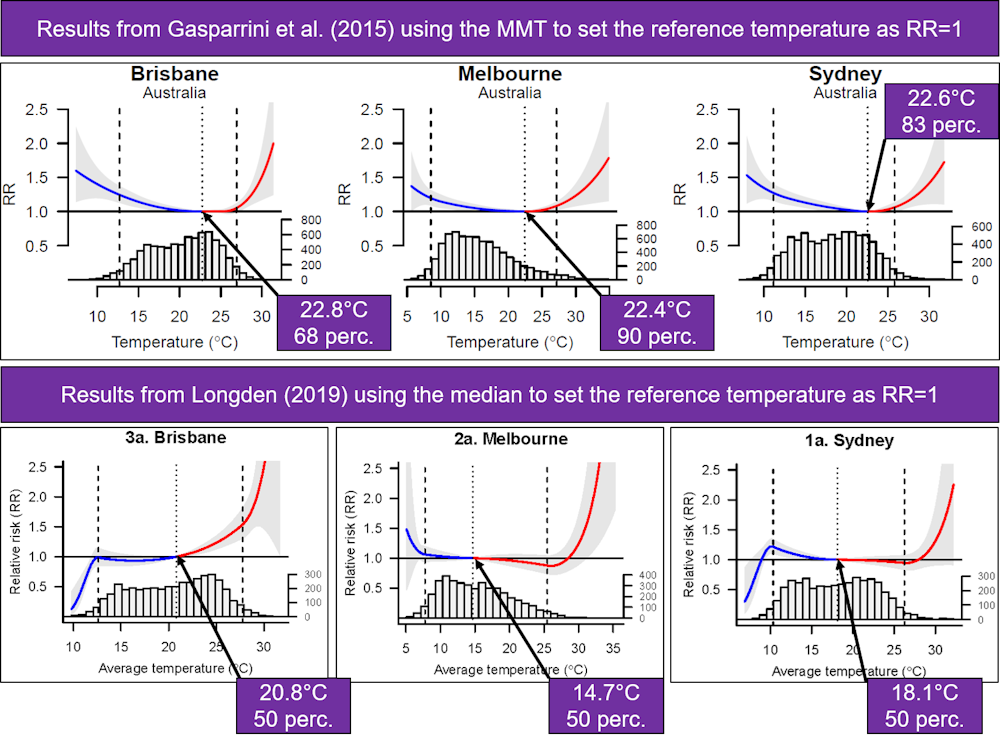
The figure below shows how the estimated curves, called temperature-mortality curves, can differ when the reference temperature is changed. It compares temperature-mortality curves from my latest study (the bottom row), to those from the study published in The Lancet (the top row).
Red and blue shading show the parts of the curve defined as heat and cold. Arrows point to the reference temperature used to estimate the curves.
 A comparison of temperature-mortality curves.
Gasparrini et al. (2015) and Longden (2019)
A comparison of temperature-mortality curves.
Gasparrini et al. (2015) and Longden (2019)
Numerous studies, including the Lancet study, have estimated the number of deaths attributable to heat and cold using what’s called a minimum mortality temperature (MMT) as the reference temperature.
The MMT is the lowest point of a temperature-mortality curve and is often interpreted as the daily average temperature at which there’s the lowest risk of death.
Based on the findings for Australia, I’m concerned the reference temperature (the MMT) used in The Lancet study was too high. For example, a reference temperature of 22.4°C (shown in the figure above) meant almost 90% of Melbourne’s historical daily average temperatures were classified as cold. This could be equivalent to a day with a maximum of 31.4°C and a night minimum of 13.4°C.
I’ve used a different reference temperature in my latest study. I used the median of historical daily average temperatures as the reference temperature. For example, in my study cold days in Melbourne are those below a daily average temperature of 14.7°C. All daily average temperatures above 14.7°C are considered hot.
Using the median as the reference temperature creates a 50/50 split between what’s considered hot and cold.
Comparing the results
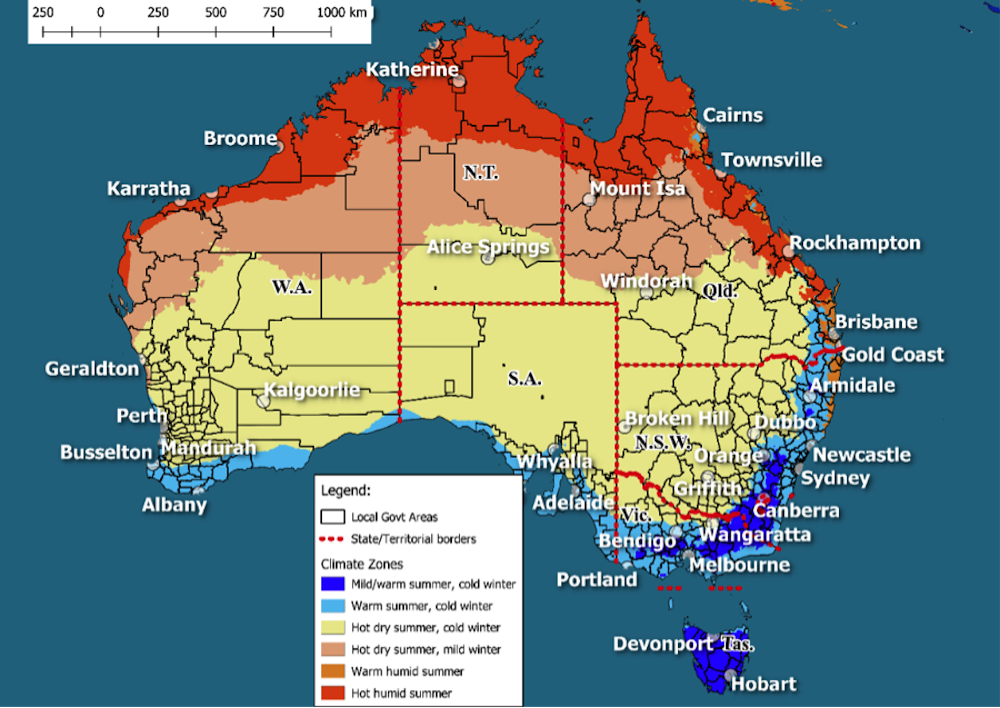
As well as using a different reference temperature, I used national death record data to estimate temperature-related deaths for six climate zones. They range from areas with a “hot humid summer” in the north and areas of “mild/warm summers and cold winters” in Tasmania, the ACT and parts of NSW and Victoria.
The other studies I mentioned used data for many cities from around the world, but only included the three largest Australian capitals (Sydney, Melbourne and Brisbane).
 Climate zones across Australia.
Longden (2019)
Climate zones across Australia.
Longden (2019)
In my study, I estimated 2% of deaths in Australia between 2006 and 2017 were due to the heat.
In the three warmer climate zones this number was higher, ranging from 4.5% to 9.1% of deaths. However, as the majority of the population lives in the second coldest climate zone (warm summer, cold winter), this brings down the national estimate.
In the coldest climate zone, 3.6% of deaths were due to the cold and the heat was less dangerous.
These estimates are notably different to those in The Lancet study where the total for Sydney, Melbourne and Brisbane had 6.5% of deaths associated with cold temperatures, but only 0.5% of deaths due to the heat.
Read more: Car accidents, drownings, violence: hotter temperatures will mean more deaths from injury
The difference between these results suggests the need to explore alternative approaches for estimating temperature-related deaths.
Future research should assess whether changing the reference temperature impacts the estimates of temperature-related deaths for other countries.
Finally, accounting for climate zones is another important factor that will affect the balance between the danger of cold and heat.
Authors: Thomas Longden, Research Fellow, Australian National University
Read more https://theconversation.com/heat-kills-we-need-consistency-in-the-way-we-measure-these-deaths-120500

















