

Akram Khan and telling historical truths through dance
- Written by: Christine de Matos, Senior Lecturer in History; Associate Dean of Academic Development and Research, University of Notre Dame Australia
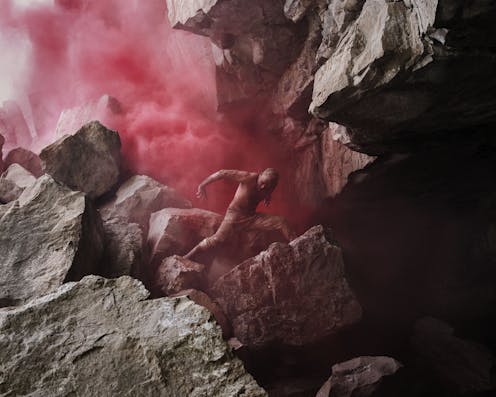
A dancer, in Indian classical Kathak style, appears on the stage and enters into a corporeal conversation with the seated vocalist and percussionist. He wears a clean white cotton kurta, metallic ghungroo around his ankles, jingling as he moves. Watching, you think of human connection, tradition, cultural identity, stability.
But the idyllic scene quickly transforms. Ropes hitherto leaning innocuously against the high, backwards-angled wall begin to move, slowly pulling away the few objects of “civilised” life — chairs, tables. Lights hanging over the stage flicker. The ghungroo transform into bandoliers, bells shaped into bullets.
The dancer’s moves become more contemporary, while foreboding words drift across the stage: “This is not war. It is the ending of the world.” The music too transforms, now an intense relentless industrial crescendo of violin, double bass, percussion, saxophone.
The stage blackens, the only light revealing the musicians on a platform above, as if floating ethereal beings in despair of what is to come. You are made acutely aware of the futility of resisting the imminent descent into chaos. I am transfixed, and already sobbing.
This is Xenos, the latest offering from the Akram Khan Company recently performed at the 2018 Adelaide Festival. Khan is one of the foremost international contemporary dancers and this piece was commissioned by the “14–18 NOW” arts program for the first world war centenary in the United Kingdom. At a time when this war is causing so much remembering, it is extraordinary that so much remains forgotten.
The aim of Khan and his creative team is to make a forgotten past — the Indian sepoys of WWI — take centre stage. Around 1.3 million Indian soldiers served in the war, over 74,000 of them giving their life for that cause. They even fought alongside Australians at Gallipoli.
For a few moments, Khan resurrects these marginalised stories — those who fought for the colonial oppressor have become too difficult to fit into a narrative of Indian independence, too disposable for a long-disintegrated British Empire. Khan forces us to acknowledge their suffering, caused both by war and our forgetting. He does so not by demanding our pity, but by taking us on journey through war’s horror and pathos, with his own body as our guide.
There are few props. The gramophone at the top of the tilted wall, now a trench, exudes a spectral quality as it whispers the names of the Indian dead, rescuing them from mere statistics. Dirt is flung over the stage. Early in the piece, earth in the hand represents home. But the war alters that too. It becomes the mud of the trenches, filth covering the body, the soil in which trenches entrap, bodies are buried.
Many know of the terrors of that war. I am watching, not just as a lover of dance, but as a historian who wants to find answers. Can contemporary dance reveal something about the past that words alone cannot?
Representations of history can be controversial. Historians claim academic dominion over the past and yet historical narratives are so often the subject of fiction, of film, of art. The historian, like the dancer, is an interpreter of the past tasked with finding meaning in its traces. It is the expression of that meaning that differs.
Dance, however, is a form of representation with which historians are rather reluctant to engage. But with the popularity of dance theatre companies like Bangarra, with a growing repertoire that captures the complexities of colonisation from an Indigenous perspective, it is perhaps well time we started paying more attention. Bennelong, for instance, which also featured in the festival, captures the tragedy of a life lived between two worlds, while Patyegarang imagines a more beautiful and curious encounter between a Cadigal woman and Lieutenant William Dawes.
The main difficulties for historians are, first, that dance is ephemeral, making it difficult to analyse, and, second, that it lacks the familiarity of words. It requires developing skills to understand a new language — that conveyed by the body, an affective language that is vicariously felt rather than heard or read on a page.
Through his body, whether a stunning multiple pirouette or the stillness of simply lying, Akram not only allows us to think about the pain of war, but to imagine its psychological impact.
This is the genius of Akram: Xenos is not just a resurrection of a neglected story. As Akram the sepoy moves into the world of war in foreign lands, he transforms from that Kathak dancer into a killing machine, a destroyer of other bodies, his own beautiful dancer’s body mutilated by military discipline and constant shelling. He becomes increasingly alienated, from his home, from himself. He is in a strange land, a stranger to his home, a stranger to himself; he is, as they say in Greek, xenos.
Whose war?, asks an estranged voice. Who points my gun? Rather than a tourist going on a battlefield tour, Khan brings the war and its terrors to us. He takes it out of the museums, away from the commodification of the past, raises it above nationalisms, giving it a painful purity and an emotional honesty, even in its corporeal fictionalisation. Historians speak of historical truth; are there not human truths that cannot be located in archives or found in books?
When the lights come on, I am inconsolable. Khan, an absolute master of his body and his craft, has performed war trauma and the changes wrought by it with such an exquisite beauty that I am left breathless. I wipe my tears, can hardly speak or move. I provide a tissue to the lady beside me, a stranger who has shared in his visual poetry and who is likewise in tears.
That is the power of a fine dancer, choreographer, teller of stories. Akram is one sepoy from northern India. His is all soldiers, everywhere.
War’s greatest and most horrifying effects are corporeal ones; what better way than dance to emotionally entangle us with bodies past, albeit briefly. To remind us of our common humanity in the now.
Authors: Christine de Matos, Senior Lecturer in History; Associate Dean of Academic Development and Research, University of Notre Dame Australia
Read more http://theconversation.com/akram-khan-and-telling-historical-truths-through-dance-93644


















