

In the midst of an LNG export boom, why are we getting so little for our gas?
- Written by Diane Kraal, Senior Lecturer, Business Law and Taxation Dept, Monash Business School, Monash University
So worried is the government about the meagre income it is getting from gas during the middle of Australia’s biggest gas export boom that it asked an independent advisor to chair a review and is getting the treasury to run the ruler over his recommendations.
Australia gets paid for gas mined from under its waters by the “petroleum resource rent tax” set up by the Hawke government in 1988.
But payments peaked at around A$2.5 billion in 2000-01. They are now less than half that, and much lower still as a share of the economy and as a share of gas exported.
The government’s December budget update predicts petroleum resource rent tax revenue of just $1.15 billion this financial year, revised down from the $1.4 billion expected in the May budget.
It has pencilled in only $1.15 billion for each of the next three years.
Qatar, which exports the about the same amount of gas as Australia, is said to have got more than A$20 billion in 2018.
Our tax is good in theory
The weak performance of the petroleum resource rent tax is all the odder because it has been held up as the gold standard for resource taxation.
The 2009 Henry Tax Review wanted to apply the model to iron ore and other minerals, which the Rudd government attempted to, announcing a resource super profit tax in 2010.
The Gillard government cleaved it to what became the milder minerals resource rent tax, before it was abolished by the Abbott government in 2014.
The petroleum resource rent tax collects a share of the profit made from mining gas instead of charging a fixed royalty of the kind imposed by state governments for other minerals.
But the “profit” depends on the choice of the price at which the gas is “sold” from one part of the entity that mines it to another before it is processed and turned into liquid for export.
It’s not as good in practice
There is a regulated method to calculate the true “transfer price” for the purpose of determining the tax payable. If it produces too low a result (as it seems to have) too little profit will be recorded and too little tax will be charged.
The Turnbull government was concerned enough about what was being charged to set up a petroleum resource rent tax review headed by former treasury official Mike Callighan in 2016.
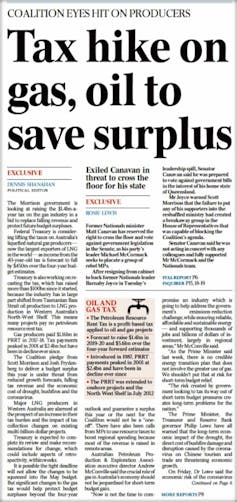 The Australian , Saturday February 8, 2020
Callahan identified four reasons for dwindling reported profits at a time of record production: declining oil and gas prices, declining production from older projects, the massive expenses involved in setting up new mega projects, and transfers of spending between projects for accounting purposes.
He also recommended an examination of the transfer pricing formula.
In 2018 Treasurer Josh Frydenberg tightened some of the provisions and asked the treasury to lead a review of the formula that is due to report mid-year.
So large are the potential revenue gains that The Australian newspaper has reported that they could keep the budget in surplus.
We calculate the price of gas strangely
To determine the transfer price at which gas from Commonwealth waters is transferred from the part of the entity that extracts it to the rest of the entity, the Australian government uses a method used nowhere else in the world, and certainly not by Australian states in the calculation of their royalties on minerals.
It adopted the method on the recommendation of accounting firm Arthur Anderson in 1998, a few years before it was disgraced in the Enron scandal in the United States and stopped using that name.
The method averages two prices – the “net-back” price, which is used elsewhere, and a bespoke “cost-plus price” which is used nowhere else and purports to be a measure of the cost of mining the gas, but which oddly excludes both the cost of exploring for the gas and the cost of the gas itself.
Read more:
Australia must catch up with Papua New Guinea on how we tax gas
The more commonly-used (and usually larger) net-back price is calculated by working backwards from the price at which the product is sold to the end-user, subtracting the costs involved in getting it to that point.
Modelling I have conducted for a article co-authored with Machiel Mulder and Peter Perey in the UNSW Law Journal finds that if the net-back price alone was used (as it is elsewhere) the big gas exporters would pay the government A$15.5 billion over the years between now and 2030, instead of the presently-expected $5.5 billion.
We shouldn’t value gas at zero
There is no obvious reason for the Australian government to value the gas itself at zero. The idea that its only value comes from the equipment, labour and technical know-how used to extract it wouldn’t be accepted in the United States or in any other place that charges for resources extracted and demands payment promptly upon extraction.
Fortunately, the government of Queensland continues with royalties for onshore gas and the government of Western Australia continues with royalties for North West Shelf gas.
If the treasury’s review of gas transfer pricing results in only fine-tuning the existing regulations it will miss the chance to get us a proper return on our resources. We own them and they are worth something.
Australians have a right to be paid what their resources are worth and to use that money to build government services or a budget surplus.
Listen to Dr Kraal discuss petroleum resource rent tax at Monash ‘Thought Capital’
The Australian , Saturday February 8, 2020
Callahan identified four reasons for dwindling reported profits at a time of record production: declining oil and gas prices, declining production from older projects, the massive expenses involved in setting up new mega projects, and transfers of spending between projects for accounting purposes.
He also recommended an examination of the transfer pricing formula.
In 2018 Treasurer Josh Frydenberg tightened some of the provisions and asked the treasury to lead a review of the formula that is due to report mid-year.
So large are the potential revenue gains that The Australian newspaper has reported that they could keep the budget in surplus.
We calculate the price of gas strangely
To determine the transfer price at which gas from Commonwealth waters is transferred from the part of the entity that extracts it to the rest of the entity, the Australian government uses a method used nowhere else in the world, and certainly not by Australian states in the calculation of their royalties on minerals.
It adopted the method on the recommendation of accounting firm Arthur Anderson in 1998, a few years before it was disgraced in the Enron scandal in the United States and stopped using that name.
The method averages two prices – the “net-back” price, which is used elsewhere, and a bespoke “cost-plus price” which is used nowhere else and purports to be a measure of the cost of mining the gas, but which oddly excludes both the cost of exploring for the gas and the cost of the gas itself.
Read more:
Australia must catch up with Papua New Guinea on how we tax gas
The more commonly-used (and usually larger) net-back price is calculated by working backwards from the price at which the product is sold to the end-user, subtracting the costs involved in getting it to that point.
Modelling I have conducted for a article co-authored with Machiel Mulder and Peter Perey in the UNSW Law Journal finds that if the net-back price alone was used (as it is elsewhere) the big gas exporters would pay the government A$15.5 billion over the years between now and 2030, instead of the presently-expected $5.5 billion.
We shouldn’t value gas at zero
There is no obvious reason for the Australian government to value the gas itself at zero. The idea that its only value comes from the equipment, labour and technical know-how used to extract it wouldn’t be accepted in the United States or in any other place that charges for resources extracted and demands payment promptly upon extraction.
Fortunately, the government of Queensland continues with royalties for onshore gas and the government of Western Australia continues with royalties for North West Shelf gas.
If the treasury’s review of gas transfer pricing results in only fine-tuning the existing regulations it will miss the chance to get us a proper return on our resources. We own them and they are worth something.
Australians have a right to be paid what their resources are worth and to use that money to build government services or a budget surplus.
Listen to Dr Kraal discuss petroleum resource rent tax at Monash ‘Thought Capital’
Authors: Diane Kraal, Senior Lecturer, Business Law and Taxation Dept, Monash Business School, Monash University

















