All it takes is paint and pancakes. How to boost your preschooler’s science skills
- Written by Goutam Roy, PhD Candidate in STEM education, Charles Sturt University
Parents of young children will be aware of the need to encourage early reading and maths skills in their kids. They know it’s important to make time to read with their children. Or point out that “cat” starts with the letter “c”. Similarly, they will help their children begin to count (“how many sausages are on your plate?”).
But what about science skills? Studies suggest parents may not be as confident about teaching these skills in every day family life.
Our study, published in The Australian Educational Researcher outlines five practical ways parents can help their children develop their science skills and scientific literacy at home.
Parents can lack confidence
We know Australians science skills are slipping. For example, there are gaps in Year 12 enrolments in key areas including agricultural science, artificial intelligence, biotechnology, data science and climate science.
One way we can address this is by fostering scientific knowledge from a young age.
Children can gain scientific knowledge from everyday contexts. We know parents can play a significant role in extending children’s science literacy at home before they go to school.
But studies have found many parents believe they do not have adequate science knowledge to teach their children or respond to their questions.
However, parents do not need to be experts in science to do this. Simple science activities at home can gradually enhance scientific learning.
Here are five ways to do it.
1. Encourage science play at home
Helping your child’s science skills does not need to be about formal lessons and explanations. You can do this through play.
Parents can regularly arrange small activities at home to extend children’s interest in science. For this, they do not need specialised knowledge. They can build upon a child’s existing areas of interest.
For example, if a child shows interest in colours, provide three primary colours (red, yellow, and blue) in paints and ask children to experiment with how many colours they can produce using those three.
This experiment provides children with a greater sense of colour mixing. Parents do not need to discuss chemistry, but this experience plants a root in children’s minds about chemical reactions.
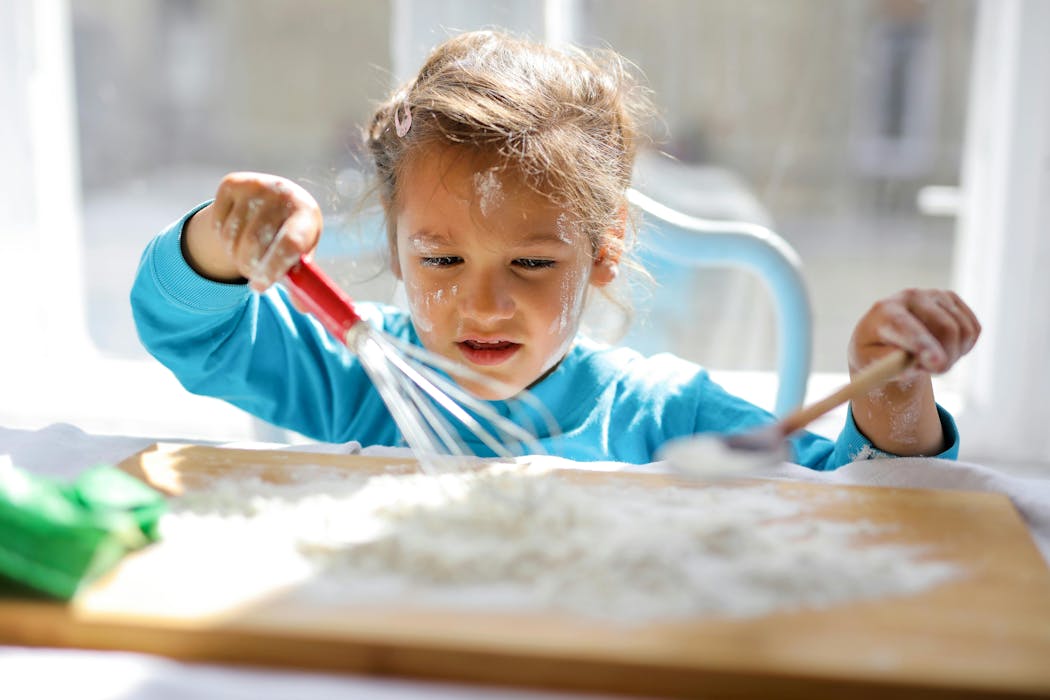
Or you could cook something like pancakes together. This shows how mixing certain ingredients and adding heat can transform them into another form. At the same time, children gain an understanding of a step-by-step approach.
2. You already have the materials
Parents do not need to offer high-cost or specialist materials. The household or nature can provide what you need.
What happens if you mix flour and water? How many different-shaped leaves can you find in the park? What insects live in our garden?
Existing toys can also help. Lego blocks can used to build an understanding of engineering (how high can you stack the tower before it wobbles?). Toy cars can be used in a game to see what surfaces are quickest.
3. Keep the emphasis on play
With little kids, creating interest in science is not about talking about abstract concepts. It’s about helping a child to understand the concept in action. And hopefully, extending their curiosity.
This is why it’s important to play or engage in the activity together.
For example, rather than discuss what text books say about photosynthesis, role play what happens to a flower in the sun. The flower needs the sun to grow, but too much sun (or not enough water) will see the flower wilt.
Sometimes parents can initiate play activities, sometimes they can follow their children’s lead.
4. Try and answer questions
Children’s questions can be tricky. And sometimes we don’t know the answer. But rather than say “magic” or “I don’t know”, tell your child you can find out together.
This might be through looking something up or doing your own experiment.
For example, “why does ice cream melt so quickly when we eat it but not in the freezer?”
You could then experiment by keeping ice cream in different places, such as at room temperature, in the freezer, and in the refrigerator. You could see how long it takes for the ice cream to melt at each temperature.
5. Get suggestions from your child’s educators
If you need some ideas for science-based games or activities, talk to your child’s educators at daycare or preschool/kinder.
Educators regularly arrange a variety of play activities at early learning centres and know how to tailor play to children’s specific interests and needs.
What now?
Keep in mind, not all development is visible. Children can internalise their learning and apply it in a new situation in their own way.
But if parents regularly talk about science and incorporate it into play, they can help build their child’s logical thinking, problem-solving, and conscious decision-making.
This paves the way for them to enjoy and engage with science subjects when they reach school.
Authors: Goutam Roy, PhD Candidate in STEM education, Charles Sturt University