Modern Australian
The Times

how organisations create their own red tape

  • Written by Natasha Hamilton-Hart, Professor in Management and International Business, University of Auckland, Waipapa Taumata Rau

“Dress appropriately.”

Soon after becoming General Motors’ vice president of global human resources in 2009, Mary Barra used those two words to replace a clunky employee dress code that had grown to ten pages long.

One might think that move by Barra, who now heads the company, simply signalled a return to “common sense” – meaning fewer rules and more freedom.

But in practice, “dress appropriately” actually requires something else: authority.

Employees gain more discretion, but inevitably some will get it wrong. When that happens, managers must step in and say so – a responsibility that, in General Motors’ case, some senior managers had been reportedly reluctant to exercise.

This speaks to two deeper points.

If we cede authority to people in a hierarchy – or empower them to decide what is appropriate – then we can make the rule book much shorter. And if the prospect of exercising that discretion feels uncomfortable, it suggests how unused to authority we have become.

Contemporary society, particularly in the Anglo-American world, produces rules in abundance. In this era, bosses and bossing are viewed as something of an embarrassment.

How stupid rules made for more ‘sludge’

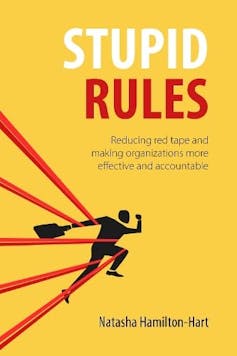
In my new book, Stupid Rules: Reducing Red Tape and Making Organisations More Effective and Accountable, I describe how a flight from authority in recent decades has stripped organisations of command capacity. This is the ability to tell others what to do without having to reference formal guidance, standards or legal rules.

I’m far from the only observer to have identified problems with the rule-heavy approach we often see taken today.

In their 2025 book Abundance, US journalists and podcasters Ezra Klein and Derek Thompson describe how land-use rules can prevent homes from being built and mire infrastructure projects in delays, rising costs and litigation.

More broadly, people struggle with red tape and pervasive “sludge” – the term used by behavioural economists for obstructive paperwork and administrative burdens.

And despite the proliferation of rules, the powerful have not been effectively restrained. Corporate lobbying has flourished and market competition has declined, as well-resourced actors have learned how to bend complex rules to their advantage.

How did we get here?

Dismantling authority was meant to make organisations more efficient and accountable. Over time, hierarchies were replaced with markets and market-like systems designed to incentivise the delivery of services such as healthcare, electricity and environmental protection.

Paradoxically, the attempt to reduce hierarchy produced more red tape. Sometimes described as neoliberal, this shift ushered in what scholars call the regulatory state.

Private markets providing services such as electricity, sewage treatment and drinking water now operate under complex rules and performance targets meant to guide their behaviour.

Yet these systems have often failed spectacularly. Each failure – whether sewage leaks, leaky buildings, healthcare scandals or other disasters – tends to trigger another round of regulation: more rules, more detailed standards and ever more elaborate performance metrics.

Is more authority the antidote?

In many cases, more detailed rules are not the answer. Organisations would often function better if they made more space for the logic of hierarchy.

Nearly a century ago, pioneering British American economist Ronald Coase explained why: firms exist because it is often more efficient to organise work through authority than through contracts and rules.

The same principle applies today. Giving decision-makers greater discretion could cut through the regulatory mire that can thwart democratically made decisions.
how organisations create their own red tape
In another American example from my book, I describe how a city government in Oregon was forced to stop construction for seven months on a water-treatment plant, even after years of planning and approvals. The city lacked authority to proceed in the face of legal objections, leading to another court hearing and increased costs. Similar problems have appeared in New Zealand. An environmental official in Christchurch described how a popular project to rewild the city’s earthquake-affected red zone ran into difficulty. He explained how situations like this are not uncommon, with planning mechanisms intended to protect the environment sometimes reducing the ecological benefits they are meant to achieve. Such “stupid rules” are not just a bureaucratic phenomenon. Many of the rules that companies work to are created by private bodies that create standards, accreditation requirements and auditing processes. Technology giant Apple’s sustainability rules, for example, set out a detailed code of conduct for its suppliers. But Apple’s own flight from authority makes these rules cumbersome and weak. Because Apple does not directly control the making of its products, its sustainability rules need to be imposed on suppliers outside the boundaries of Apple itself. Over the past 20 years, recurrent scandals saw Apple ratchet up these rules, while moving the cost of compliance onto its suppliers. Some things have improved, but the rules are in conflict with the basic structure of the supply chain set up by Apple to grind down costs. It replaced the direct control – and responsibility – of hierarchy with market exchange and contractual standards. Authority, of course, needs to be checked. But stupid rules can turn organisations into “accountability sinks” in which no one is truly responsible. Empowering decision makers – just as in that simple “dress appropriately” rule – helps restore clear lines of responsibility.

Authors: Natasha Hamilton-Hart, Professor in Management and International Business, University of Auckland, Waipapa Taumata Rau


Read more https://theconversation.com/too-many-stupid-rules-too-little-authority-how-organisations-create-their-own-red-tape-277608

Chatswood Tutoring And Its Role In Academic Achievement

Academic success often requires more than classroom attendance alone. Students face increasing expectations as they progress through school, particu...

Why Laser Hair Removal Treatments Continue Growing In Popularity

Managing unwanted hair can become time-consuming and frustrating for many people, especially when shaving, waxing, and other temporary methods requi...

Choosing the Right Devices for a Flexible Workplace

For IT leaders managing large fleets, the device layer is where workforce productivity and security policy meet. The shift towards flexible and hybrid...

How Business Advisory Services Help Companies Achieve Sustainable Growth

Every business owner aims to build a profitable and sustainable organisation. While dedication, innovation, and hard work are important, achieving l...

Why Body Contouring Has Become A Popular Cosmetic Treatment

Many people maintain healthy lifestyles through regular exercise and balanced eating habits but still struggle with stubborn areas of fat that are d...

How to Choose the Right POS Hardware for Your Business in Australia

A lot of Australian business owners spend weeks researching POS software but buy hardware almost as an afterthought. That's a mistake. The wrong har...

Why Material Handling Hose Is Critical for Industrial Efficiency

A high-performance material handling hose is an essential component in industries that transport abrasive, dry, or bulk materials on a daily basis...

How to Choose the Right Lawyer in Melbourne for Your Situation

Choosing legal support can feel difficult, especially when the stakes are personal or business-related. The right lawyer in Melbourne should underst...

Hoteliers Look to Clever Value Adds to Increase Revenue

The Australian hospitality industry is still in recovery mode after a notoriously rough patch in recent years. While there has been a post-COVID tra...

Moving to Queensland? Here’s How to Prep Your Car for the Big Move North

There’s no sign of the northern migration slowing down, with thousands of southerners fleeing from chaotic lifestyles and cooler climates for a brig...

Diesel Shortage to Impact Trades and Contractors

Strait of Hormuz blockage affecting all major parts of trades and construction Trades and construction across residential, commercial and industria...

Why Holiday Home Owners Turn to Rental Management Agents

The Allure — and the Reality — of Renting Out Your Property Owning a holiday home is a dream for many Australians. Whether it's a beachside sha...

Why Finding Reliable Doctors In Bundoora Is Important For Long-Term Health

Access to quality healthcare plays an important role in maintaining overall wellbeing and managing health concerns early. Trusted Doctors in Bundoor...

Understanding the Different Types of Car Services: Minor vs Major

When it comes to car maintenance, one of the most important things every vehicle owner should understand is the difference between a minor and a maj...

How Superannuation and TPD Insurance Work Together

Superannuation is an essential part of financial planning in Australia. It is designed to provide individuals with income during retirement, helping...

Tiny Towns funding granted for Mt Hotham and Mt Buller upgrades

Alpine Resorts Victoria (ARV) has welcomed funding support from the Victorian Government’s  Tiny Towns Fund, with both Mt Hotham and Mt Buller se...

Locksmith Services: Why Professional Security Solutions Matter More Than Ever

Security is a critical concern for homeowners, businesses, and vehicle owners alike. Whether it involves protecting a property, replacing damaged lo...

Why Tooth Fillings Are Important For Protecting Damaged Teeth

Cavities and minor tooth damage are common dental problems that can worsen if left untreated. Professional tooth fillings help restore damaged teeth, ...