

The Commonwealth Games of exclusion: what are authorities so afraid of?
- Written by: Colin Tatz, ANU Visiting Professor, Politics and International Relations, Australian National University
Sport, race and racism are entwined. It was always so, and it will always will be so – even in the Commonwealth Games, the event we dub the “friendly games”.
In a throwback to the 1982 Commonwealth Games in Brisbane, preparations for next month’s event on the Gold Coast are forcing the homeless to move out of town, and even out of the state – to Tweed Heads in New South Wales. Women who run soup kitchens for the poor and indigent have been told to close their shops until these “friendly games” are over.
Australia, the Commonwealth Games, and race
In the 1930s, Australia’s sporting authorities deemed the previously named Empire Games worthier than the Olympics. Empire above all else, Australia second, was the motto.
Some British officials even advocated a British Empire Olympic team. The Empire Games appealed to “a narrower local patriotism” and that was the healthier way to go, The Sydney Morning Herald editorialised, hinting that Australia avoid intimate contact with “foreigners” at the Olympics. But all that changed after the second world war.
The “friendly games” have since tended to be the tense and the nervous games. Race has marred several events. Australia made extraordinary efforts to keep South Africa and (the then) Rhodesia in the fold when no-one else wanted to have dealings with them.
A near-calamitous era for sport resulted from the highly divisive Springbok rugby union tours to Australia (1971) and to New Zealand (1981), the 28-African nation boycott of the Montreal Olympics (1976) – because of New Zealand–South Africa rugby ties – and the 61-nation boycott of the Moscow Olympics because of the Soviet invasion of Afghanistan (1980).
Many will remember Commonwealth Games head Arthur Tunstall threatening to punish Cathy Freeman for wrapping herself in an Aboriginal flag in Canada at the 1994 Games. This was hardly the friendliest event on racial matters, and we can tie them to Moscow.
The Moscow Olympics in 1980 was held at the time of Western outcry at the treatment of “dissidents”, of refuseniks – those refused the right to emigrate to Israel and elsewhere. Aimed mainly at Jews, refusal also applied to Ukrainian Greek Catholics, Jehovah’s Witnesses and Volga Germans. By the time of the Olympics, the ban on Jews had been lifted (largely through Australian-led pressure), but some were still being held as financial hostages.
To give the appearance and the message that Moscow was “clean”, the Soviet regime removed all the “unsightly ones” from that city for the two weeks of sport.
Remembering the protests of 1982
Two years after the Moscow Olympics, in September 1982, Brisbane hosted the Commonwealth Games. At the helm of draconian government was Joh Bjelke-Petersen, a fundamentalist Lutheran and a man intolerant of democracy and its institutions. He ruled Queensland from 1968 to 1987.
Bjelke-Petersen placed all of Queensland under a state of emergency, declaring martial law, when the Springbok rugby team toured, disastrously for all, in 1971. He made dubious history as the first leader in a democracy to declare a state of emergency in peacetime over a sporting event. Martial law reigned for three weeks to enable matches, with indemnities given to all police against lawsuits.
The Bjelke-Petersen government passed the Commonwealth Games Act, a statute not commented on then or later. The law ensured Brisbane was free of Aboriginal people and their “friends”.
Possibly the Western world’s most punitive law on sport, police had the power under the act to declare a state of emergency. It also gave specially deputised non-police full police powers and enabled seizure of people and property “on suspicion”.
The act provided for palm, foot, toe and voice-printing, with a A$2,000 fine or two years’ jail for offences under the act, and disallowed any consequent criminal or civil charges against real or “temporary” police. But human rights organisations – especially the vociferous rights body in Queensland – said nary a word on this statute.
Bjelke-Petersen was adamant there would be no Aboriginal land rights marches in Brisbane at that time, and the statute was meant to ensure that. By coincidence or not, the ABC ran a Saturday-night Four Corners special program on land rights mid-Games, and that led to much press publicity.
I was there, reporting on the event for The Australian. Two land rights marches took place, peacefully.
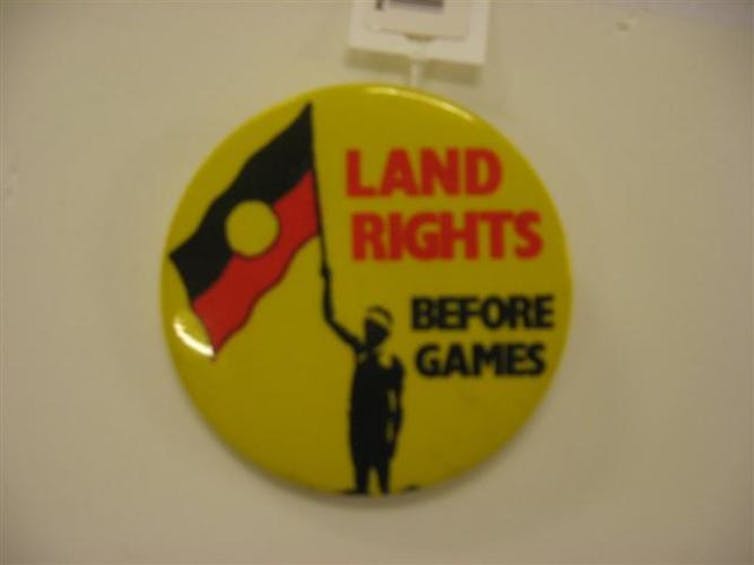 Land rights marches attracted foreign media attention at the 1982 Commonwealth Games in Brisbane.
Museums Victoria
Land rights marches attracted foreign media attention at the 1982 Commonwealth Games in Brisbane.
Museums Victoria
Interestingly – but not surprisingly – the British, Canadian and New Zealand journalists were much more interested in learning about the Aboriginal story than in the sporting contests, and I was able to help them file stories of greater import than the discus thrower’s ankle.
Aboriginal protests didn’t stop or disrupt the Games, and police generally behaved politely. True, there was a great deal of camera scrutiny of events. The land rights marches hastened native title change in Queensland, with the Mabo case starting that year and ending in native title in 1992.
In America as in Australia
Atlanta was the low-water mark of a city using anti-loitering statutes to keep it “clean” during the 1996 Olympics. Whole suburbs were vacuumed to eliminate the “black spots”, literally.
So, two decades on, what are sports officials and governmental authorities still so afraid of? That we will be seen as a normal country, with normal problems like poverty, homelessness and hunger?
Are we really still mired in the mentality of yesteryear — that the deranged, the mentally ill, the vagrant must be kept out of sight lest they remind us of human frailty?
Authors: Colin Tatz, ANU Visiting Professor, Politics and International Relations, Australian National University


















