

An ancient oracle warned invading Persia would backfire – from Croesus to Trump, rulers have failed to listen
- Written by: Peter Edwell, Associate Professor in Ancient History, Macquarie University
Invasions of ancient Persia were always daunting tasks. They often led to disaster.
In the 6th and 5th centuries BCE, the Persian empire came to dominate a vast and varied geography with Iran at its heart.
Comprising modern Iran, Iraq, Turkey, the Persian Gulf and parts of other neighbouring countries, the Persian Empire was established and ruled by the Achaemenids. This powerful dynasty lasted all the way to about 330 BCE when Alexander the Great defeated its last ruler, Darius III.
But in the early days of this Achaemenid Persian expansion (546 BCE), the legendary King Croesus (from Lydia, in western Turkey) decided to challenge it.
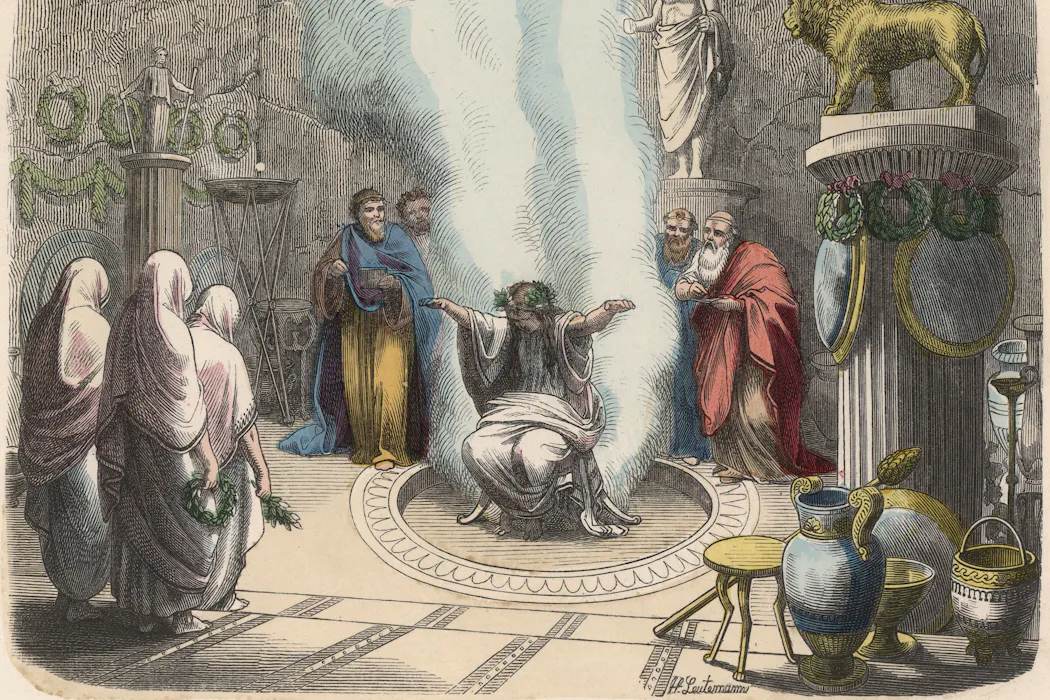
Reputedly the richest man in the world, Croesus consulted the famed Oracle of Apollo at Delphi (in Greece). The oracle, according to ancient writer Herodotus, told Croesus:
that if he should send an army against the Persians he would destroy a great empire.
Croesus’ subsequent invasion and defeat by the Persian king, Cyrus, saw the destruction of his own empire. The oracle accurately foretold the outcome but not as Croesus had hoped.
Croesus wasn’t the last ruler to invade Persia and realise he’d bitten off more than he could chew.
From the 6th century BCE to the 4th century CE, Greeks and Romans invaded Persia multiple times. The risks were high, the logistics complicated.
In fact – as US President Donald Trump is now discovering – wars like these, in this part of the world, are a lot easier to start than they are to end.
Complex and high-risk
The vast resources and manpower of the Achaemenid empire, together with its varied geography, made any invasion of Persia complex and high-risk.
When Alexander the Great (also known as Alexander III of Macedon) invaded in 334 BCE, he led stunning military successes against the Persians over the next few years.
But by the time of his premature death in Babylon in 323 BCE, organisation of the vast territory he had conquered was a hodge-podge of short-term arrangements.
Over time, the memory of Alexander in the Iranian territories he conquered was one of contempt. The Persian territory he conquered couldn’t be held by his successors.
Around 70 years after Alexander’s death, a new dynasty emerged in Iran.
Known as the Arsacid Parthians, they would dominate much of the former Achaemenid territory for centuries.
The Arsacid Parthians became the key rivals of the Romans as they (the Romans) expanded further east from the 1st century BCE onwards.
The first invasion of the Parthian empire by the Romans ended in total disaster – for the Romans.
The Roman general Crassus invaded Parthian imperial territory in southern Turkey in 53 BCE. The Parthian army annihilated Crassus’ forces near the city of Carrhae. Around 20,000 Roman soldiers died (including Crassus and his son) and 10,000 were captured.
This disaster would live in the Roman memory for centuries.
‘A source of constant wars and great expense’
Even when Roman invasions of the Parthian empire in the 2nd century CE were successful, there was often a sting in the tail. The emperor Trajan invaded all the way to the Persian Gulf in 116/117 CE but couldn’t hold any of his gains.
Later in the 2nd century CE, Roman invasions of the Parthian empire did see territorial gains in Mesopotamia (southern Turkey).
But one contemporary Roman writer, Cassius Dio, thought these gains were more trouble than they were worth:
He [emperor Septimius Severus] used to declare that he had added a vast territory to the empire and had made it a bulwark of Syria. On the contrary, it is shown by the facts themselves that this conquest has been a source of constant wars and great expense to us.
From loss to ultimate humiliation
In the 3rd century CE, the Sasanian dynasty took control of Iran and Mesopotamia from the Parthians. The Sasanian Persians inflicted serious defeats on invading Roman armies in the centuries ahead.
The Roman emperor Gordian III died in battle against the Sasanians in 244 CE. He led a large-scale invasion of the Persian empire but died trying to attack the capital, Seleucia-Ctesiphon. His successor (Philip I) signed a humiliating peace treaty to ransom what was left of the army.
But the ultimate humiliations for Roman emperors were yet to come.
In 260 CE, the emperor Valerian was captured by the Persian king, Shapur I.
Legendary accounts claimed Valerian served as a footstool for Shapur when he mounted his horse.
Rock reliefs from the 3rd century depicting Valerian and Philip I in subjection to Shapur survive in Iran to this day.
Around a century later, the emperor Julian died while invading the Persian empire. Leading an army of 60,000 men, Julian suffered a heavy defeat and was killed north of the Persian capital, Seleucia-Ctesiphon.
The ensuing peace treaty saw Rome lose key territory and fortresses in northern Mesopotamia.
It would take more than a century for Rome to recover from this defeat.
Most ancient invasions of the Persian empire caused serious problems for those who prosecuted them.
The varied and sometimes harsh nature of the geography was an important factor. The national resolve and military preparedness were others.
While the current US-Israel war against Iran is different in many ways to ancient wars directed at Persia, the 3rd-century Sasanian rock reliefs are reminders of what can go wrong.
Authors: Peter Edwell, Associate Professor in Ancient History, Macquarie University


















