

NZ’s latest push to roll out more EV chargers is a good thing – but can it go the distance?
- Written by: Mingyue Selena Sheng, Senior Research Fellow, Faculty of Business and Economics, University of Auckland, Waipapa Taumata Rau
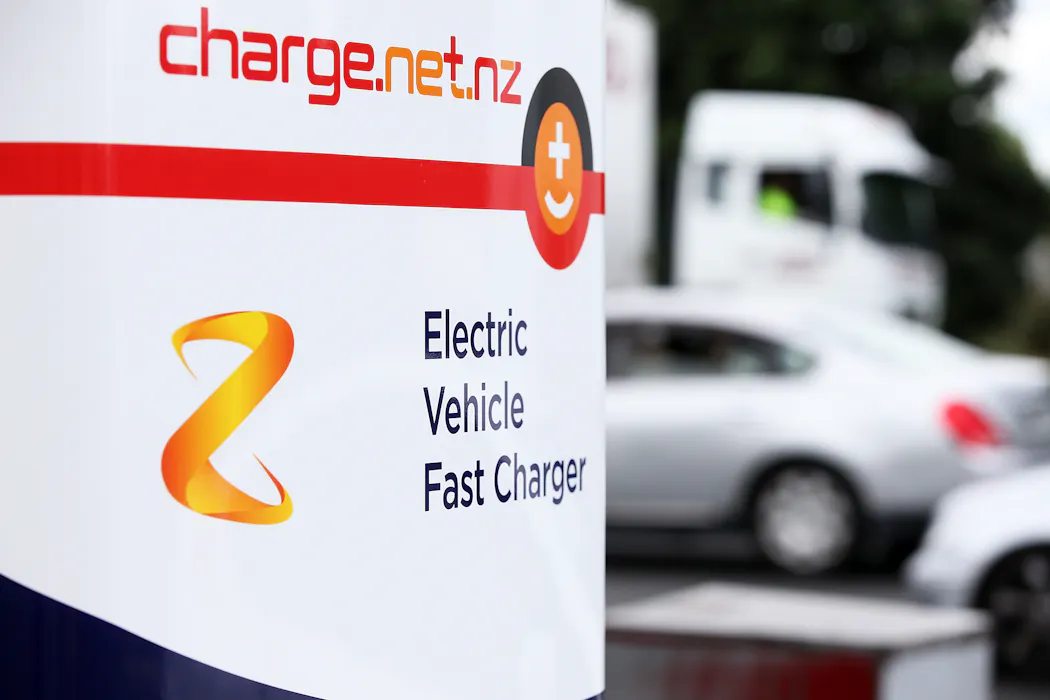
A $50 million plan to expand New Zealand’s public electric vehicle (EV) charging network marks another step toward a lower-emissions transport system.
The government will provide interest-free loans to private operators ChargeNet and Meridian Energy, which will invest a further $60 million to lift the national network to around 4,500 charge points.
The aim is to ease a key constraint on EV uptake: limited public charging infrastructure, particularly outside major urban centres.
It partly reflects what’s been called a chicken-and-egg problem, in which providers are reluctant to invest without enough EVs on the road, while drivers are hesitant to switch without a reliable charging network.
By lowering upfront costs for providers and encouraging rollout in smaller towns and along regional routes – where usage and returns are less certain – the scheme would help bring forward the investment needed to build a functional national network.
That is a positive and timely development. But our research suggests that without deeper shifts in pricing, incentives and driver behaviour, expanding charging infrastructure alone is unlikely to drive EV uptake at the pace New Zealand needs.
What puts the brakes on EV uptake?
The Climate Change Commission sees electrifying New Zealand’s largely ageing and fossil fuel-powered vehicle fleet as among the key steps to meeting national emissions reduction targets.
There is a long way to go. With its 1,800 charge points, New Zealand remains well short of the infrastructure needed to reach a goal of 10,000 public chargers by 2030.
While an expanding range of EV models and policy measures – including some since rolled back – has encouraged more motorists to switch, uptake remains uneven across regions and demographic groups.
Cities might be quickly plugging in, but many rural towns and lower-income areas are being left behind, where high costs and limited access to chargers continue to deter buyers.
In these places especially, “range anxiety” is less about battery capacity and more about confidence in the charging network. Our recent modelling shows EV uptake is higher where charging is visible and reliable, with that sense of convenience often proving just as decisive as the upfront purchase price.
It might seem, then, that simply adding more chargers is the solution. But the reality is more complicated.
Even where chargers exist, drivers worry about whether they will be available, working, or already in use. For those outside major centres, gaps between towns – or along key highways – can make longer trips feel uncertain or impractical.
This reflects the networked nature of charging infrastructure. In a geographically dispersed country like New Zealand, the value of charging infrastructure depends as much on where chargers are located – and how well they connect – as on how many there are.
At the same time, expanding the network brings its own challenges. If large numbers of drivers plug in at the same time – particularly in the early evening – this can place additional strain on local electricity networks and increase system costs.
Why NZ’s EV shift needs a ‘systems’ approach
These factors suggest that, rather than focusing only on building more infrastructure, we need to consider how that infrastructure is used, experienced and integrated into the wider energy system.
It’s also here where we begin to see the limitations of a loan-based policy like the one just announced by the government.
It may be true that lower-cost finance can help bring forward investment. But it does not remove the underlying risks for providers, particularly in areas where demand is low or uncertain.
In regions where returns are structurally low – such as rural or remote communities – loans alone may be insufficient to ensure equitable access. Nor does it address questions about where chargers should go, how they are used, or how drivers respond to them.
As international evidence suggests, concessional finance – such as loans or grants provided at below-market rates – can support infrastructure rollout. But it is rarely enough on its own to deliver rapid, system-wide deployment.
A more effective response would take a system-wide approach – combining infrastructure investment with clearer long-term signals, targeted support in underserved areas, and incentives that influence when and how people charge.
This could include measures such as time-of-use pricing to shift charging away from peak periods, or coordinated planning across central government, councils and network operators to ensure chargers are placed where they are most needed.
New technologies may also play a role. Wireless charging, for example, has the potential to reduce reliance on large batteries and make charging more seamless.
Our research on in-road charging systems – including modelling for Auckland’s electric bus network – suggests this could improve efficiency and reduce infrastructure constraints over time.
Ultimately, the government’s loan scheme should be seen as a good thing. But building a reliable, equitable charging network will require a more coordinated and long-term approach.
Authors: Mingyue Selena Sheng, Senior Research Fellow, Faculty of Business and Economics, University of Auckland, Waipapa Taumata Rau


















