

We know how long coronavirus survives on surfaces. Here's what it means for handling money, food and more
- Written by Ian M. Mackay, Adjunct assistant professor, The University of Queensland
Like the other 200 or so respiratory viruses we know of, severe acute respiratory syndrome coronavirus 2 (SARS-CoV-2), the new coronavirus, infects the cells of our airways.
It causes a range of signs and symptoms, or none at all. It can spread easily from person-to-person, and can be coughed into the air and onto surfaces.
Viruses only replicate inside a living cell - outside the cell, they’re on a path to either infect us, or their own destruction. How long a virus survives outside a cell varies.
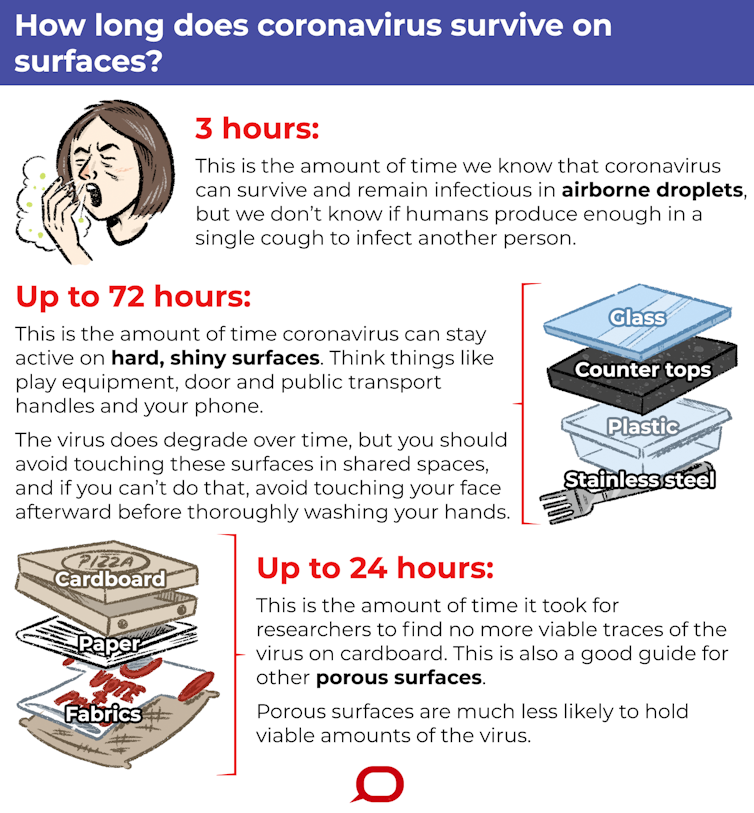
Researchers found SARS-CoV-2 remains infectious in airborne droplets for at least three hours. This doesn’t mean infected humans produce enough virus in a cough to infect another person, but they might.
 Wes Mountain/The Conversation, CC BY-ND
We think the virus also spreads by touch. Hard, shiny surfaces such as plastic, stainless steel, benchtops, and likely glass can support infectious virus, expelled in droplets, for up to 72 hours. But the virus rapidly degrades during this time. On fibrous and absorbent surfaces such as cardboard, paper, fabric and hessian, it becomes inactive more quickly.
How can we reduce risk from surfaces and objects?
Frequently touched surfaces are all around us. Benches, handrails, door handles – they are in our homes, on our way to work, school, play, shop, and every other destination. There’s a risk of contaminating these surfaces if we touch them with virus-laden fingers, and a risk we’ll contract the virus from such surfaces.
Think of your hands as the enemy. Wash them well, and much more often than usual. Between hand-washing, avoid constantly touching the mucous membranes that lead to your airways. Basically, try not to rub your eyes, pick your nose, or touch your lips and mouth.
Read more:
Can I get coronavirus from mail or package deliveries? Should I disinfect my phone?
Taking precautions through small actions
We’re already seeing engineering initiatives to help combat the virus’s spread. In Sydney, pedestrian crossings have been automated so people can avoid touching the buttons.
To slow the spread of SARS-CoV-2, assume everything outside your home is potentially contaminated, and act accordingly. So don’t touch your face, sanitise frequently while you are out, and wash your hands and clean your phone once home.
While it’s best to stay home, keep these tips in mind if you must leave the house.
• Going shopping
Grocery shopping requires touching surfaces and items, including trolleys and baskets. Sometimes sanitiser or antibacterial wipes are available for hands and handles at the store entrance - but they’re often not, so bring your own (if you can get some). It probably doesn’t matter what type of bag you use, but have a plan for how to avoid bringing the virus into your home.
• Making payments
Cards and cash could transfer the virus to your hands. That said, card payment is probably lower risk because you retain the card and don’t have to touch other people. But wherever possible, contact-free bank transfers would pose the least risk.
• Handling and eating fresh and canned food
SARS-CoV-2 is inactivated at temperatures well below those required in the process of canning food, so canned food is free of it. For freshly packaged food, risk depends on whether the person doing the packing was sick or not. If you are concerned, stick with food that can be cooked, peeled or washed in mild soapy water, and thoroughly rinsed.
Read more:
Can coronavirus spread through food? Can anti-inflammatories like ibuprofen make it worse? Coronavirus claims checked by experts
While evidence is weak, we know soap and water should inactivate SARS-CoV-2 on food - but this will work better on foods with a shinier, harder outer surface, compared to foods that have been cut or have softer surfaces, such as strawberries and raspberries. If you decide to wash any food with soap, make sure all the soap is removed.
• At the park
Avoid equipment that is likely used a lot, including play equipment and water fountains. It would be safer to kick a ball around or play on the grass, rather than use swings. Sandpits hold horrors other than SARS-CoV-2.
• Takeaway and deliveries
When getting takeaway food, or for businesses offering it, avoid plastic containers and use more fibrous materials such as cardboard, paper and fabric for packaging. Researchers found no infectious SARS-CoV-2 on cardboard after 24 hours.
Also, avoid proximity to servers and delivery people, and opt for contactless delivery whenever you can.
• Public transport, escalators, elevators and bathrooms
Frequently touched hard, shiny surfaces such as lift buttons and handle bars in trams are a big risk, more so than fabric seats, or taking the stairs. Even the most high-tech overseas surface cleaning efforts are intermittent, so you’ll need to take responsibility for yourself. Also, after using public bathrooms, wash your hands well.
Calm and calculated
It’s important to be calm, realistic and not focus on single events or actions once you step outside. You can’t account for everything.
Think more about the risk of the entire task rather than the many small risks encountered during the process. A silver lining in taking such precautions is that you’ll also reduce your risk of catching the flu this season.
It’s also important to keep your home clean. You can use diluted bleach, detergents or alcohol solutions on surfaces. Queensland Health has more information.
Read more:
How to clean your house to prevent the spread of coronavirus and other infections
For items that are hard to clean, sunshine may be valuable. Leave your shoes outside, soles up, in the sun. Coronaviruses begin degrading quickly in temperatures higher than 56 degrees Celsius, and in direct UV light.
Ultimately, the best ways to avoid SARS-CoV-2 infection are primitive ones - sanitise your hands and stay away from others. Physical distancing remains the most effective measure to slow the progression of this pandemic.
Wes Mountain/The Conversation, CC BY-ND
We think the virus also spreads by touch. Hard, shiny surfaces such as plastic, stainless steel, benchtops, and likely glass can support infectious virus, expelled in droplets, for up to 72 hours. But the virus rapidly degrades during this time. On fibrous and absorbent surfaces such as cardboard, paper, fabric and hessian, it becomes inactive more quickly.
How can we reduce risk from surfaces and objects?
Frequently touched surfaces are all around us. Benches, handrails, door handles – they are in our homes, on our way to work, school, play, shop, and every other destination. There’s a risk of contaminating these surfaces if we touch them with virus-laden fingers, and a risk we’ll contract the virus from such surfaces.
Think of your hands as the enemy. Wash them well, and much more often than usual. Between hand-washing, avoid constantly touching the mucous membranes that lead to your airways. Basically, try not to rub your eyes, pick your nose, or touch your lips and mouth.
Read more:
Can I get coronavirus from mail or package deliveries? Should I disinfect my phone?
Taking precautions through small actions
We’re already seeing engineering initiatives to help combat the virus’s spread. In Sydney, pedestrian crossings have been automated so people can avoid touching the buttons.
To slow the spread of SARS-CoV-2, assume everything outside your home is potentially contaminated, and act accordingly. So don’t touch your face, sanitise frequently while you are out, and wash your hands and clean your phone once home.
While it’s best to stay home, keep these tips in mind if you must leave the house.
• Going shopping
Grocery shopping requires touching surfaces and items, including trolleys and baskets. Sometimes sanitiser or antibacterial wipes are available for hands and handles at the store entrance - but they’re often not, so bring your own (if you can get some). It probably doesn’t matter what type of bag you use, but have a plan for how to avoid bringing the virus into your home.
• Making payments
Cards and cash could transfer the virus to your hands. That said, card payment is probably lower risk because you retain the card and don’t have to touch other people. But wherever possible, contact-free bank transfers would pose the least risk.
• Handling and eating fresh and canned food
SARS-CoV-2 is inactivated at temperatures well below those required in the process of canning food, so canned food is free of it. For freshly packaged food, risk depends on whether the person doing the packing was sick or not. If you are concerned, stick with food that can be cooked, peeled or washed in mild soapy water, and thoroughly rinsed.
Read more:
Can coronavirus spread through food? Can anti-inflammatories like ibuprofen make it worse? Coronavirus claims checked by experts
While evidence is weak, we know soap and water should inactivate SARS-CoV-2 on food - but this will work better on foods with a shinier, harder outer surface, compared to foods that have been cut or have softer surfaces, such as strawberries and raspberries. If you decide to wash any food with soap, make sure all the soap is removed.
• At the park
Avoid equipment that is likely used a lot, including play equipment and water fountains. It would be safer to kick a ball around or play on the grass, rather than use swings. Sandpits hold horrors other than SARS-CoV-2.
• Takeaway and deliveries
When getting takeaway food, or for businesses offering it, avoid plastic containers and use more fibrous materials such as cardboard, paper and fabric for packaging. Researchers found no infectious SARS-CoV-2 on cardboard after 24 hours.
Also, avoid proximity to servers and delivery people, and opt for contactless delivery whenever you can.
• Public transport, escalators, elevators and bathrooms
Frequently touched hard, shiny surfaces such as lift buttons and handle bars in trams are a big risk, more so than fabric seats, or taking the stairs. Even the most high-tech overseas surface cleaning efforts are intermittent, so you’ll need to take responsibility for yourself. Also, after using public bathrooms, wash your hands well.
Calm and calculated
It’s important to be calm, realistic and not focus on single events or actions once you step outside. You can’t account for everything.
Think more about the risk of the entire task rather than the many small risks encountered during the process. A silver lining in taking such precautions is that you’ll also reduce your risk of catching the flu this season.
It’s also important to keep your home clean. You can use diluted bleach, detergents or alcohol solutions on surfaces. Queensland Health has more information.
Read more:
How to clean your house to prevent the spread of coronavirus and other infections
For items that are hard to clean, sunshine may be valuable. Leave your shoes outside, soles up, in the sun. Coronaviruses begin degrading quickly in temperatures higher than 56 degrees Celsius, and in direct UV light.
Ultimately, the best ways to avoid SARS-CoV-2 infection are primitive ones - sanitise your hands and stay away from others. Physical distancing remains the most effective measure to slow the progression of this pandemic.
Authors: Ian M. Mackay, Adjunct assistant professor, The University of Queensland

















