

More Australians are worried about a recession and an increasingly selfish society than about coronavirus itself
- Written by Alexander Saeri, Research Fellow, BehaviourWorks Australia, Monash Sustainable Development Institute, Monash University
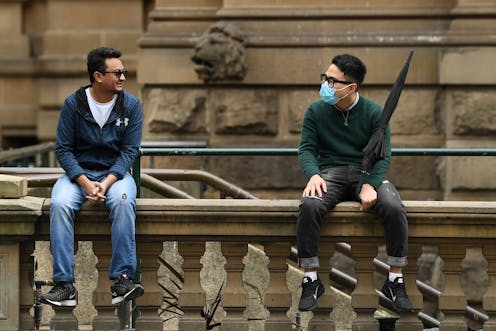
More Australians are worried about the longer-lasting, societal effects of the COVID-19 pandemic – specifically that the health system could be overburdened and the country could enter a recession – than they are about the more immediate changes to their own lives, our new survey of 1,000 Australians reveals.
In a world where social distancing is becoming the norm and many Australians are working apart from one another, it would be reasonable to expect society to become more selfish.
Surprisingly, people were more worried about this exact thing – society becoming more selfish – than they were about losing their jobs, feeling lonely or catching the virus themselves.
The findings are part of a study developed in collaboration with researchers around the world, gauging people’s behaviours and concerns related to the COVID-19 pandemic.
The Australian version of the survey, conducted from March 27-30 and including people of all age groups, sought to understand:
- what people are thinking, feeling and doing in relation to COVID-19,
- drivers of key behaviours,
- where people are getting their information from,
- who they trust to fix the problem,
- beliefs about the virus and
- their own wellbeing.
We hope to repeat the survey throughout the pandemic to keep track of Australians’ thoughts, feelings and behaviours, and to support evidence-informed policy responses that help encourage people to take actions to protect each other and themselves.
Australians are generally following the rules
Recent data suggests some of the strict self-isolation measures put in place by the government may be starting to slow the rate of infection.
That said, it is still difficult to know what behaviours Australians are actually committing to, particularly since some are less publicly visible than others.
Our findings show that behaviours related to hygiene and social distancing had largely been adopted in the seven days prior to the survey.
For example, 87% of people said they often or always washed their hands, while 86% reported often or always staying home and 86% often or always staying two metres away from others.
We also found a majority of respondents denying panic buying of any sort. When we asked if people had bought larger than normal amounts of various items, we found 65% said they never did so for medicine, 54% for disinfectants and just under half for everyday items.
Just 37% said they never bought larger than normal amounts of food, and on the flip side, only 14% said this was something they often or always did.
To be sure, there is still some room for improvement. For instance, a significant number of Australians report not consistently performing protective measures like physical distancing. Worryingly, more than 30% of participants also reported they did not consistently cancel gatherings or meetings with vulnerable populations in the last seven days.
But overall, our findings run counter to the images we have seen in the media in recent weeks of Australians flouting social distancing rules and panic buying toilet paper and other supermarket items.
While these stories get attention because the images are so outrageous, our data suggests they are the exception rather than the rule.
Most people are doing what is recommended. They’re worried, they’re taking protective action and they’re listening to the government. This is what people need to hear: that people like them are doing the right thing, so they should, too.
Younger people more worried than older people
Our survey also looked at what people in different age groups were concerned about and how they were behaving.
Younger people have been the target of scorn in the media, with some suggestions they are not taking COVID-19 seriously and are not undertaking the same level of precautions as older Australians.
Data from our survey shows this may not be true. Those aged 18-29 are taking preventative measures, such as social distancing, staying at home and avoiding travellers from overseas, at the same rate as those in older age brackets.
Read more: Young people are anxious about coronavirus. Political leaders need to talk with them, not at them
Interestingly, younger people (aged 18-49) were more worried about some impacts of the virus than older people (over 50), such as becoming infected with coronavirus themselves, being lonely, the health system being overloaded and becoming unemployed.
However, we also found young people admitting to buying larger than normal amounts of medication and food than older people. Nearly a quarter of people aged 18-29 said they often or always did this, compared to less than 10% of those over 50.
Younger people were also less likely to respond to the recommendations of health authorities and political leaders. People under 50 were more likely to follow recommendations from social media than people over 50.
Whose advice do Australians follow?
We asked the sample about where they get their COVID-19 information. The most common sources were the media (73% indicated they often or always get information from this source) and health authorities (71%).
However, when we asked whose advice they followed, health authorities (80% of people responded “often” or “always”) were the clear leaders. Despite trust in politicians generally being low, 64% of respondents also indicate they often or always followed their advice.
The least popular sources of information were coworkers (81% of respondents said they never, rarely or only sometimes got information from this source) and social media (70%).
Not surprisingly, advice from these sources was also rarely followed (80% never, rarely or sometimes for social media and 77% for coworkers).
Taken together, these findings emphasise the importance of well-communicated advice from health authorities and political leaders – people are listening and generally following the advice they are getting.
With further analysis of the data, we also hope to uncover what kinds of messages are more or less effective in encouraging Australians to take preventative health measures, including over the next months.
Read more: Are you complicit in deaths if you don't stay home? How to do good during the virus lockdown
Who do Australians trust to fix the problem?
Among other questions, we asked Australians who they had confidence in to minimise the harm caused by COVID-19 on a scale of 1-7, from “very low confidence” to “very high confidence”.
Our data showed health authorities to be the most-trusted to minimise harm, with 64% of respondents indicating scores of 5 (“a lot of confidence”) or higher. In fact, respondents expressed significantly greater confidence in health authorities to fix the problem than either state or Commonwealth leaders.
Interestingly the World Health Organisation ranked second with 59% of Australians indicating “a lot of confidence” or higher, suggesting people understand the global nature of COVID-19 and that flattening the curve in one country will not end the pandemic for everyone.
This is also why we have built an international collaboration to share the study materials and data, and are coordinating with other international efforts (the iCARE study and the International Survey on Coronavirus) to understand the crucial role of behaviour change in reducing the harm from COVID-19.
Authors: Alexander Saeri, Research Fellow, BehaviourWorks Australia, Monash Sustainable Development Institute, Monash University

















