

For children in foster care, the coronavirus pandemic could be extremely destabilising
- Written by Melissa Kaltner, Senior Lecturer, University of Sydney
As Australians grapple with the sudden and challenging changes that COVID-19 has brought to their daily lives, the impact of the virus is being felt in extreme ways by vulnerable children and families.
New research led by myself and EY partner Mark Galvin suggests we have a unique opportunity to support at-risk children who require care in the months ahead.
COVID-19 will increase exposure to abuse and neglect
Government responses aimed at reducing coronavirus infection rates may inadvertently increase risk for vulnerable children and families.
As a result of the partial lockdown, for instance, domestic and family violence services in Australia are experiencing surges in demand.
At the same time, the inability of teachers, health workers and community members to easily monitor child wellbeing is likely to temporarily reduce reporting of child abuse.
Child protection systems around the world have observed dramatic decreases in child abuse reporting in the past month.
Instability for children in foster care
Beyond these immediate concerns, there are other implications for children in need of child protection support.
Our research based on COVID-19 infection rates and carer demographics suggests that 20% of existing foster carer households could become affected by the virus through carer infection alone. This could affect placements for some 8,500 children in foster and kinship care.
As 88% of foster carers are over the age of 40, they are particularly vulnerable to more severe COVID-19 symptoms.
We know Aboriginal and Torres Strait Islander people are also more at risk of becoming infected. As Aboriginal children are 11 times more likely to be in the care of the state, their foster and kinship care placements could be disproportionately impacted by COVID-19 as a result.
Not all carers who contract the illness will be unable to provide ongoing care, but many children are likely to require support and alternative accommodations during this time.
And with foster carers already in critically short supply, child protection agencies may struggle to locate alternative options. Demand will increase further as more children enter care in the months ahead.
Read more: Coronavirus and 'domestic terrorism': how to stop family violence under lockdown
Suspensions of face-to-face biological family contact are also in place in Victoria and elsewhere, and can have significant implications on children’s relationships with their biological families.
Foster carers Anne and Luke (all names in the story are pseudoymns) are all too aware of the changing reality for 5-year-old Josh. Josh will be unable to meet with his biological parents in person or have sleepovers with his grandparents. The family will only be receiving virtual visits from support workers in the months ahead.
In our interviews with the family, Anne told us she is apprehensive.
Josh can be challenging at times, and not having any respite is going to create added stress in the house. Now the challenge of having us all cooped at home, and having to school Josh as well is going to be difficult.
Online services can be particularly difficult for vulnerable families to access and are a less-than-ideal substitute for maintaining relationships, which are necessary for returning children safely back to their families.
Can the foster care system respond?
However, there is some good news. Even if health concerns make finding foster carers more challenging during the crisis, an ensuing economic recession may not exacerbate the situation further.
Read more: 'Stupid coronavirus!' In uncertain times, we can help children through mindfulness and play
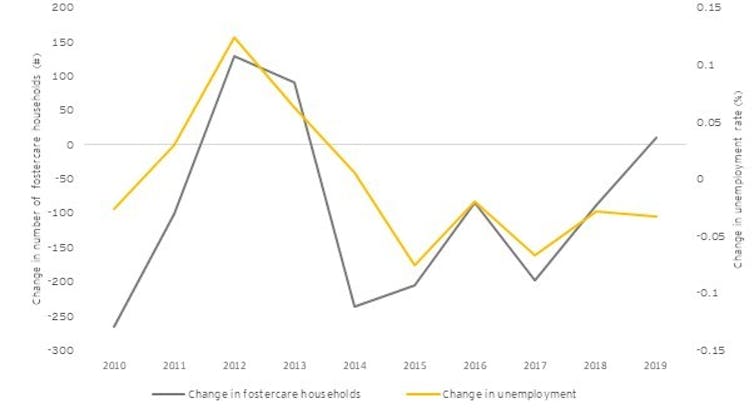
Recent history shows that as unemployment increases in Australia, so, too, does the number of people in our community who become foster carers.
Our analysis suggests this isn’t driven by foster care placement demand. Rather, more Australians are keen to support children in need when they have the time to do so.
 Author provided
As a result, now is the time to intensify foster carer recruitment efforts, assessment and training.
How we can support children and families
There are several strategies that can be used to meet the needs of at-risk children during this time. These include:
Ensuring the community understands the importance of reporting any concerns they have about children’s safety during the lockdown.
Improving support for the sector as it transitions to remote service delivery. This includes enabling child protection services to use technologies like video streaming and apps to connect with at-risk children and families, keep children connected to their biological families and provide remote counselling services.
Monitoring foster households at risk of COVID-19 and supporting these carers, including through socially distanced caseworker visits.
Making data-informed decisions on the re-accommodation of children where necessary and for placing new children entering the system, and;
Increasing efforts to recruit, train and support new foster and kinship carers.
The evidence suggests we have a window of opportunity to act swiftly to support the well-being of Australia’s must vulnerable children.
Author provided
As a result, now is the time to intensify foster carer recruitment efforts, assessment and training.
How we can support children and families
There are several strategies that can be used to meet the needs of at-risk children during this time. These include:
Ensuring the community understands the importance of reporting any concerns they have about children’s safety during the lockdown.
Improving support for the sector as it transitions to remote service delivery. This includes enabling child protection services to use technologies like video streaming and apps to connect with at-risk children and families, keep children connected to their biological families and provide remote counselling services.
Monitoring foster households at risk of COVID-19 and supporting these carers, including through socially distanced caseworker visits.
Making data-informed decisions on the re-accommodation of children where necessary and for placing new children entering the system, and;
Increasing efforts to recruit, train and support new foster and kinship carers.
The evidence suggests we have a window of opportunity to act swiftly to support the well-being of Australia’s must vulnerable children.
Authors: Melissa Kaltner, Senior Lecturer, University of Sydney

















