

PolyU researchers invent intelligent soft robotic clothing for automatic thermal adaptation in extreme heat
HONG KONG SAR - Media OutReach Newswire - 13 August 2024 - As global warming intensifies, people increasingly suffer from extreme heat. For those working in a high-temperature environment indoors or outdoors, keeping thermally comfortable becomes particularly crucial.
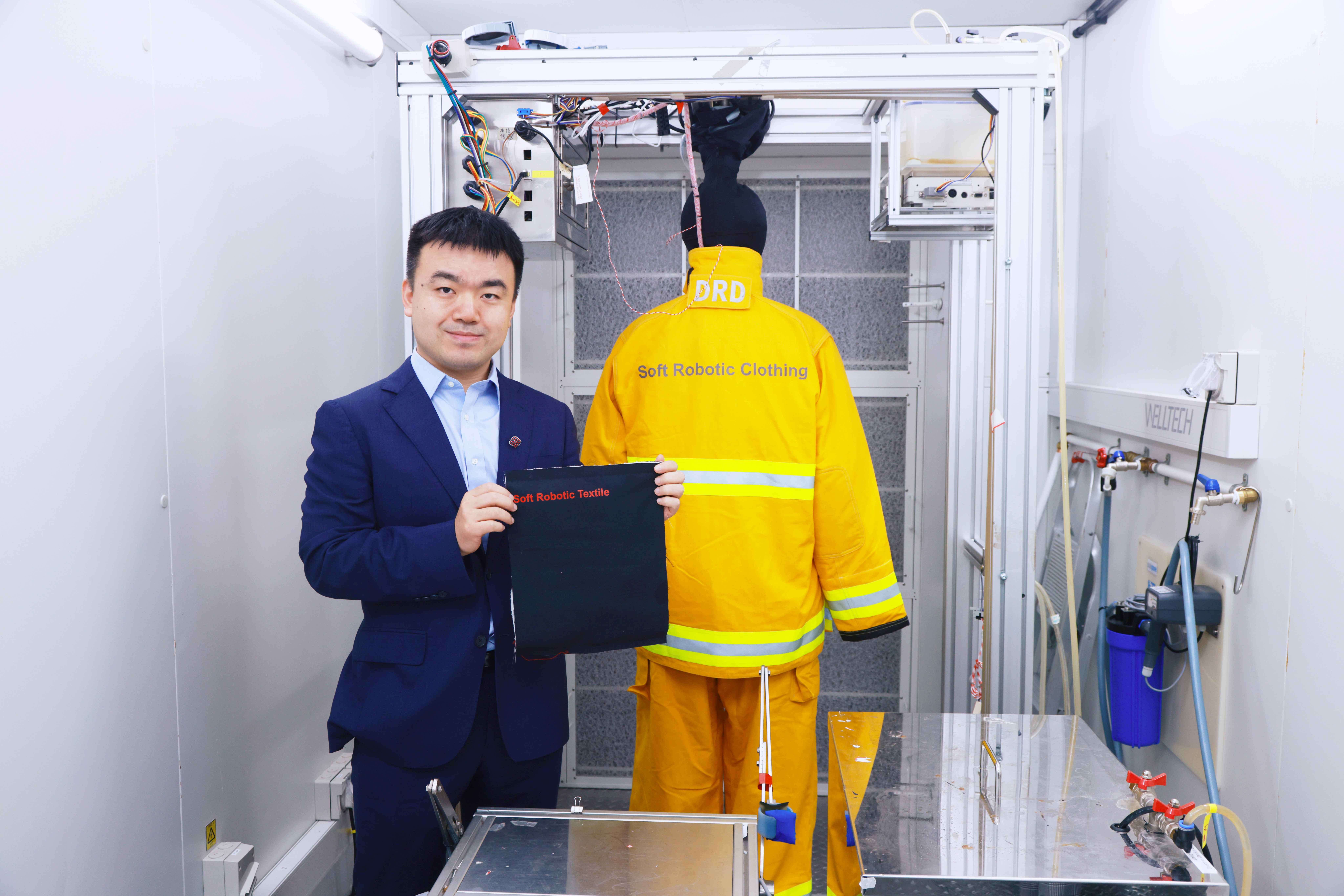
A team led by Dr Dahua SHOU, Limin Endowed Young Scholar in Advanced Textiles Technologies and Associate Professor of the School of Fashion and Textiles of The Hong Kong Polytechnic University (PolyU) has developed first-of-its-kind thermally-insulated and breathable soft robotic clothing that can automatically adapt to changing ambient temperatures, thereby helping to ensure worker safety in hot environments. Their research findings have been published in the international interdisciplinary journal Advanced Science.
Maintaining a constant body temperature is one of the most critical requirements for living and working. High-temperature environments elevate energy consumption, leading to increased heat stress, thus exacerbating chronic conditions such as cardiovascular disease, diabetes, mental health issues and asthma, while also increasing the risk of infectious disease transmission. According to the World Health Organisation, globally, there were approximately 489,000 heat-related deaths annually between 2000 and 2019, with 45% occurring in Asia and 36% in Europe.
Thermal protective clothing is essential to safeguard individuals in extreme high-temperature environments, such as firefighters who need to be present at fires scenes and construction workers who work outdoors for extended periods. However, traditional gear has been limited by statically fixed thermal resistance, which can lead to overheating and discomfort in moderate conditions, while its heat insulation may not offer sufficient protection in extreme fire events and other high-temperature environments. To address this issue, Dr Shou and his team have developed intelligent soft robotic clothing for automatic temperature adaptation and thermal insulation in hot environments, offering superior personal protection and thermal comfort across a range of temperatures.
Their research was inspired by biomimicry in nature, like the adaptive thermal regulation mechanism in pigeons, which is mainly based on structural changes. Pigeons use their feathers to trap a layer of air surrounding their skin to reduce heat loss to the environment. When the temperature drops, they fluff up their feathers to trap a significant amount of still air, thereby increasing thermal resistance and retaining warmth.
The protective clothing developed by the team uses soft robotic textile for dynamic adaptive thermal management. Soft actuators, designed like a human network-patterned exoskeleton and encapsulating a non-toxic, non-flammable, low-boiling-point fluid, were strategically embedded within the clothing. This thermo-stimulated system turns the fluid from a liquid into a gas when the ambient temperature rises, causing expansion of soft actuators and thickening the textile matrix, thereby enhancing the gap of still air and doubling the thermal resistance from 0.23 to 0.48 Km²/W. The protective clothing can also keep the inner surface temperatures at least 10°C cooler than conventional heat-resistant clothing, even when the outer surface reaches 120°C.
This unique soft robotic textile, made by thermoplastic polyurethane, is soft, resilient and durable. Notably, it is far more skin-friendly and conformable than temperature-responsive clothing embedded with shape-memory alloys and is adjustable for a wide range of protective clothing. The soft actuators have exhibited no signs of leakage after undergoing rigorous standard washing tests. The porous, spaced knitting structure of the material can also significantly reduce convective heat transfer while maintaining high moisture breathability. Not relying on thermoelectric chips or circulatory liquid cooling systems for cooling or heat conduction, the light-weighted, soft robotic clothing can effectively regulate temperature itself without any energy consumption.
Dr Shou said, "Wearing heavy firefighting gear can feel extremely stifling. When firefighters exit a fire scene and remove their gear, they are sometimes drained nearly a pound of sweat from their boots. This has motivated me to develop a novel suit capable of adapting to various environmental temperatures while maintaining excellent breathability. Our soft robotic clothing can seamlessly adapt to different seasons and climates, multiple working and living conditions, and transitions between indoor and outdoor environments to help users experience constant thermal comfort under intense heat."
Looking forward, Dr Shou finds the innovation to have a wide range of potential applications, from activewear, winter jackets, healthcare apparel and outdoor gear, to sustainable textile-based insulation for construction and buildings, contributing to energy-saving efforts. Supported by the Innovation and Technology Commission and the Hong Kong Research Institute of Textiles and Apparel, Dr Shou and his team have also extended the thermo-adaptive concept to develop inflatable, breathable jackets and warm clothing. This soft robotic clothing is suitable for low-temperature environments or sudden temperature drops to aid those who are stranded in the wilderness to maintain normal body temperature.
Hashtag: #PolyU
The issuer is solely responsible for the content of this announcement.


















