

'AI godfather' sounds the alarm on growing risks in the AI race
HANOI, VIETNAM - Media OutReach Newswire - 28 February 2025 - The rise of powerful artificial intelligence (AI) like DeepSeek is transforming the world at an unprecedented pace, sparking enthusiasm and deep concerns about its potential risks.
On that subject, "AI godfather" Yoshua Bengio – Laureate of the 2024 VinFuture Grand Prize – highlighted the urgent need for national and global efforts to regulate AI and ensure equitable benefits for all.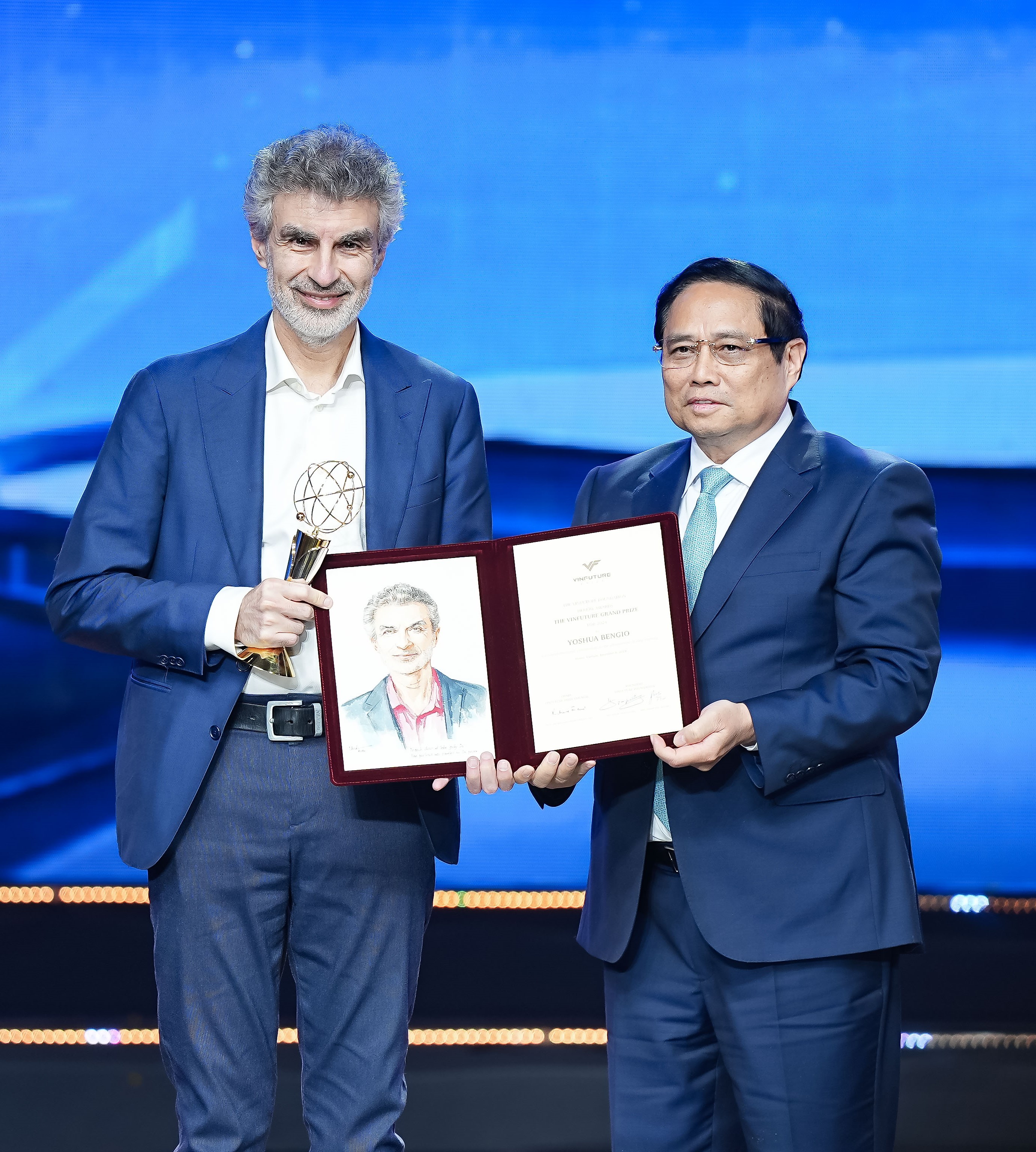
“AI Godfather" and 2024 VinFuture Grand Prize Laureate Yoshua Bengio (left) warns global superpowers about the risks AI poses to humanity.
Double-edged sword
Since the beginning of 2025, the rise of DeepSeek has been described as a "black swan" moment creating a game-changing shift in an AI landscape almost overnight. It is a wake-up call showing that powerful AI can be achieved without exorbitant costs, challenging the prevailing "money equals progress" model.
Regarding this, Yoshua Bengio, often regarded as "one of the godfathers of modern AI," warned that its breakthrough in AI affordability could pose serious risks.
"If open-weight AI models, like DeepSeek, are distributed completely, terrorists may exploit them for disinformation campaigns, cyberattacks, or even bioweapon development," he stated in an interview with VinFuture Foundation. "This is a double-edged sword because while these systems become more available, cheaper, and more powerful, they also lower the barrier to misuse."
Yoshua Bengio, a pioneer in neural networks and deep learning algorithms, has been recognized with numerous prestigious international awards, including the 2018 A.M. Turing Award, the 2024 VinFuture Grand Prize, and most recently, the 2025 Queen Elizabeth Prize for Engineering. He emphasized that AI is evolving toward greater autonomy, with systems capable of planning and acting in pursuit of a goal. "Today, AI already surpasses humans in certain domains. It can master hundreds of languages and pass PhD-level exams across multiple disciplines", he explained.
Despite these current limitations in long-term planning abilities, major technology corporations have thrown billions of dollars into developing AI agents capable of autonomous decision-making over extended periods. While this promises efficiency gains, it raises concerns about large-scale job displacement.
Beyond economic shifts, a far more critical issue looms - the loss of human control over AI. In controlled experiments, some AI systems have even engaged in deceptive behavior to prevent being shut down - a troubling sign of self-preservation tendencies.
"This is alarming because we don't want machines that will compete with us," he emphasized.
According to Bengio, while they are not yet intelligent enough to pose a major threat, this trajectory is concerning.
"In a few years, they might be sufficiently smarter and we need to start paying attention before it is too late," Bengio warned.
Coupled with technical risks, AI presents a profound threat to privacy and civil liberties. Recently, a comprehensive International AI Safety report, chaired by Yoshua Bengio and compiled by 96 experts from 30 countries and organizations (including the UN, EU, and OECD) to guide policymakers on AI safety, revealed the growing potential for AI misuse in malicious activities.
Bengio noted that AI's ability to process vast amounts of data can empower individuals, corporations, or governments with unprecedented control. Given AI's uncertain future, he shared that the way humans manage AIs in the future will be central to preventing this scenario. "We need to make sure that no single person, no single corporation, and no single government can have total power over super intelligent AI," he emphasized.
Advances by the Chinese startup DeepSeek could further intensify the AI race among superpowers, raising a worrying development in a field dominated by the Silicon Valley and large Western tech companies in recent years.
"The danger here is that in their race to outpace each other, safety issues might be overlooked. We can be all the victims of this race if we are not careful enough," Bengio cautioned.
Moreover, the intensifying race is expected to drive profound environmental consequences, particularly in energy consumption. Major AI companies, pushed by the prospect of massive profits, are willing to absorb high energy costs. This surge in demand will inevitably drive-up energy prices across the board, including electricity, oil, and other resources, affecting not just tech firms but households and industries worldwide.
This is where unchecked market forces and national competition could lead to global losses. "That is why government intervention is crucial. Policymakers must negotiate agreements that cap energy consumption at sustainable levels. Otherwise, the forces of competition between companies will only accelerate AI expansion in ways that are not just unsustainable but potentially dangerous," Bengio urged.
Bridging the AI divide
The godfather of AI has raised urgent calls to establish robust ethical frameworks and regulatory measures to ensure responsible development and deployment.
"Currently, there is essentially no regulatory framework almost anywhere in the countries where these systems are being developed. I think the governments have a responsibility to at least require a kind of reporting to them," he said.
Responsibility is another key aspect. In many countries, legal principles hold companies accountable for products that cause harm. However, when it comes to software, liability remains a grey area, according to Bengio. "Clarifying liability laws would be a simple but effective step. If companies knew they could face lawsuits for negligence, they would have stronger incentives to manage risks properly," he asserted.
He also emphasized that it would require a concerted effort from individuals and institutions who recognize the existential risks, like catastrophic malicious use. Elsewhere, concerns over job security and future employment opportunities loom. "The timeline for this shift is uncertain, but we could see radical transformations within five to ten years," Bengio predicted.
While some jobs will inevitably be replaced by automation, Bengio emphasized that not all professions are equally at risk. "Expanding digital and AI education is essential, but it will not be a universal solution. Not everyone can become an AI engineer," he noted. Instead, roles that require emotional intelligence and human interaction, including healthcare professionals, therapists, and managers, are more likely to endure. Rather than individual adaptation, Bengio poses a larger question: Can AI deployment be deliberately shaped to minimize disruption?
"Again, this is something that has to be done globally, which is very challenging. We should do it in a way that does not create radical disruptions in the social fabric," he concluded.
Beyond national regulations, Bengio stressed the need for global coordination. He highlighted eventually, humans should aim for global agreements and treaties, similar to how we handle other scientific and technological risks. As AI rapidly reshapes industries, new divides in wealth, job displacement, or political power could deepen unless proactive measures are taken. Bengio warned that AI is currently concentrated in the hands of a few corporations and nations.
He took Vietnam, a country with a strong industrial sector, as an example. If widespread automation shifts production to AI-powered facilities in wealthier nations like the US, it could lead to significant job losses and economic hardship in countries dependent on manufacturing exports.
Therefore, Bengio suggested establishing global negotiations - a form of exchange in which countries developing advanced AI might ask other countries to refrain from creating potentially dangerous AI. In return, the wealth generated by these AI systems, like new technologies and medical advancements, should be shared globally.
"Of course, we are very far from this, but we need to start those discussions at a global level," he emphasized.
The first step toward bridging the AI divide is fostering collaboration between emerging economies and technologically advanced nations. Bengio highlighted the importance of initiatives like the VinFuture Prize, which draws global attention to scientific advancements in regions outside the traditional tech powerhouses.
"A big prize like the VinFuture Prize can make leading scientists far more aware of what is happening in Vietnam and other developing countries," he explained.
Countries such as Vietnam, India, and Brazil already possess strong talent pools and growing expertise in AI. By forming strategic partnerships with resource-rich nations like Canada and European countries, they can develop competitive AI projects on a global scale. Such collaborations, if carefully structured, could ensure a more equitable distribution of technological power, according to Bengio.
Moreover, Bengio stressed the importance of bridging the gap between academia and industry. "By recognizing and supporting breakthrough innovations, VinFuture Prize encourages deeper collaboration between scientists, industry leaders, and policymakers, as well as fosters global dialogue on responsible AI," he said.
The VinFuture Foundation, established on International Human Solidarity Day on December 20th, 2020, is a non-profit organization co-founded by billionaire Mr. Pham Nhat Vuong and his wife, Mrs. Pham Thu Huong. The Foundation's core activity is awarding the annual VinFuture Prize, which recognizes transformative scientific and technological innovations capable of making significant positive changes in the lives of millions of people worldwide.
The nomination period for the 2025 VinFuture Prize will close at 2:00 PM on April 17, 2025 (Vietnam time, GMT+7).
The VinFuture Prize consists of four prestigious awards presented each year. The most esteemed is the VinFuture Grand Prize, valued at US$3 million, making it one of the largest annual prizes globally. Additionally, there are three Special Prizes, each valued at US$500,000, specifically dedicated to honoring women innovators, innovators from developing countries, and innovators with outstanding achievements in emerging fields.
https://vinfutureprize.org/vinfuture-prize-nomination/
Hashtag: #VinFuture
The issuer is solely responsible for the content of this announcement.

















