

what we can learn from the successes of post-war reconstruction
- Written by David Lee, Associate Professor of History , UNSW
As Australia begins to plot a recovery strategy from the first recession in the country in decades, the Morrison government needs to examine what has worked well in the past.
Crises require strong leadership, national cohesion and a framework for carrying out recovery efforts on a grand scale.
As such, there is a case to be made for a new Commonwealth agency to lead the recovery effort, built on the model of the Department of Post-War Reconstruction that helped Australia emerge from the turmoil of the second world war.
The Department of Post-War Reconstruction
In December 1942, Prime Minister John Curtin established the Department of Post-War Reconstruction. Even though the war was still raging, its task was to begin planning and coordinating Australia’s transition to a peacetime economy.
The department brought together a talented group of officials, many of them from the new discipline of economics, to advise the government. Its establishment reflected the efforts to which the Commonwealth government went after the war to professionalise the Australian public service.
The department did not have a large staff. It was devised as a policy department that would coordinate the work of other agencies. The treasurer, Ben Chifley, was appointed the first minister for post-war reconstruction. H. C. “Nugget” Coombs, one of Australia’s “seven dwarfs”, named for their diminutive stature, was his first departmental secretary.
Read more: Lessons from history point to local councils' role in Australia's recovery
One of the major successes of the department was its contribution to the full-employment policy, a goal set by post-war governments to achieve a higher standard of living and regular employment for all Australians after the war.
To that end, the department helped establish a new employment agency, the Commonwealth Employment Service, to match workers with jobs. It also helped overhaul the social welfare system and create the pharmaceutical benefits scheme.
Full employment became a bipartisan policy goal throughout the economic “golden age” from the end of the war to the 1970s. The policy was so popular that even the smallest deviation from it, such as during the “credit squeeze” of 1960-61, almost cost the Menzies government re-election.
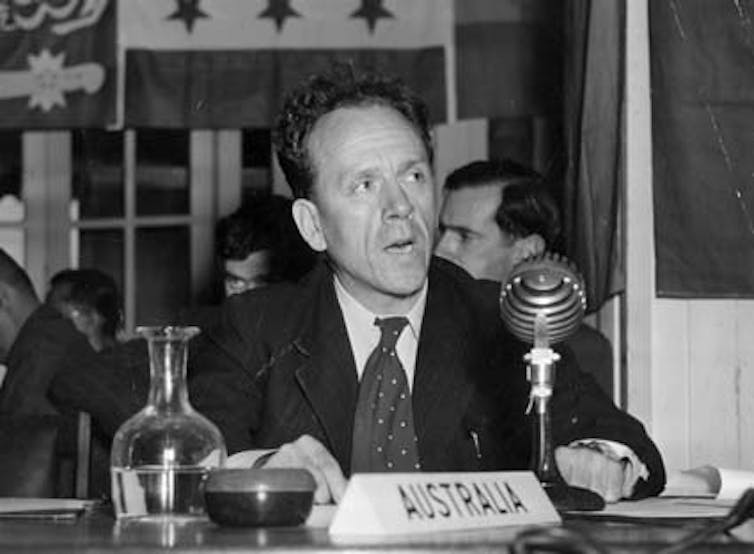 H. C. Coombs at a conference in 1948.
Wikimedia Commons
H. C. Coombs at a conference in 1948.
Wikimedia Commons
The Department of Post-War Reconstruction didn’t succeed in pushing through sweeping new federal powers for reconstruction in a 1944 referendum. Nonetheless, it found ingenious ways to foster Commonwealth-state cooperation, for instance, through section 96 grants (which provided federal funding to the states on terms and conditions set by the Commonwealth), and the federal funding of housing, hospitals and later universities in the states.
Read more: Australia's post-war recovery program provides clues as to how to get out of this
New Commonwealth-state bodies were also devised to support the coal and aluminium industries. The Commonwealth and NSW state Joint Coal Board, for example, completely revamped the almost moribund NSW black coal industry. A revived and mechanised NSW coal industry became internationally competitive and a significant export earner for Australia by the 1970s.
On the international front, Chifley and Coombs supported Australia’s participation in the 1944 Bretton Woods Conference, which reinvented the global financial system based on fixed exchange rates with the US dollar as a reserve currency. The International Monetary Fund and the World Bank were also established at the time.
Chifley and Coombs supported the new international arrangements because they understood the revival of the global economy was essential for Australia’s own prosperity. As they hoped, the Bretton Woods system, the General Agreement on Tariffs and Trade (GATT) and the Marshall Plan for western Europe all laid the global foundations for Australia’s domestic recovery.
How a post-pandemic agency might work
The federal government has already trialled a new policy-making agency during the COVID-19 pandemic with its “wartime” National Cabinet, which featured federal and state governments and their agencies working as one.
There are many ways a new economic recovery agency could build on the cohesion demonstrated by the National Cabinet and advise the Commonwealth government on rebuilding the economy.
Specifically, it could help replicate Curtin’s achievement in 1942 by advising on comprehensive reform of the Commonwealth-state taxation system. This process is already under way with several states calling for the substitution of land taxes for stamp duties.
A post-COVID-19 agency could also be involved in the revamping of the welfare system (post-JobKeeper/JobSeeker) to cope with the higher levels of unemployment and under-employment.
The agency could advise or coordinate a strategy for new infrastructure to create jobs, such as the building of hospitals, public housing and a transition to cleaner energy. Another possibility would be a return to independent petroleum refining, similar to Billy Hughes’s Commonwealth Oil Refineries that operated from 1919-52.
Read more: The PM wants to fast-track mega-projects for pandemic recovery. Here's why that’s a bad idea
And a new agency could advise on reviving other major industries, such as tourism, the airlines, the higher education sector and even the banking system. During the Global Financial Crisis, the Rudd government had to underwrite loans to the banks and guarantee bank deposits. A major intervention may again be required.
Creating a Department of Post-War Reconstruction was considered by some to be the “boldest experiment” the country took after the war. And as a result, Australia’s post-war recovery was a remarkable success. This is what we need now – another bold experiment, in the spirit of bipartisanship.
Authors: David Lee, Associate Professor of History , UNSW

















