

let's learn from COVID-19 and make the traditional workplace better
- Written by: Geoff Plimmer, Senior lecturer in Human Resource Management, Te Herenga Waka — Victoria University of Wellington
Having had to rapidly adjust to working from home due to COVID-19, many people are now having to readjust to life back in the office. Many will have enjoyed aspects of what is sometimes called “distributed work”, but some may be dreading the return.
So is there a middle ground? Could hybrid work arrangements, known for boosting well-being and productivity, be a more common feature of workplaces in the future?
We say yes. Organisations need to recognise the valuable habits and skills employees have developed to work effectively from home during the lockdown. But they will need good strategies for easing the transition back into the physical workplace.
In doing so, they should aim for the best of both worlds — the flexibility of distributed work and the known benefits of the collaborative workplace.
Read more: The death of the open-plan office? Not quite, but a revolution is in the air
Good riddance to hot-desking
A good start would be a proper re-evaluation the two worst aspects of office life: crowded open-plan designs and so-called “hot-desking”.
Cramped shared offices and free-for-all hot-desking are both known for their negative impacts on quality of workplace life. The results are often interpersonal conflict, reduced productivity and higher rates of sickness.
Some organisations have already done away with hot-desking in an effort to improve physical and mental well-being. Acknowledging the evidence that tightly packed, cost-saving, open-plan office arrangements have not delivered what was promised should be another priority.
Hopefully, the impact of COVID-19 on business as usual will spell the end of these often poorly thought through management fads.
 Work-life imbalance: how do companies help their employees and also boost productivity?
www.shutterstock.com
Work-life imbalance: how do companies help their employees and also boost productivity?
www.shutterstock.com
Working from home can be isolating
At the same time, there is no need to throw the baby out with the bathwater. The office still has its advantages, and there is research showing that working from home has clear disadvantages for employees and organisations when it is offered as a permanent arrangement.
One study involved a large (anonymous) US Fortune 100 technology firm. It began as a traditional survey of what it was like for individuals to work from home, but evolved into a study of the effect of what happened to the company’s community when working from home was normalised.
Read more: The research on hot-desking and activity-based work isn't so positive
The option of unrestricted distributed work meant employees simply stopped coming to work at the office. Many reported the well-known benefits of working from home, such as work-life balance and productivity.
They also reported a kind of “contagion effect”. As colleagues began to stay at home a tipping point arrived where fewer and fewer people opted to work in the office.
But this actually increased a sense of isolation among employees. It also meant the loss of opportunities to collaborate through informal or unplanned meetings. The chance to solve problems or be given challenging assignments were lost as well.
Those who participated in the study said social contact and productively interacting with colleagues was the main reason they wanted to come to work. Without it there was no real point. The research raises the possibility of a net loss in well-being if everyone were to work remotely.
Well-being and job satisfaction depend on a range of factors, including having clear goals, social contact and the structure of the traditional working day. Of course, jobs can also be toxic if there is too much structure. But fully distributed work may not provide the support, identity and community that offices provide for some.
Nor is technology always adequate when it comes to the subtle value of face-to-face catch ups. Five minute water-cooler talks and post-meeting debriefs still matter for both productivity, social contact and cohesion.
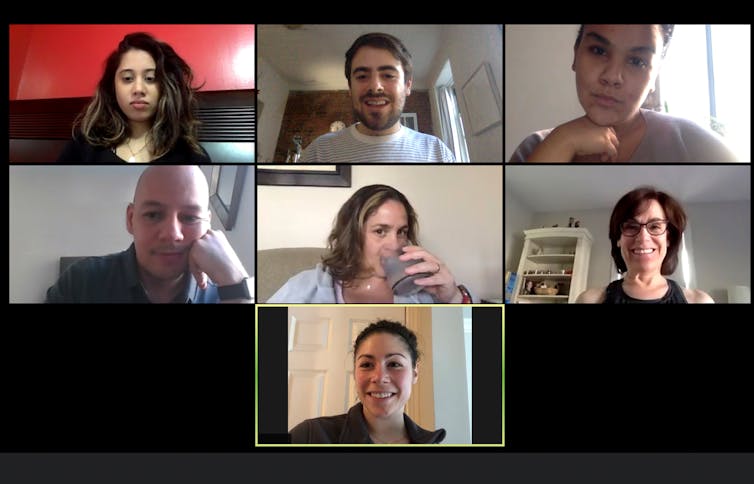 A different kind of management: motivating and maintaining morale in a distributed workplace requires new skills.
www.shutterstock.com
A different kind of management: motivating and maintaining morale in a distributed workplace requires new skills.
www.shutterstock.com
Management has to adapt too
None of which is to suggest there are not identifiable advantages of distributed work and the flexible workplace. As many of us discovered during the lockdown, just avoiding the daily commute helped with lowering stress and better work-life balance. Choosing when we worked was attractive too.
But this requires better management skills. Distributed workers require different (often better) engagement strategies, including the ability to build mutual trust.
Read more: Working from home: what are your employer's responsibilities, and what are yours?
Research into how best to manage the health and safety of distributed workers has found that some leaders simply can’t adapt to the digital environment. Trust, consideration and communicating a clear vision or sense of purpose matter more for distributed workers than for those in the traditional office.
Recognition, reward, development and advancement in a distributed working environment will all need special attention. So too will ways to deal with people not pulling their weight, maybe because of too much time on social media.
Even the simple benefits of spontaneous humour in meetings or informal team interactions are easily lost with “e-leadership”, so new ways of building and maintaining morale are vital.
This is not an either/or question. Rather, the challenge is to strike a new balance — how to retain the benefits of distributed work while maintaining the sense of community that comes from personal interaction in the office.
Authors: Geoff Plimmer, Senior lecturer in Human Resource Management, Te Herenga Waka — Victoria University of Wellington


















