what's the new coronavirus saliva test, and how does it work?
- Written by Deborah Williamson, Professor of Microbiology, The Peter Doherty Institute for Infection and Immunity
A cornerstone of containing the COVID-19 pandemic is widespread testing to identify cases and prevent new outbreaks emerging. This strategy is known as “test, trace and isolate”.
The standard test so far has been the swab test, in which a swab goes up your nose and to the back of your throat.
But an alternative method of specimen collection, using saliva, is being evaluated in Victoria and other parts of the world. It may have some benefits, even though it’s not as accurate.
Read more: Victoria is on the precipice of an uncontrolled coronavirus outbreak. Will the new measures work?
Saliva testing can reduce risks for health workers
The gold standard for detecting SARS-CoV-2 (the coronavirus that causes COVID-19) is a polymerase chain reaction (PCR). This tests for the genetic material of the virus, and is performed most commonly on a swab taken from the nose and throat, or from sputum (mucus from the lungs) in unwell patients.
In Australia, more than 2.5 million of these tests have been carried out since the start of the pandemic, contributing significantly to the control of the virus.
Although a nasal and throat swab is the preferred specimen for detecting the virus, PCR testing on saliva has recently been suggested as an alternative method. Several studies demonstrate the feasibility of this approach, including one conducted at the Doherty Institute (where the lead author of this article works). It used the existing PCR test, but examined saliva instead of nasal samples.
Read more: Keep your nose out of it: why saliva tests could offer a better alternative to nasal COVID-19 swabs
The use of saliva has several advantages:
it is easier and less uncomfortable to take saliva than a swab
it may reduce the risk to health-care workers if they do not need to collect the sample
it reduces the consumption of personal protective equipment (PPE) and swabs. This is particularly important in settings where these might be in short supply.
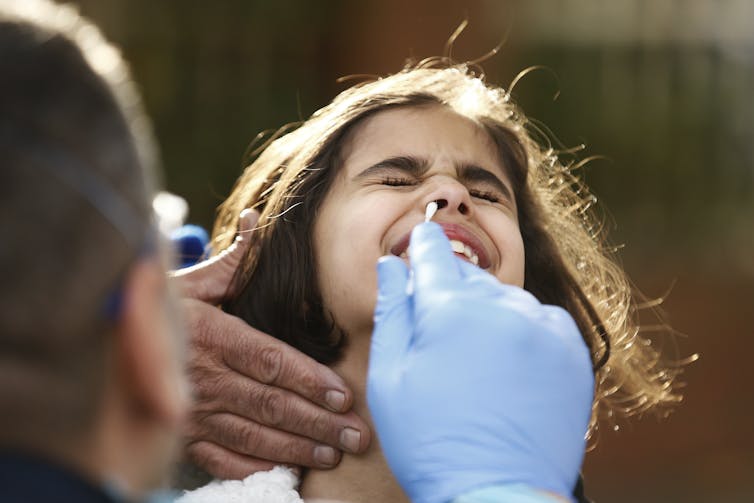 A ‘spit test’ might be more comfortable than a swab.
Daniel Pockett/AAP
A ‘spit test’ might be more comfortable than a swab.
Daniel Pockett/AAP
But it’s not as sensitive
However, a recent meta-analysis (not yet peer-reviewed) has shown detection from saliva is less sensitive than a nasal swab, with a lower concentration of virus in saliva compared to swabs. It’s important to remember, though, this data is preliminary and must be treated with caution.
Nonetheless, this means saliva testing is likely to miss some cases of COVID-19. This was also shown in our recent study, which compared saliva and nasal swabs in more than 600 adults presenting to a COVID-19 screening clinic.
Of 39 people who tested positive via nasal swab, 87% were positive on saliva. The amount of virus was less in saliva than in the nasal swab. This most likely explains why testing saliva missed the virus in the other 13% of cases.
The laboratory test itself is the same as the PCR tests conducted on nasal swabs, just using saliva as an alternative specimen type. However, Australian laboratories operate under strict quality frameworks. To use saliva as a diagnostic specimen, each laboratory must verify saliva specimens are acceptably accurate when compared to swabs. This is done by testing a bank of known positive and negative saliva specimens and comparing the results with swabs taken from the same patients.
When could saliva testing be used?
In theory, there are several settings where saliva testing could play a role in the diagnosis of COVID-19. These may include:
places with limited staff to collect swabs or where high numbers of tests are required
settings where swabs and PPE may be in critically short supply
some children and other people for whom a nasal swab is difficult.
The use of saliva testing at a population level has not been done anywhere in the world. However, a pilot study is under way in the United Kingdom to test 14,000 health workers. The US Food and Drug Administration recently issued an emergency approval for a diagnostic test that involves home-collected saliva samples.
In Australia, the Victorian government is also piloting the collection of saliva in limited circumstances, alongside traditional swabbing approaches. This is to evaluate whether saliva collection is a useful approach to further expanding the considerable swab-based community testing occurring in response to the current outbreaks in Melbourne.
Read more: These 10 postcodes are back in Stage 3 coronavirus lockdown. Here's what that means
A saliva test may be better than no test at all
Undoubtedly, saliva testing is less sensitive than a nasal swab for COVID-19 detection. But in the midst of a public health crisis, there is a strong argument that, in some instances, a test with moderately reduced sensitivity is better than no test at all.
The use of laboratory testing in these huge volumes as a public health strategy has not been tried for previous infectious diseases outbreaks. This has required a scaling up of laboratory capacity far beyond its usual purpose of diagnosing infection for clinical care. In the current absence of a vaccine, widespread testing for COVID-19 is likely to occur for the foreseeable future, with periods of intense testing required to respond to local outbreaks that will inevitably arise.
In addition to swab-free specimens like saliva, testing innovations include self-collected swabs (which has also been tested in Australia), and the use of batch testing of specimens. These approaches could complement established testing methods and may provide additional back-up for population-level screening to ensure testing is readily available to all who need it.
This article is supported by the Judith Neilson Institute for Journalism and Ideas.
Authors: Deborah Williamson, Professor of Microbiology, The Peter Doherty Institute for Infection and Immunity