

As world leaders rose to the occasion at the Biden climate summit, Morrison faltered
- Written by Lesley Hughes, Professor, Department of Biological Sciences, Macquarie University
Prime Minister Scott Morrison overnight addressed a much anticipated virtual climate summit convened by US President Joe Biden, claiming future generations “will thank us not for what we have promised, but what we deliver”.
But what will his government actually deliver?
Morrison’s speech was notable for its stark lack of ambition and a defensive tone at odds with the urgent, front-footed approach of other world leaders. He resisted the peer pressure to enter the global fold on climate action by setting clear goals, saying Australia made only “bankable” emissions-reduction commitments.
Morrison instead pointed to Australia’s “transformative technology targets”. As we will explain below, those targets are small, vague and certainly not “bankable”. And the spending commitments pale in comparison to the past and future cost of extreme weather in Australia.
Expectations of Australia heading into the summit were low – a fact perhaps reflected in the summit’s agenda. Morrison’s address was way down in the running order – he was 21st of 27 speakers. Biden was reportedly not in the room when Morrison spoke. And in an unfortunate glitch, Morrison’s microphone was on mute at the start of his speech.
The summit did deliver some major gains. There was palpable relief as Biden brought the US back to the table on global climate efforts, committing to an emissions-reduction target twice the ambition of Australia’s. Other nations including Japan, Canada and Britain also outlined major new commitments.
But sadly for Australians, the summit revealed the stark contrast in climate policy leadership between Morrison and his international peers.
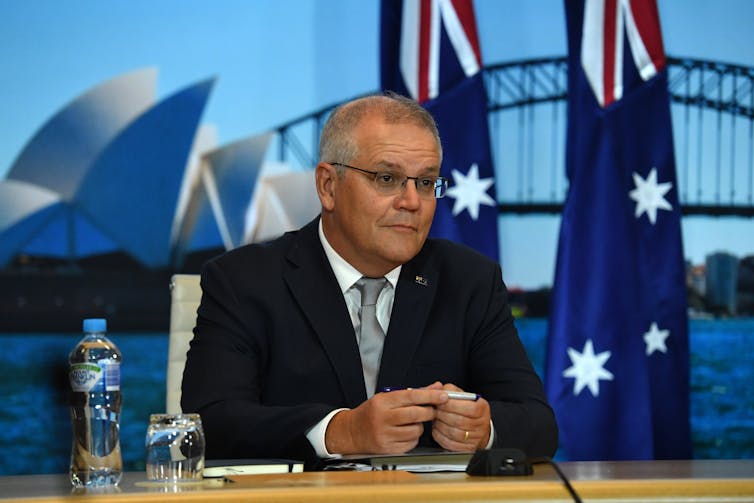 The contrast on climate policy leadership between Scott Morrison and Joe Biden was on display at the summit.
Mick Tsikas/AAP
The contrast on climate policy leadership between Scott Morrison and Joe Biden was on display at the summit.
Mick Tsikas/AAP
The world steps up
Biden opened the summit by emphasising the urgent need to keep global warming below 1.5℃ This century. Failing to do so, he said, would bring:
More frequent and intense fires, floods, droughts, heat waves, and hurricanes tearing through communities, ripping away lives and livelihoods, increasingly dire impacts to our public health […] We can’t resign ourselves to that future. We have to take action, all of us.
Biden committed the US to a 50-52% emissions reduction by 2030 compared with 2005 levels. Other notable emissions-reduction pledges included:
There were hopes Morrison would use the summit to announce Australia would finally join more than 100 countries to set an emissions target of net-zero by 2050. (Australia’s current emissions trajectory has us on track to get to net-zero in the year 2167).
But Morrison dashed those hopes early, telling world leaders: “For Australia, it is not a question of if or even by when for net-zero, but importantly how”.
He pointed to the government’s Technology Investment Roadmap, including A$20 billion to bring down the cost of clean hydrogen, green steel, energy storage and carbon capture. He also spoke of a goal to produce clean hydrogen for A$2 a kilogram, and his dream that Australia’s hydrogen industry would one day rival the scale of California’s Silicon Valley.
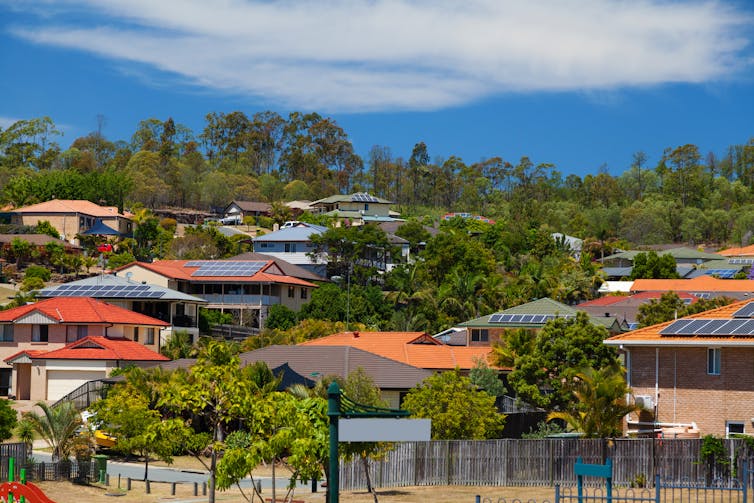 Morrison spruiked Australia’s high uptake of rooftop solar.
Shutterstock
Morrison spruiked Australia’s high uptake of rooftop solar.
Shutterstock
Will technology save us? Not likely
Earlier this week, Morrison set the scene for his address by announcing a suite of technology funding commitments. Let’s take a closer look at them.
On Wednesday Morrison announced A$540 million for regional hydrogen hubs and carbon-capture and storage (CCS) projects. Some A$275 million will be committed to seven hydrogen hubs in regional areas over five years – that’s about A$7.8 million per hub each year.
It’s hard to see this buying much more than a plan on a piece of paper. Further, there’s little detail on how much will be spent on clean vs dirty hydrogen – that is, hydrogen generated from renewables vs fossil fuels. However the proposed location of some of these hubs in fossil-fuel rich areas, such as the Latrobe Valley and Hunter Valley, does not bode well.
A further A$263.7 million over ten years will fund CCS projects. Since 2003, the Australian government has spent more than A$1 billion on CCS projects, with very little to show for it.
Globally, CCS has been criticised as unproven and expensive, simply designed to extend the life of fossil fuel industries.
Read more: 'Failure is not an option': after a lost decade on climate action, the 2020s offer one last chance
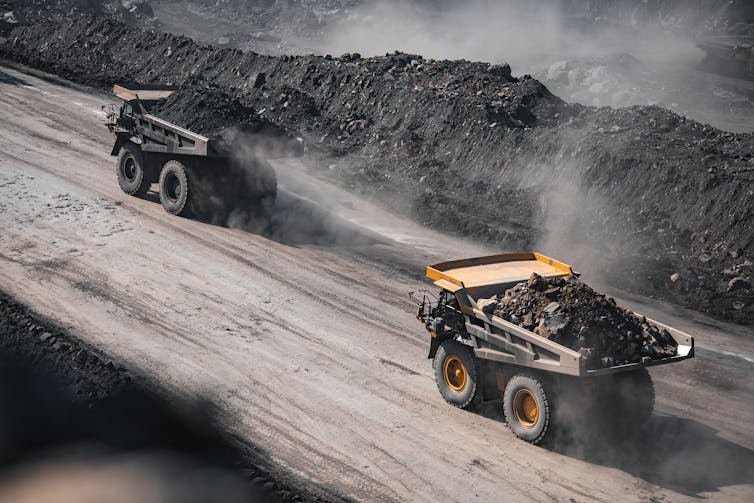 CCS critics say it is simply a move to prop up fossil fuel industries.
Shutterstock
CCS critics say it is simply a move to prop up fossil fuel industries.
Shutterstock
The third tranche of funding, announced on Thursday, is A$566 million for research partnerships with other countries for new technology such as green steel, small modular nuclear reactors and soil carbon storage. There was little detail in the announcement, so for now it remains rather hypothetical.
In sum, the government will spend a relatively small amount on hydrogen production and CCS, spread wafer thin in various regional areas (and at least some of it subsidising fossil fuels), plus hypothetical funding for research.
Compare this to the A$35 billion cost of extreme weather disasters in Australia between 2010 and 2019, as detailed in this Climate Council report.
More recently, the New South Wales government estimated the potential cost of last month’s devastating floods at A$2 billion. A report by the NSW Treasury estimated by 2061, future economic costs of climate impacts in four key risk areas (bushfires, sea level rise, heatwaves and agricultural production) could reach up to A$17.2 billion a year – and this is just for NSW.
Read more: Cyclone Seroja just demolished parts of WA – and our warming world will bring more of the same
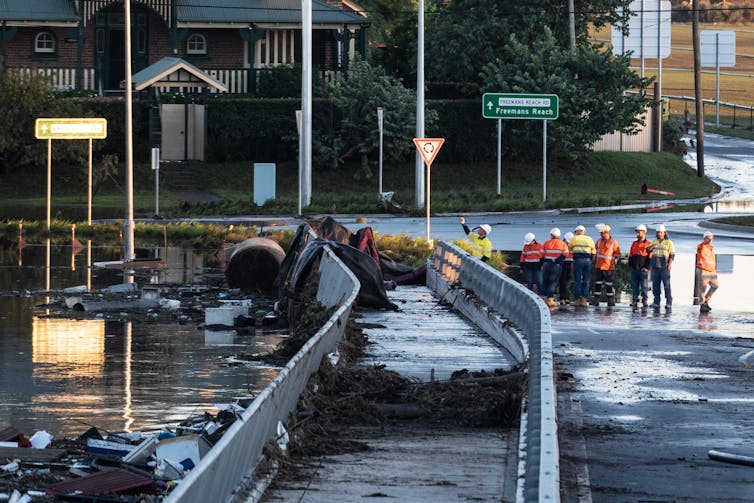 The recent NSW floods caused $2 billion in damage, the state government says.
James Gourley/AAP
The recent NSW floods caused $2 billion in damage, the state government says.
James Gourley/AAP
A tale of two leaders
Morrison told world leaders Australia would update its emissions-reduction target ahead of the Glasgow climate summit later this year. The current target – a 26-28% cut by 2030, based on 2005 levels – is broadly viewed as woefully inadequate.
Any increased ambition would be long overdue. However, more broadly, the contrast on climate policy between Morrison and Biden could not be clearer. Biden used the summit to tell world leaders:
Your leadership on this issue is a statement to the people of your nation and to the people of every nation, especially our young people, that we’re ready to meet this moment […] We really have no choice. We have to get this done.
Morrison, depressingly, showed little sign of hearing that message.
Authors: Lesley Hughes, Professor, Department of Biological Sciences, Macquarie University

















