Thirteen years after 'Sorry', too many Aboriginal and Torres Strait Islander children are still being removed from their homes
- Written by Sharynne Hamilton, Post-Doctoral Research Fellow Aboriginal Health, Telethon Kids Institute
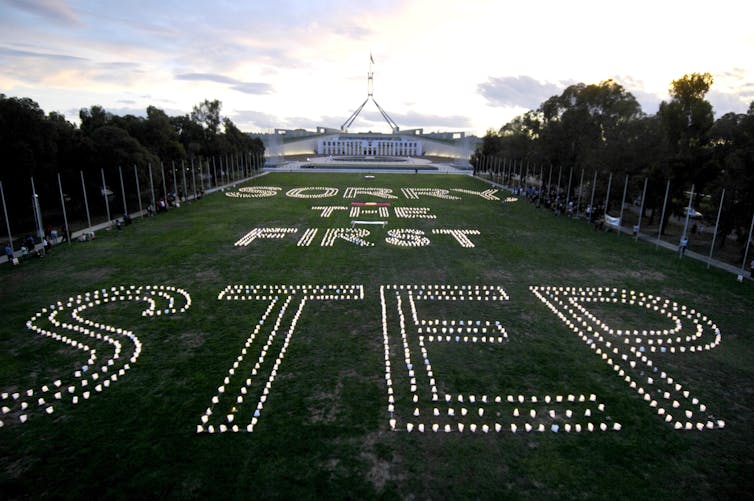
On February 13, 2008, then-Prime Minister Kevin Rudd said “we are sorry” to members of the Stolen Generations. This was a significant moment in the shameful history of Australia’s treatment of Aboriginal and Torres Strait Islander peoples.
The Apology represented a formal acknowledgement that the forced removal of Aboriginal and Torres Strait Islander children was based on racist policies that caused unspeakable harm to our communities.
Children were forced off their lands. They were disconnected from their kin, Country, traditional languages and culture.
Today on Sorry Day, 13 years since the Apology, our Elders, families and communities still grieve these losses. And many families are being repeatedly traumatised by contemporary child removal practices. Aboriginal and Torres Strait Islander children are nearly 10 times more likely than non-Indigenous children to be in out-of-home care.
To find new ways to confront this problem and promote community-identified solutions, the Ngulluk Koolunga Ngulluk Koort (Our Children, Our Heart) project conducted consultations with over 100 Elders and senior Aboriginal community members in Perth.
The Elders and community members repeatedly expressed concerns they were not being consulted or included in decisions being made about child protection interventions.
 We need a new strategy for creating a more responsive and just child protection system.
Alan Porritt/AAP
We need a new strategy for creating a more responsive and just child protection system.
Alan Porritt/AAP
Families still being separated
Aboriginal and Torres Strait Islander children have a right to be kept safe and free from harm. Removing them from their families has been proven to have devastating consequences. They are vulnerable to a lifetime of grief and loss, shattered identities, poor health outcomes and intergenerational trauma.
Aboriginal and Torres Strait Islander families involved with the child protection system represent some of the most marginalised and stigmatised members of our community. We are witnessing child removals across multiple generations, yet policymakers are not making connections between the past harms of the Stolen Generations and the current problems families are experiencing.
This leaves little room to redress the harm that past policies have inflicted.
We need a new strategy for creating a more responsive and just child protection system.
This requires a public debate about the thresholds for child removal and for clearly defining what it means to be a “good enough” parent to maintain guardianship of a child. And we need to reassess what actually constitutes risky parenting.
There is a lack of national leadership and coordinated, inclusive and culturally secure practice in the child protection system. Decisions are no longer made explicitly based on race, but there are enduring problems with how the actions taken by authorities affect Aboriginal and Torres Strait Islander families.
Read more: First Nations families need support to stay together, before we create another Stolen Generation
The role of Elders bringing families together
In the Ngulluk Koolunga Ngulluk Koort project, most of the Elders were either part of the Stolen Generations themselves, or have directly experienced the effects of that era.
They called for a recognition of the harm these past policies caused, and for this to be used as a foundation for formulating future policies and practices. They highlighted the deep distrust of “the welfare” (child protection services) that continues to flow through communities.
The Elders also discussed the ongoing disregard of the Aboriginal and Torres Strait Islander child placement principle. Aboriginal and Torres Strait Islander children are disproportionately being placed with non-Indigenous carers, despite the placement principle’s recommendation against this.
As part of the project, the Elder co-researchers developed principles and practice recommendations of their own.
These call for child protection services to harness resources from the vast social networks that exist in the Aboriginal and Torres Strait Islander community and communicate respectfully with these community members. By doing this, trust can begin to be restored to families and damaged relationships can begin to heal. Hope can be cultivated, and the need for removing children in the future can be reduced.
 Child protection services need to consider the potential role of Aboriginal and Torres Strait Islander elders in offering solutions that avoids separating families.
Julieanne Birch/Getty Images
Child protection services need to consider the potential role of Aboriginal and Torres Strait Islander elders in offering solutions that avoids separating families.
Julieanne Birch/Getty Images
What the Elders call for resonates with the concept of responsive regulation. This means that regulators — in this case the child protection authority — need to take into account the cultures, behaviours and environments of the people they are regulating.
Responsive regulation promotes restorative practices that are relationship-centred and geared toward solving problems. These practices involve future-focused conversations that draw on the skills and insights that exist in communities.
Principles of responsive regulation and those developed by the Elders offer a counter-balance to the current formalistic approaches of child protection services, such as mandatory reporting, forensic investigations, court hearings, timelines for termination of parental rights, and the adoption of children in care.
Nationally, we need a greater commitment to using family group conferencing forums that prioritise Aboriginal and Torres Strait Islander decision-making.
Elders have deep knowledge from lived experience and their voices must be heard. Their principles and practice recommendations, as well as their values and beliefs about raising strong children, give us a pathway to positive change.
The Elders advocate community-led, place-based solutions to child protection concerns. They stress this is the only way we can move forward and repair the harms from past policies that have wreaked havoc in our communities. We must do better for our children.
Authors: Sharynne Hamilton, Post-Doctoral Research Fellow Aboriginal Health, Telethon Kids Institute