Australia's news media play an important role reminding the country that Black lives still matter
- Written by: Bonita Mason, Senior Lecturer in Journalism, University of South Australia
Aboriginal and Torres Strait Islander readers are advised this article contains names of people who have passed away, and descriptions of these deaths.
One year has passed since George Floyd’s death under the knee of a Minneapolis police officer. Floyd’s name is imprinted upon our consciousness, as it should be.
However, in Australia we know less about the more than 474 Indigenous people who have died in police or prison custody in the 30 years since the Royal Commission into Aboriginal Deaths in Custody.
While Floyd’s death and the Black Lives Matter movement sparked extensive media attention, Australian Indigenous deaths in custody have had a harder time attracting sustained coverage, particularly from mainstream news outlets. Media attention on the issue has been episodic and too often absent.
The Great Australian Silence continues
As Darumbal and South Sea Islander journalist Amy McQuire says, there is a national apathy in response to First Nations deaths in custody. McQuire, who consistently reports on deaths in custody as an independent journalist, says: “When Aboriginal people die in custody there is a national silence”. Some deaths in custody break through, but many more pass unnoticed.
The royal commission stated that to reduce Aboriginal deaths in custody it is critical to reduce imprisonment rates (which have doubled since 1991), and to improve the exercise of the duty of care owed to people in custody.
Two Indigenous deaths in custody, 20 years apart, demonstrate the failure to achieve both.
In 1994, 30-year-old Aboriginal woman Ms Beetson died of treatable heart disease in Sydney’s Mulawa women’s prison.
She was admitted to prison unwell; previous open-heart surgery and other concerns were highlighted on her admittance form. She was given a cursory medical examination and her symptoms were put down to drug withdrawal. Over a week, she became weaker and sicker, received no effective medical attention and died alone in a cell.
In 2014, Yamatji woman Ms Dhu, 22, was arrested for unpaid fines, against royal commission recommendations. She was held in a South Hedland, WA, police watch house for three days in intense pain and growing sicker.
The usual assumptions were made about drug withdrawal and that she was “faking it”. She died of staphylococcal septicaemia and pneumonia.
Twenty years apart, the circumstances around Ms Beetson’s and Ms Dhu’s deaths reflect the same inadequate medical treatment, inhumanity, lack of professionalism and failures. Both medical conditions were treatable and both deaths preventable.
But the story of Ms Dhu’s case broke through, due to local and effective activism, and because the media landscape had started to change.
The year before Ms Dhu’s death, The Guardian began publishing an online Australian edition. Guardian journalist Calla Wahlquist reported at least one story every day from the inquest into Ms Dhu’s death.
The Guardian’s sustained deaths in custody reporting and its “Deaths Inside” database have made a difference to deaths in custody coverage.
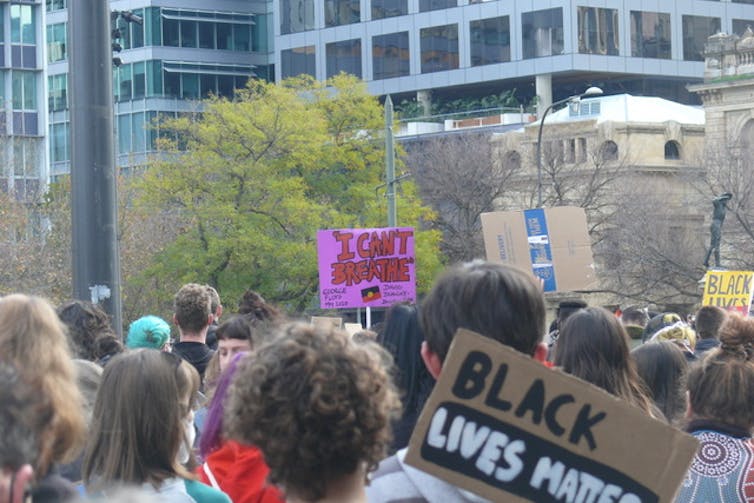 Australian journalists must report the chain of events that lead to Aboriginal deaths in custody.
Provided by author, Author provided (no reuse)
Australian journalists must report the chain of events that lead to Aboriginal deaths in custody.
Provided by author, Author provided (no reuse)
Australian media needs to keep addressing deaths in custody
Media attention was important in helping to create the conditions for the royal commission’s establishment. Among the more influential and agenda-setting stories were those by Western Australian freelance journalist Jan Mayman reporting on Roebourne teenager John Pat’s 1983 death for The Age, and a 1985 Four Corners program presented by David Marr.
In its report and recommendations, the royal commission recognised the important role of the media as a form of “collective conscience”, contributing to the possibility of increased justice for Aboriginal people.
The release of the royal commission’s final report was a Black-lives-just-could-matter moment in Australia.
Here was the blueprint for transforming the life chances of Aboriginal people, and the relationship between Aboriginal and non-Aboriginal Australians. Implementing the report’s 339 recommendations could reduce imprisonment rates, deaths in custody, inequality and disadvantage.
When the report was released, the media was again interested and engaged. Aboriginal people’s points of view were heard, and Aboriginal deaths in custody became an important story that put individual deaths into context. However, this kind of reporting soon fell away.
Four years after the report, governments were claiming successful implementation of the royal commission’s recommendations. However, the Australian Institute of Criminology was reporting deaths in prison at record levels.
Research by the Australian Centre for Independent Journalism found the media uncritically reported government implementation claims as if they were true.
Non-Indigenous journalists need to step up
While First Nations journalists, such as Amy McQuire, Gamilaraay and Yawalaraay woman Loreena Allam and Muruwari man Allan Clarke, are telling stories of injustice meted out to Aboriginal people, non-Indigenous journalists must also keep telling stories about the injustices caused by colonisation.
It took an event in the US to spark the Indigenous lives matter response across Australia. Journalists must continue to report on the chain of events that lead to Black deaths at the hands of the state.
How we can do this:
We can report the facts, for instance, Indigenous adult and youth apprehension and imprisonment rates, Aboriginal youth and adult suicide rates, coronial inquest findings and recommendations.
We can interview witnesses, family members and representatives, police and prison officers, and other experts and report what they and other informed commentators say about the facts, consequences and causes of those deaths.
We can investigate and discern the patterns emerging from these deaths; the similar facts and common factors, the same systemic failures, the ongoing evidence of institutional racism.
Through our journalism we need to honour each person who has died, and try to bring some comfort to their affected families and communities.
As investigative journalist Allan Clarke says:
Australia, we can do better and we must do better.
See here for resources and guides for what we as journalists can do.
Authors: Bonita Mason, Senior Lecturer in Journalism, University of South Australia