

Tokyo Olympiad, Kon Ichikawa’s documentary of the 1964 Games, is still a masterpiece
- Written by: Kenta McGrath, Sessional Academic in Screen Arts, Curtin University
Of the countless documentaries about the Olympic Games, two have long held their place on the podium.
The first is Olympia (1938), Leni Riefenstahl’s landmark two-part film about the controversial 1936 Berlin Games. Funded by the Nazi regime and made with the backing of the International Olympic Committee, it is both a monumental propaganda piece and a majestic celebration of athletic strength and beauty.
The second is Kon Ichikawa’s far lesser known, but no less audacious, Tokyo Olympiad (1965).
Ichikawa was a prolific and renown director, best known for The Burmese Harp (1956) and Fires on the Plain (1959) — a pair of bleak, but humanistic, anti-war films — and the stylistically daring An Actor’s Revenge (1963).
Tokyo Olympiad was his first documentary. He held little interest in sport, let alone the Olympics, when he scored the gig.
For his homework, he studied Riefenstahl’s film exhaustively.
Like Riefenstahl, Ichikawa employed a vast array of techniques to showcase athletic feats with an abstract grandeur. And, like his predecessor, he was granted a wealth of access and resources: he had at his disposal more than 100 cameras, cutting-edge equipment and a small army of technicians.
Besides the historical and political context, there remains a crucial difference between the two documentaries. Fascism infused the Berlin Games and Riefenstahl’s film elevated the Olympics to mythic proportions, portraying athletes as something bordering on supernatural.
In Tokyo Olympiad, the athletes — like the spectators and officials given almost equal attention — come across as human. No more, and no less.
Read more: Leni Riefenstahl: both feminist icon and fascist film-maker
Moments big and small
Other than an occasional caption or narration, there is minimal effort to inform the viewer who won what at the 1964 Tokyo Games. While some key events receive their due coverage — Ethiopian Abebe Bikila’s marathon victory is given an epic treatment — others don’t get so much as a mention.
Tokyo Olympiad isn’t a film of facts and statistics. Ichikawa depicted events not necessarily as they happened, but as he saw them to be.
The wrestling is a claustrophobic tangling of limbs. The walking race a comical dance of bobbing heads and swaying butts. The rifle competition is reduced to a series of Sergio Leone-esque close-ups of eyes deep in concentration.
 ‘The wrestling is a claustrophobic tangling of limbs.’
Tokyo Olympiad/IMDB
‘The wrestling is a claustrophobic tangling of limbs.’
Tokyo Olympiad/IMDB
Despite the massive scope and scale of the production, Tokyo Olympiad is as committed to highlighting minutiae as to presenting spectacle.
There’s the fascinating, twitchy ritual of Soviet shot-putter Adolf Varanauskas before he makes the throw. The curious sight of Japanese hurdler Ikuko Yoda placing a lemon on the starting block. And the blistered and bleeding soles of marathon runners who collapse after they limp to the finish line.
When English runner Ann Packer wins the 800 metre final, Ichikawa replays the end of the race in slow motion with the soundtrack stripped almost bare, capturing the moment she smiles at her fiancé watching from the sidelines.
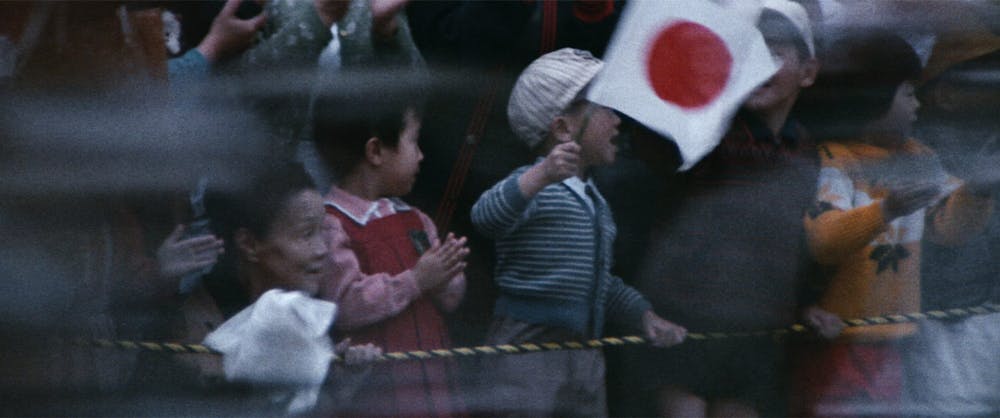 ‘Ichikawa dedicates as many close-ups to spectators as he does to competitors.’
Tokyo Olympiad/IMDB
‘Ichikawa dedicates as many close-ups to spectators as he does to competitors.’
Tokyo Olympiad/IMDB
Ichikawa dedicates as many close-ups to spectators as he does to competitors. He delights in watching officials scrambling to ensure events run smoothly. He crafts impressionistic interludes: a frenzied montage of typewriters in the press room; a melancholic passage showing the rain beginning to fall.
Winners and losers
The 1964 Tokyo Olympics embodied the optimism of Japan’s triumphant economic and social transformation in the two decades after the second world war. But there’s little flag-waving in Ichikawa’s film. The city is hardly shown. The Japanese team’s 16 gold medals (behind only the US and USSR) is underplayed.
The Japanese authorities who commissioned the film were expecting a straightforward documentary which faithfully recorded results and promoted the nation’s achievements. They were unimpressed by Ichikawa’s artistry.
Their disapproval did not affect audiences’ enthusiasm. Tokyo Olympiad was watched by 23 million people upon its release in Japan, holding the box-office attendance record until Hiyao Miyazaki’s Spirited Away in 2001.
Ichikawa’s refusal to bow to patriotic impulses wasn’t a simple act of defiance (ironically, Japanese leftists also criticised the film for being too nationalistic). His stance was consistent: he celebrated the underdogs and the losers as much as the winners; he privileged individuals over the nations they represented.
American Billy Mills won the 10,000 metre race, but in Tokyo Olympiad images of lesser athletes linger just as strongly. A runner’s surprise at getting lapped is captured in a freeze frame; a dejected participant is shown unable to finish. A competitor from Ceylon (now Sri Lanka) comes dead last, but receives a rousing ovation as he runs the final lap alone.
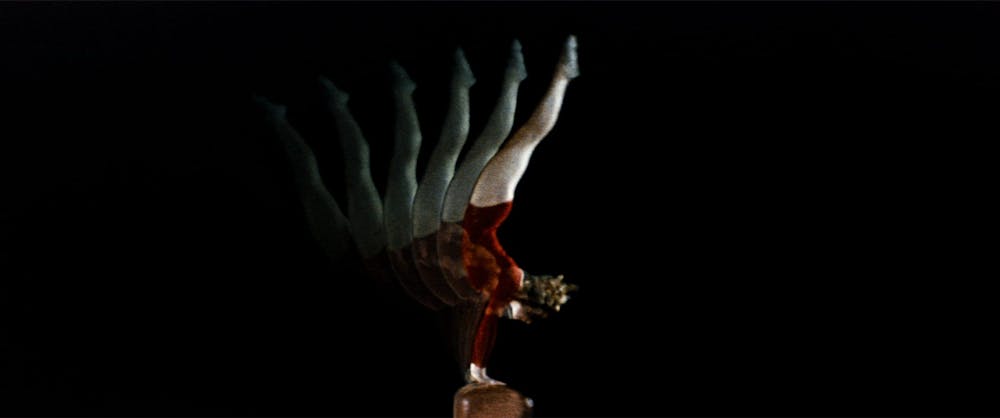 ‘Ichikawa privileged individuals over the nations they represented.’
Tokyo Olimpiad/IMDB
‘Ichikawa privileged individuals over the nations they represented.’
Tokyo Olimpiad/IMDB
Elsewhere, Ichikawa devotes a lengthy section to the middle-distance runner Ahmed Issa, one of just two representatives from the newly independent Chad. Issa doesn’t qualify for the final, but Ichikawa is drawn to his quiet dignity and resilience. He follows the athlete as he arrives in Tokyo, wanders the streets, runs his race, and eats alone in the mess hall after bowing out of the competition.
This emphasis on an unknown athlete from a little-known nation, whom history likely would’ve forgotten otherwise, speaks volumes about Ichikawa’s priorities.
Tokyo Olympiad mark II
The celebrated Japanese director Naomi Kawase has been commissioned to make the official 2021 documentary. Her assignment may be the toughest yet.
The optimism that surrounded the 1964 Games is in short supply. Most in Japan oppose the Olympics going ahead. Medical experts continue to warn of the dangers of pressing on. If Kawase points her cameras at the stands, they will be empty.
Kawase has huge shoes to fill. She’ll be following in the footsteps of a fellow Japanese director who made one of the great sporting documentaries — if not simply one of the great documentaries.
But she will, no doubt, make the 2021 Games her own.
The restored Tokyo Olympiad can be streamed on the International Olympic Committee website.
Authors: Kenta McGrath, Sessional Academic in Screen Arts, Curtin University


















