

How do you teach a child to swallow a pill? Hint: use lollies
- Written by: Nial Wheate, Associate Professor of the Sydney Pharmacy School, University of Sydney
When was the last time you swallowed a pill, be it a tablet or capsule? This morning or sometime in the past week? Now, can you remember the very first time you had to take a pill? Probably not.
Unlike your first kiss, there is usually nothing remarkable about the first time you take a pill. But taking solid medicines orally does not come naturally and chances are you had to be taught how to do it. And because you don’t remember how you were taught it can be hard for parents to figure out how to teach their kids to do it too.
But here’s how to make the learning process fun and safe.
Read more: Curious Kids: why do we burp?
Is this necessary?
Before trying to teach your child to swallow a pill, first see if your child really needs to learn.
Most medicines commonly used by children under 12 years of age are readily available as formulations other than pills. These include liquids, suspensions, chewable tablets and suppositories. The liquids and suspensions usually come in palatable flavours.
Doctors can also write prescriptions to allow pharmacists to compound (make up) some drugs usually available as a pill into a suspension instead.
If these options aren’t available, you will need to teach your child to swallow a pill. You’ll also need to go down this path as your child gets older, their weight increases, and some of the child-friendly formulations are no longer suitable. That’s because the higher doses often needed can be impractical to give using children’s products. So it would be much easier and cheaper to use a tablet or a capsule.
However, don’t be tempted to crush or break a pill for them, or ask them to chew it, unless your pharmacist has given the go-ahead for that medicine. This can affect the way the medicine is absorbed, which could lead to an overdose.
Read more: Health Check: is it OK to chew or crush your medicine?
Turn it into a game
Teaching relaxation techniques, learning by imitation or modelling, and learning by repetition and exercise are all useful ways to teach pill swallowing. However, turning it into a game is popular.
First of all, this method is NOT suitable for children under five. The mechanics of swallowing are too difficult for them to understand and both you and the child are likely to end up frustrated. Also, the younger they are, the smaller their throat and the likelihood something will get stuck.
The basis of the game is to start your child trying to swallow very small, everyday foodstuffs and work your way up to things the size of a pill. Lollies (candy) are best because you don’t have to convince your child to play the game.
More importantly, lollies are water soluble so if there are any problems you can ask your child to have a big drink of water to break it apart. If you don’t know if the lolly is water soluble, test it first in a glass of water to see if it dissolves.
Read more: Sickly sweet or just right? How genes control your taste for sugar
Ready, steady, go!
Start your child on the smallest sized lolly. Ask them to sit up straight, facing forward, without tilting their head up or down. Ask them to take a sip of water before each lolly, to get them prepared for the swallowing action. Then ask them to place the lolly on their tongue (towards the back is best) and take another sip to wash it down.
If they can swallow that, move up to the next size. But if they can’t, ask them to chew and swallow it, and try again.
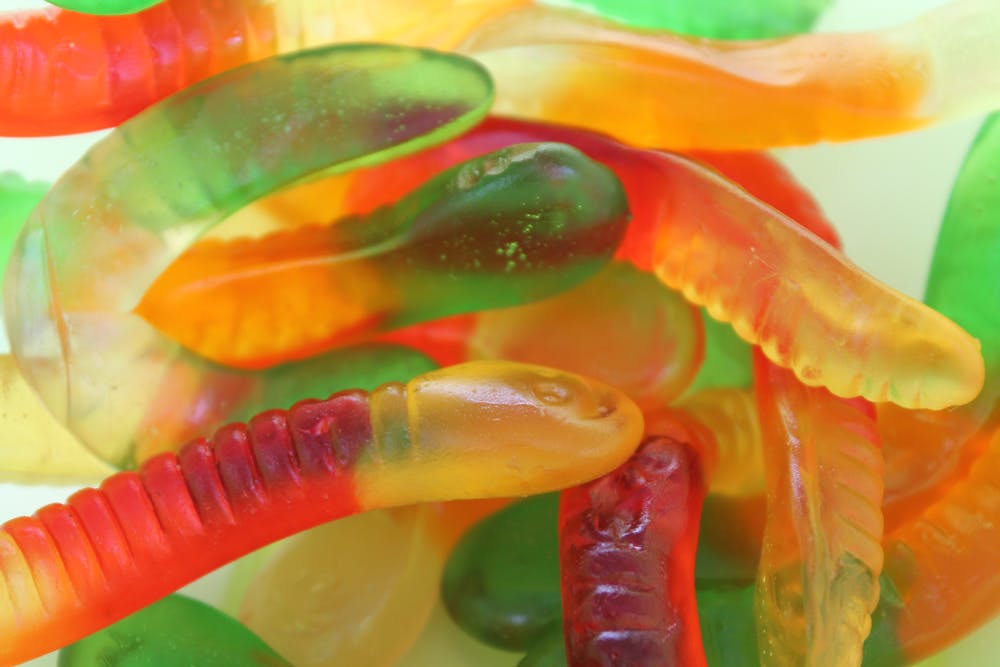 Snake lollies can come in handy and your child is unlikely to complain.
from www.shutterstock.com
Snake lollies can come in handy and your child is unlikely to complain.
from www.shutterstock.com
Our version of the game uses lollies available in Australia, increasing in size: sprinkles (such as hundreds and thousands), Nerds, Tic Tacs, M&Ms (normal, not peanut or crispy), and then snakes.
With snakes, you can cut off and swallow the head, about the size of a pill, before cutting up pieces of the body to the same size.
Some dos
do joke around and make the activity fun. Get family involved as children need to be comfortable when playing
do make sure it’s the only activity they are doing. You want your child’s full attention
do give praise. The game is all about building confidence
do put the lolly into a soft food stuff if you want. Some children find lollies, or even real pills, easier to swallow if they are in a small spoonful of pureed fruit or custard. Don’t use peanut butter as that is sticky and hard to swallow
do consolidate their skill when they are finally successful. Once they can swallow a tablet or capsule sized lollie, keep your child’s confidence up by asking them to swallow an age-appropriate vitamin pill every now and then.
Some don'ts
don’t stop on a stuck point. If your child has difficulty with a particular sized lolly that day drop back down to the size they can do so you finish on a win
don’t use a sultana or peanut-based lolly. These do not dissolve in water and if they get stuck, become be a choking hazard
don’t ask children to lay on their back. This can make it more difficult to swallow. Instead just have them sit up straight. If they like, they can tilt their head forward to place the lolly in their mouth, and then when they are ready to swallow, they can tilt their head slightly back to help it go down.
Final take-home advice
Teaching your child to swallow a pill is not easy and is likely to take weeks. Most kids will get stuck at one size of lolly at some stage. And they’ll likely not be able to swallow the largest lolly the first time they try.
This is normal, so persevere and keep the game fun. Your child will get there.
Authors: Nial Wheate, Associate Professor of the Sydney Pharmacy School, University of Sydney
Read more https://theconversation.com/how-do-you-teach-a-child-to-swallow-a-pill-hint-use-lollies-154552


















