

In NZ and around the world, women are still more likely to present and report the news than appear in it
- Written by: Susan Fountaine, Associate Professor of Communication, Massey University
Women are more visible in the world’s news than ever before — but they’re still far from achieving parity with men.
According to the just released Global Media Monitoring Project (GMMP), women made up 40% of reporters and 25% of news sources across print, TV, radio, internet news and Twitter.
This was a record result for women as both news workers and sources, but still well short of equality. The report estimates it will take another 67 years to close the gender gap in news.
The sluggish progress measured in the sixth GMMP study since 1995 is hard to justify when the UN has recognised persistent gender inequality in media representation contributes to the social, economic and political marginalisation of women and girls.
The GMMP is the world’s largest study of gender portrayal in the news. The latest results are based on news coverage from 116 countries on September 29 2020.
Designed to be a snapshot of an ordinary news day, taken once every five years, the latest study captured more than 30,000 stories, a quarter of which were related to COVID-19.
More women reporters
Promisingly, Aotearoa New Zealand performs better than the global average on gender balance. Record proportions of reporters and presenters were women (68%) and appeared in stories as sources (33%).
The 2020 results are an improvement on 2010 and 2015, when New Zealand stagnated while women’s media visibility increased in many other countries.
However, in New Zealand and around the world, women are still more likely to present and report the news than to appear in it.
Media monitoring over the past 25 years shows New Zealand performs well when there are female political leaders and political news dominates the daily news agenda. In 2000, when Helen Clark was prime minister, New Zealand even led the world in the proportion of women political news sources, boosting the overall results.
Read more: 'I still get tweets to go back in the kitchen' – the enduring power of sexism in sports media
From 2005 to 2015, though, the country lagged behind global averages. The 2020 results clearly reflect the monitoring day falling during an election campaign featuring women as leaders of the two main political parties.
In other positive findings, women made up roughly half of the academic expert and activist sources in 2020. Much of New Zealand’s economic news was reported by women, focused on employment, and included women’s personal experiences.
During a worldwide pandemic with poor health outcomes and uneven economic fallout, this is encouraging — although not a result achieved across all regions in the survey.
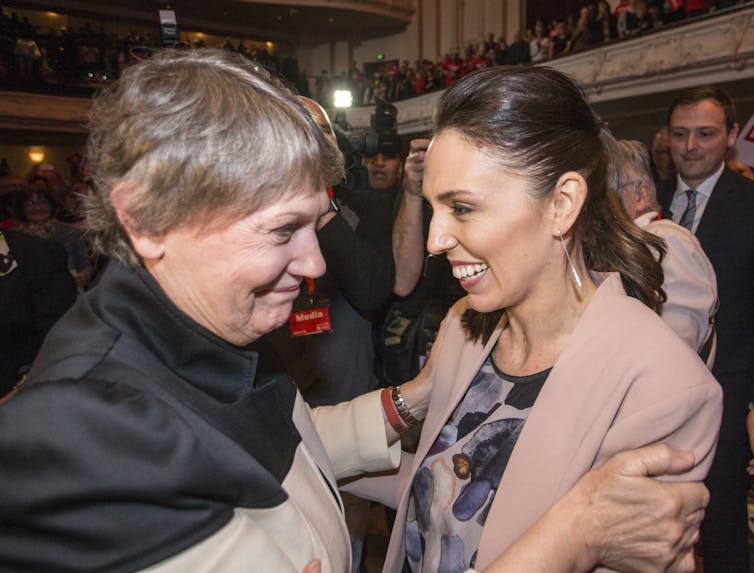 Female media representation improves when women are in power: former prime minister Helen Clark with Jacinda Ardern, then leader of the opposition Labour Party in 2017.
GettyImages
Female media representation improves when women are in power: former prime minister Helen Clark with Jacinda Ardern, then leader of the opposition Labour Party in 2017.
GettyImages
Sports reporting lags behind
But it’s women’s invisibility in sports news that continues to erode media equality in New Zealand, a pattern unchanged from earlier studies despite less sport being played during the pandemic.
On monitoring day, just 17% of sports sources were female. The sports segment on Newshub’s 6pm bulletin did not include a single female presenter, reporter or source. The channel’s announcement of the cricket summer schedule neglected the women’s game altogether.
In contrast, the male reporter who covered the same story for TVNZ’s 1 News included details on women’s fixtures and interviewed White Ferns captain Sophie Devine.
This is not an anomaly. Similar patterns were documented in Isentia and Sport NZ’s recent study of women’s media coverage.
TVNZ and Sky had nearly half their bylines attributed to women, but less than 15% of their coverage was about women. When presenters were removed from the sample, Sky’s proportion of female bylines dropped to 3.4%.
More presenters than bylines
Journalists concerned about the reporting of women’s sport have also noted the prevalence of male bylines and the dominance of male sports in the reporting hierarchy.
While many media observers have argued that more women working in journalism will improve coverage of women and gender issues, the New Zealand findings offer mixed support for this optimism.
Read more: Gender diversity in science media still has a long way to go. Here's a 5-step plan to move it along
On monitoring day in 2020, our radio news had the lowest proportion of women as sources, despite every radio presenter and reporter being female. Across the board, local male and female reporters used female sources at roughly the same rate.
In fact, women reporters were slightly more likely to refer to female subjects’ family status, a behaviour that tends to reinforce more traditional representations of women.
The diversity challenge
But it’s hardly surprising if women reporters are not transforming journalism, despite their numbers. Men often hold the key decision-making roles, and the culture of newsrooms can be masculine and sometimes toxic.
It’s unrealistic to put the onus for change on individual women when these entrenched patterns in coverage speak to the systemic and structural nature of the challenge.
Read more: The coronavirus pandemic increased the visibility of women in the media, but it's not all good news
Public and audience pressure has prompted the creative media industries to make “remarkable” improvements to the gender and racial diversity of film-makers and casts.
There is a need for news media leaders to make similar efforts to retain cultural relevance and trust, capitalise on audience growth delivered by the pandemic, and better their performance for GMMP 2025.
Looking forward to that? Me too.
Authors: Susan Fountaine, Associate Professor of Communication, Massey University


















