

Fijians harness the fundraising power of social media as their government struggles with the COVID-19 crisis
- Written by: Apisalome Movono, Senior Lecturer in Development Studies, Massey University
The current serious outbreak of the COVID-19 Delta variant in Fiji is pushing already stretched health and community resources to the brink.
With tourism stalled and the state seemingly unable to resolve the unravelling crisis, there has been a sense of deepening distress in the Pacific nation.
But despite collapsing health infrastructure, climbing death rates and an apparent overload of mortuary services, the government has refused to issue a nationwide lockdown.
Instead, it has placed its faith and the fate of its population of 900,000 in the vaccination programme, a policy that has seen it accused of putting commercial interests ahead of the health of ordinary citizens.
Some village chiefs have been so dismayed at government inaction they have instituted their own 14-day mandatory lockdowns.
Our research has found that same independent approach has seen Fijians reinvent the age-old tradition of solesolevaki — working together for a common cause — for the digital age. As Seattle-based Fijian Taniela Tokailagi explains, social media has enabled support networks to reach beyond the usual geographic or professional borders:
Solesolevaki in the digital era […] is about how deeply we are connected, regardless of where we are in the world.
Dashed hopes
While these initiatives are positive, the fact they are necessary has been a blow to Fijians who had been optimistic after a year of being COVID-19 free since the first case was recorded on March 19, 2020.
In particular, the outbreak dashed hopes of a tourism bubble with Australia (now also battling new outbreaks) and New Zealand. Instead of attracting tourists, Fiji has been welcoming Australian and New Zealand doctors, sent to aid with the crisis.
Medics have expressed grave concerns about Fiji’s infection and death rates and its struggling health infrastructure.
Read more: The Pacific went a year without COVID. Now, it's all under threat
Financial aid from New Zealand and Australia has helped the government and non-government organisations provide support. But while some residents have received food rations and FJD$50 loss-of-livelihood payments, many have had to fend for themselves.
The government has also introduced COVID-19 budget to support Fiji’s unemployed, designed to carry the economy through until the planned border opening over Christmas this year.
The news has caused mixed feelings given Fiji’s 96% debt to GDP ratio, rumours of financial and economic collapse, and the ever increasing hardships faced by Fiji’s poorest.
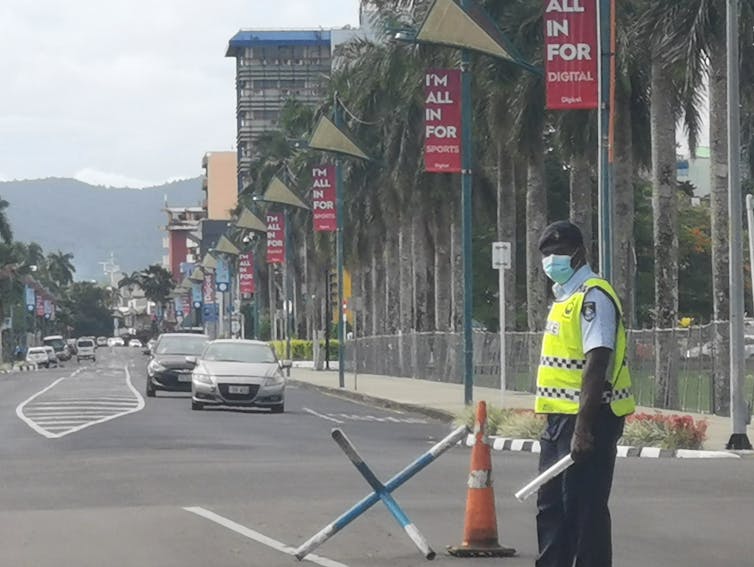 A police officer guards a checkpoint in Fiji’s capital, Suva.
GettyImages
A police officer guards a checkpoint in Fiji’s capital, Suva.
GettyImages
Home and away
Meanwhile, life has to go on. As our research focusing on how Pacific peoples have responded to the pandemic shows, there is a clear trend towards self-help and digital innovation.
Within Fiji, young creatives — including performers, fashion designers and musicians — have used Twitter and other social media to fundraise for community groups providing humanitarian assistance.
For example, bands formerly employed at tourist resorts have used Twitter Spaces to hold virtual concerts. These #TeamFiji “space jams” mainly draw listeners from Fiji, but also expats as far away as the US and even Mongolia.
Such events can raise between FJD$1,000 and $3,000, with funds directed to households in need, including single parents, widows and vulnerable sex workers.
Read more: Traditional skills help people on the tourism-deprived Pacific Islands survive the pandemic
The initiative quickly expanded beyond supporting the struggling artists themselves, as organiser Epeli Tuibeqa explained:
So far we’ve hosted over 26 artists and collected over $40,000 […] There’s a page on Facebook called “Families Helping Families Fiji” that we liaise with as well, and after some of the gigs we just contact them and they send us the number of a family and we send them money for their needs.
Facebook groups with cultural and provincial allegiances, such as the Bua Urban Youth and Hakwa Gang, raise funds directly, with the latter providing food parcels to 50 households in the Sigatoka area, targeting elderly residents.
Every platform works
These community-focused efforts extend to members of the global Fijian diaspora. For example, Fijian rugby player Peceli Yato, who played against the All Blacks on Saturday, recently supplied food for over 80 families in his home village.
Another initiative, #FijiBackToSchoolAid, raised US$18,000 for Fijian NGO, Foundation for the Education of Needy Children. This helped hundreds of children with school supplies at a time when their parents are struggling to provide the basic necessities.
Read more: Sun, sand and uncertainty: the promise and peril of a Pacific tourism bubble
Even virtual gamers have become involved. Dan Qalilawa first began live-streaming his games as an alternative income source for his household, but realised he could use his platform for pandemic relief.
Having recently raised more than FJD$7,000 to assist non-profit organisations such as Operation Grace, he extols the potential of using technology to make a difference:
While people may think that gaming is a waste of time, it has allowed me to make money to support strangers. Virtual spaces are opportunities for people to be creative and use social connections to get things done for our people — it has been very fulfilling to create change, albeit from the digital realm.
Read more: Pacific governments accused of using coronavirus crisis as cover for media crackdown
Digital giving here to stay
The rise of online platforms as centres for community support is slightly ironic, given the role social media played in creating recent pyramid scheme scandals in Fiji.
But it seems clear this will underpin much of Fiji’s community fundraising in future. Pacific peoples in general are harnessing social media and other digital tools to reinvigorate old traditions of adaptivity, innovation and solidarity to support people in need.
Traditional reciprocal relationships fit well with modern online giving. The tips and donations from live-streamed band sessions continue to flow in, reflecting the resilient and communal nature of Fijian culture.
In the words of Epeli Tuibeqa: “The pandemic will not stop us!”
Authors: Apisalome Movono, Senior Lecturer in Development Studies, Massey University


















