

7 tips for making masks work in the classroom
- Written by: David Roy, Lecturer in Education, University of Newcastle
With more infectious variants of the COVID-19 virus emerging, teachers and students have been required to wear masks in high school classrooms. It was mandatory in Greater Sydney and all of Victoria before the recent switch to remote learning under lockdowns. Mask wearing has also been compulsory in schools overseas, including parts of the US, Canada and Malaysia.
The new variants appear to have increased infection risks for younger people, and most Australians are not yet fully vaccinated. Until that time, masks may well be one of our best tools to allow a return to face-to-face schooling.
However, having to wear masks in the classroom may create challenges for teachers and students. Mask-wearing can have negative impacts on all students, although the issues can be greater for students from minority cultures and those with chronic health or disability barriers.
Education is primarily a communication and relational activity. Masks not only hinder the visual communication tools we rely on but can also muffle speech, create discomfort and be psychologically unsettling for some. The word mask is thought to come from the Medieval Latin masca, meaning spectre or nightmare.
Most of the barriers to wearing masks can be overcome. By harnessing the benefits of embracing the mask, classrooms can adapt and thrive during the pandemic. Adopting recommended practices for using masks in the classroom will benefit all students.
Read more: COVID-19’s teaching challenges: 5 tips from pediatric care for teachers wearing masks
Use masks properly
Openly and regularly discuss mask use with all students. Teach and practise mask etiquette so students understand the need to avoid touching the mask and to touch only the edges if they need to adjust their mask. They may need to do this to maximise comfort and to ensure the mouth and nose are properly covered, protecting the wearer and those around them.
Encourage students to use hand sanitiser, especially after touching the mask.
Remind students to clean reusable masks every day and to dispose of single-use masks.
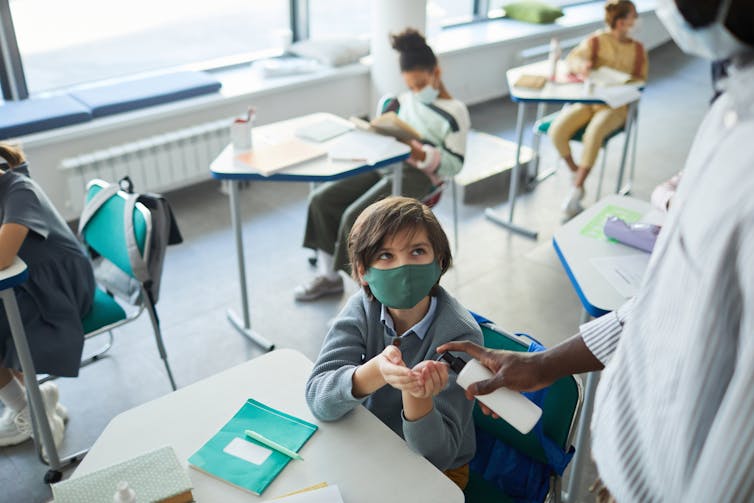 Encouraging students to use hand sanitiser adds to the protection masks provide.
Shutterstock
Encouraging students to use hand sanitiser adds to the protection masks provide.
Shutterstock
Read more: Rethink ventilation for a safe return to schools after the COVID-19 pandemic
Exaggerate body language and facial expressions
Young people take many visual cues from the mouth of the speaker, while adults take more visual cues from the eyes. When wearing masks covering the lower half of the face, teachers and students will naturally become more aware of upper face expressions.
Exaggeration is helpful to communicate clearly while wearing a mask. Teachers should continue to use natural facial expressions like smiling, such as the “Duchenne smile”, but exaggerate eye gestures and eyebrow movements to aid communication. The face has 42 individual muscles. We should use them all.
Play with facial expressions when using masks and have students read social cues from the eye movements they can see. Make the development of social and emotional intelligence a game of exploration to promote an understanding of psychology and how we react to others. This is merging science and the arts.
Teachers can and should use their whole body to communicate. For example, the teacher can shrug their shoulders when asking a question, or shake or nod their head to communicate a point of view. Exaggerated hand gestures and being near to the students are other helpful strategies.
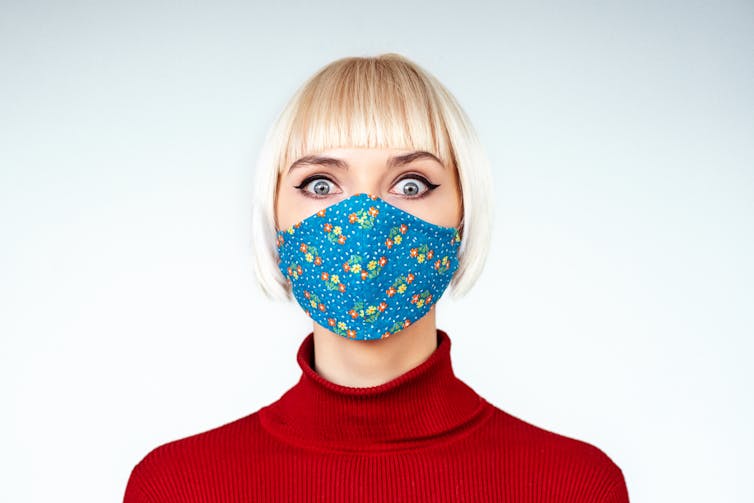 Wearing a mask means we have to express more with our eyes and body language.
Shutterstock
Wearing a mask means we have to express more with our eyes and body language.
Shutterstock
Read more: We've become used to wearing masks during COVID. But does that mean the habit will stick?
Use your voice
Although the mask covers the mouth, teachers can generally still be heard through the cloth. The key here is again a form of exaggeration as well as proximity to the student. Teachers can stay close to their listeners, speak more slowly, articulate all sounds clearly and increase volume.
However, teachers must balance vocal volume with projecting the voice. Teachers can practise diaphragmatic breathing to help avoid vocal straining.
Where possible, try to rely less on talking for teaching. Use PowerPoint and written communication. Keep language simple and straightforward.
In addition, check with students that they can hear and understand. Pay particular attention to children who are deaf or hard of hearing. Speak with them about the situation and take their advice.
Embrace technology
Where possible, use technology such as iPads or IT devices. Choose or make a video clip with subtitles instead of having to speak while wearing a mask. This is particularly important for students who are deaf or hard of hearing.
Use a microphone, carefully placing it near the mouth but not against the mask material.
Don’t panic
Masks do allow enough airflow to breathe comfortably. However, remain vigilant to children who do panic or feel claustrophobic when required to wear a mask. These psychological challenges can be made worse when a child has breathing difficulties such as asthma.
Schedule regular quiet breaks throughout the day – even every hour.
Create a safe space
Staff should try to include a photograph of themselves on their school ID badge, if wearing one. This can help reassure those who feel isolated and uncomfortable when people are wearing masks.
Children with neurological disabilities, such as autism or dyspraxia, will not always have the issues some might expect with wearing a mask. Like all children, they just need to know who we are and why we are all wearing masks.
The most important thing is to communicate. Talk with and listen to students, as the best teachers always do. Let them talk about their masks and take ownership of the situation, and then we can move forward with learning.
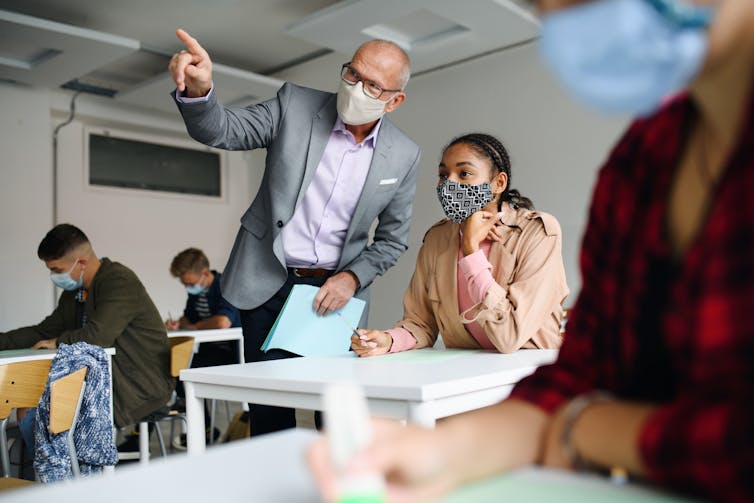 Taking the time to talk with individual students and hear what they have to say is most important.
Shutterstock
Taking the time to talk with individual students and hear what they have to say is most important.
Shutterstock
Following Maslow’s Hierarchy of Needs, children will learn when they know they are safe.
See it as a opportunity to learn
The challenges of mask-wearing can be opportunities. Rather than seeing the mask as a burden, see it as an opportunity to teach and have fun.
Incorporate lessons that look at masks in history, from the earliest Greek plays through to Asian theatre and more recent times. Look at superhero movies, look at politics and public protests. Understand medicine and the use of masks throughout history – why we wear them to keep both ourselves and others healthy.
Explore the inclusive nature of masks and how they can create acceptance and equity. Research has found masks allow children to disassociate from identities and see themselves and others from a more empathetic and accepting perspective.
Many societies where people commonly wore masks prior to COVID, in parts of Asia for example, have thrived. Schools are microcosms of society. The mask is not a barrier to learning. A mask should only be a barrier to the spread of the virus, so mask up and enjoy the masquerade.
Authors: David Roy, Lecturer in Education, University of Newcastle
Read more https://theconversation.com/7-tips-for-making-masks-work-in-the-classroom-164777


















